A geothermal well presents an awkward bargain. The hotter the rock, the more useful its heat can be. Yet the instruments needed to reach it have their own temperature limits. A drill may still be able to cut while its electronics struggle to report where it is going. Hephae Energy Technology has chosen to build a business inside that disagreement.
- The job: help drilling crews measure and navigate in hotter wells.
- The evidence: Pandora210 operated at 210°C circulating temperature in a reported field deployment.
- The next test: manufacture more tools, keep them reliable, and move toward higher temperatures.
In September 2026, Hephae announced that field milestone. The important word is “circulating”: it describes conditions while drilling fluid is moving through the well. It is a working specification with boundaries. The company’s ambition stretches toward superhot rock; its demonstrated operating temperature remains a separate, more modest number.
The 35-degree business
Much of directional drilling’s equipment comes from oil and gas. That inheritance supplies skills, hardware and familiar routines. It also supplies assumptions about temperature. Hephae’s 2024 technical presentation describes conventional measurement-while-drilling and rotary steerable tools commonly rated to 175°C, with some reaching 200°C. Geothermal asks those instruments to accompany drillers into hotter territory.
The tempting response is to cool the environment around the tool. But cooling can require pauses, equipment and careful handling. In a drilling-forum presentation, Hephae’s Matthew White described another wrinkle: the assembly can encounter its maximum temperature during a trip through the hole. Finishing a drilling interval does not mean the heat problem has finished with you.
Here is the commercial opening. If temperature tolerance reduces waiting or replacement work, a developer can get more useful drilling from the same rig. That is the logic behind paying for a hotter tool. The extra 35 degrees between a common 175°C benchmark and Pandora210’s rating acquire value through the work they permit.
Circuit boards with a different shape
Hephae’s answer reaches inside the housing. Its published engineering abstract describes circular circuit boards stacked along the tool’s axis, a modular mechanical structure and aluminum-nitride ceramic boards. The purpose is to move heat outward efficiently, through carefully arranged contacts and the surrounding chassis.
Electronics create heat of their own. Put them in an already hot well and their internal temperature can rise above the temperature outside. Packaging therefore becomes part of the thermal system. The board’s material, the route heat takes and the quality of mechanical contact all matter. A housing is doing more than keeping components in place.
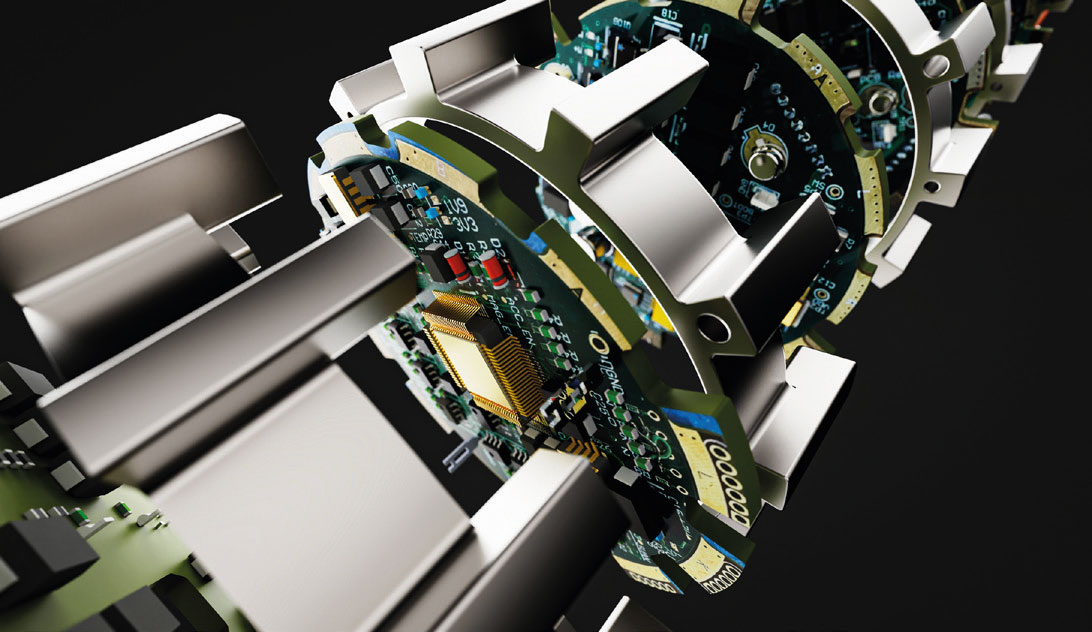
The abstract reports a temperature rise below 3.5°C in a specified four-board-stack case, at 210°C mud temperature and nominal chip power of 0.5 watts. Those conditions matter as much as the number. A thermal result from one configuration is evidence about that configuration; whole-tool reliability requires additional work.
A laboratory is only the first audience
In its 2025 testing paper abstract, Hephae describes electronics and sensing assemblies exercised at temperatures up to 230°C. It also describes high-temperature operation alongside vibration, plus mechanical and thermal shock tests. The distinction is useful: the test temperature belongs to the qualification program, while 210°C belongs to the announced field operation.
Testing heat and vibration together reflects the destination. Geothermal developers may drill hard crystalline formations, where instruments must tolerate both. Passing a quiet oven test would answer only part of the question. The company says its program aimed to expose potential failure modes before real drilling tests. For another hardware team, that is a copyable choice: test the stresses that arrive together.
“Hotter is better, but only if you can reliably drill it.”
Steve Krase, CEO · September 2026
Customers set the next temperature

Steve Krase and John Clegg brought oil-and-gas experience to the venture. The company’s current team spans locations including Texas, Spain, Britain and Canada. Hephae describes a culture of collaboration and varied backgrounds; the more revealing detail is how those backgrounds influence the product.
In an Elemental Impact interview, Krase explains that customers clarified what successive temperature improvements would mean. They could put a 210°C tool to work, then use a higher-rated tool as it became available. That feedback made intermediate milestones commercially meaningful. A distant specification was less useful than the next specification somebody could drill with.
Krase also describes combining oilfield knowledge in Texas with engineering experience from aerospace and other industries in Bilbao. His deployment aim is equally practical: crews should keep familiar surface computers and procedures when switching to Hephae equipment. The inference for other suppliers is straightforward. Spend the customer’s appetite for change on the component that needs changing.

The tool must earn its place on the rig
Hephae occupies the equipment layer of geothermal. Its customers need wells; its product helps construct them. Reporting from August 2026 describes commercial use at Fervo Energy’s Cape Station and a planned shipment to Mazama Energy. It also describes a rental model. That gives the company a tangible commercial task: build a fleet that customers can put to work.
Hephae’s $17.8 million Series A announcement says the money will support manufacturing, deployment and further development, bringing company-reported capital raised to $24.7 million. Its technology page places 300°C-rated modules on the roadmap. More capital makes the next engineering and manufacturing steps possible; it does not establish their outcome.
A hotter measurement tool still operates within a larger system. White’s presentation explicitly considers combining high-temperature MWD with cooling and insulated pipe to reach hotter formations. Geological conditions and the rest of the drilling assembly remain relevant. The sensible buyer asks which operating constraint the tool removes, and what the project still needs around it.
That is what makes Hephae worth watching. It has selected a specific obstacle between underground heat and a productive well, then built hardware to address it. The next chapters will be written in repeat deployments: how long the tools work, how many can be supplied, and whether the drilling plan improves when they arrive.