Henry Ludlam had a football club to help and a fundraising problem to solve. He tried running a marathon. By his own account, it was slow. The larger difficulty was that the familiar ways of collecting money demanded an extraordinary amount of effort from people who already had something else to do. A local cause needed support; finding that support had become a project in itself.
He went on to co-found the business now called Goodstack with Stefan Greer. Its beginnings were modest enough to fit beside a touchline. The underlying question, however, had room to grow: could giving happen inside the things people were doing anyway? A purchase, a workday, a piece of software, a moment on a phone. Somewhere between the intention and the completed donation, Ludlam saw a business to build.
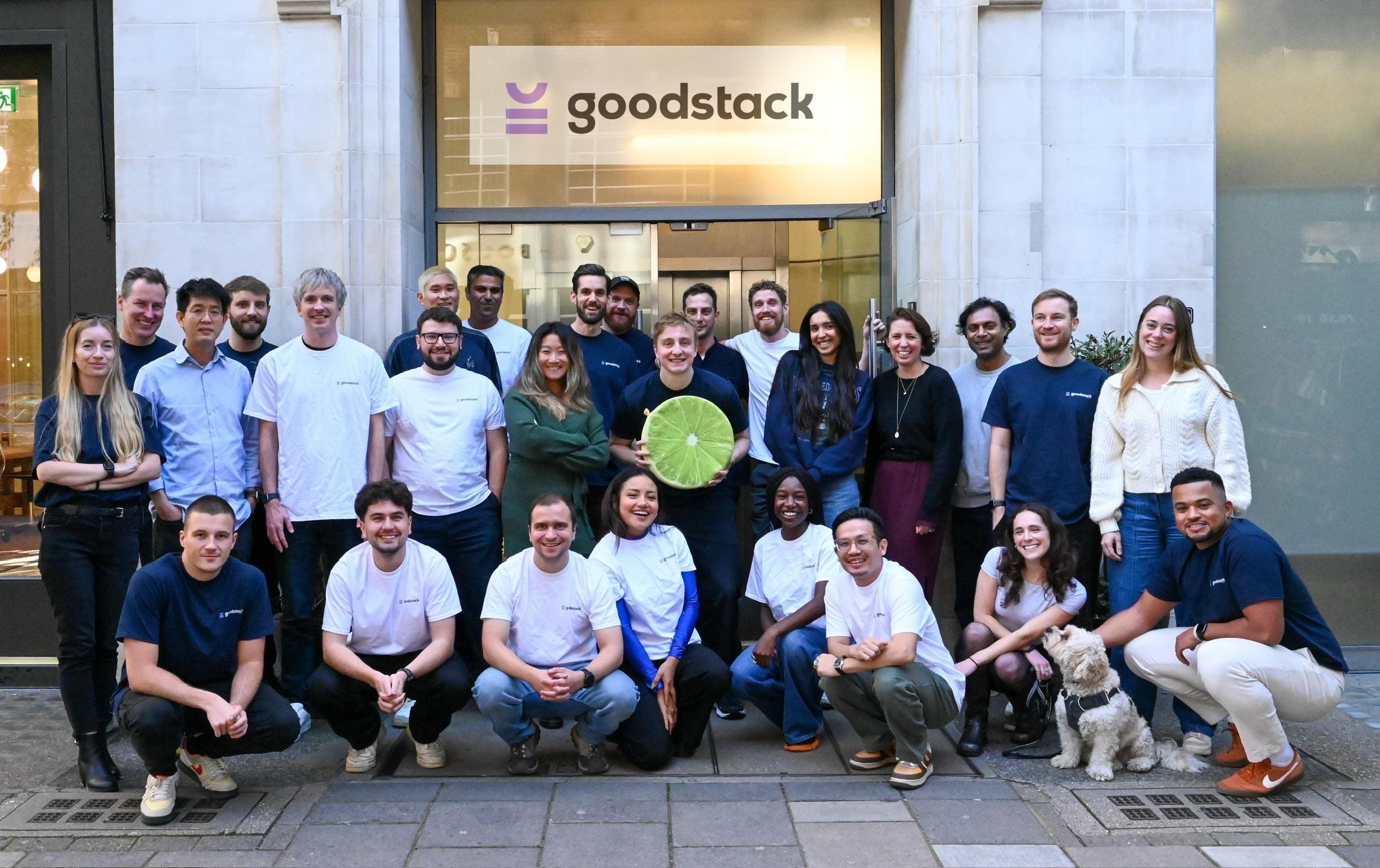
Today he is Goodstack’s co-founder and CEO, based in London. The company helps businesses verify nonprofits, run giving programs and connect causes with money and technology. The distance from a football club to corporate infrastructure is considerable. Follow the decisions along the way, though, and the route becomes less mysterious. Ludlam kept returning to the difficulty of making a good intention practical.
A festival education
Before there were donation systems, there were music events. Ludlam co-founded S&C Productions and was among the six founders of Strawberries & Creem. His long-running business partner William Young described a distinctly Cambridge beginning: a café conversation over jam and a scone in April 2014. An invitation to organise a garden party grew, within the discussion, into the idea of a small festival.
The first edition took two months to put together. Young later described a team working across bookings, marketing, partnerships and operations, coordinating online because the founders were not all working on it full-time. Cambridge mattered to the festival’s identity: a city associated with tradition was making room for a new set of sounds. The scone had acquired quite a demanding afterlife.
Ludlam’s university years ran from 2010 to 2014 at Manchester, where he studied Italian with Business and Management and graduated with first-class honours. His education and early companies overlapped. That places the festival venture within a period of trying things while studying, rather than a tidy sequence in which qualifications end and entrepreneurship politely begins.
The customer did not need another destination
Percent, the original name of Goodstack, began with a consumer proposition. People could use their payment cards at participating retailers and direct a portion of their spending toward a chosen cause. Ludlam’s January 2017 plan laid out an ambition much larger than a fundraising campaign: to connect everyday commerce with support for charities.
The reasoning started with ordinary behaviour. People are busy. Businesses have commercial priorities. Asking both to develop an entirely separate routine creates another task in an already crowded day. The early app tried to attach the donation to an existing purchase, giving a cause a place in something that was going to happen regardless.
By January 2020, Ludlam’s later account put the ecosystem at more than 50,000 users across 23 UK cities, with over 500,000 transactions generating support for causes. Participating names included Nando’s, Deliveroo and Franco Manca. These were places and services people already knew, which was central to the proposition: a familiar purchase could carry an additional consequence.
In his May 2021 explanation of the next phase, Ludlam argued that the app’s reach was too confined. Retail was only one industry; the experience belonged inside Percent’s own product. The company moved toward an API, allowing partners to build giving into their own services. By that account, 20 partners had signed up. The practical change was substantial: other businesses could now own the customer experience.
the Percent app
into their own products
A new name for a wider job
On 15 October 2024, Ludlam announced that Percent was becoming Goodstack. His explanation connected the name to a broader business: companies could bring different giving activities together, while nonprofits could gain access to donated technology and new funding opportunities. Product donations, grants, workplace giving and customer donations were all part of the picture.
A name cannot do the work of a product, but it can reveal the work a founder thinks the product should do. Percent suggested a slice of a transaction. Goodstack suggested layers of technology. The change made sense for a company whose role had expanded beyond its original consumer app into a service used by other organisations.
The following month brought a $28 million Series A led by General Catalyst, with Morpheus Ventures and Repeat participating. The announced plan was to develop services for corporate customers, improve technology for nonprofits and hire across the team. For Ludlam, the financing supported an increasingly demanding proposition: a company should be able to offer several ways of giving without assembling every underlying system itself.
“Being purpose-led is baked into our generation.”Henry Ludlam, November 2024
The queue behind the good deed
The work becomes easier to understand through an unglamorous scene: an application waiting to be checked. At Atlassian, sales teams once reviewed nonprofit applicants manually, a process that could take weeks. Staff who were supposed to help customers get started were also spending time establishing whether an organisation qualified for the nonprofit program.
Atlassian implemented Goodstack’s verification technology in 2021. Standard applications could be validated automatically, while cases requiring judgment could be flagged for human review. The distinction matters. Some decisions are routine; others have awkward details. A useful system must be able to recognise the difference rather than making every applicant wait for the same treatment.
A May 2026 account of the partnership listed 12,000 nonprofit customers and $37.5 million in donated product value in Atlassian’s fiscal 2024. Those are Atlassian program figures, not Goodstack’s sales. They help explain the kind of outcome Ludlam’s company sits behind: tools reaching organisations that qualify for them, with less of the day consumed by checking forms.
On TikTok, the visible action looks quite different. Users can put a cause link on a profile, add a donation sticker to a video or fundraise during a live session. Goodstack supplies infrastructure behind those experiences. The interface belongs to the platform and its creators. The less visible work includes eligibility checks, screening and routing the donation. A video gets the applause; the routing has to work.
One platform, several kinds of generosity
In April 2025, Goodstack introduced its all-in-one impact suite. The offering brought together grants management, customer donations, workplace giving, employee volunteering and verification. Ludlam described a request from organisations for a single place to manage their programs globally and locally, with fewer separate systems to operate.
There is a mundane organisational problem underneath that request. A grant application, a matched employee donation and a customer fundraiser may all support a cause, yet each can arrive through a different department and process. Bringing those activities into one platform gives Goodstack a wider job than moving a payment. It also makes the quality of the underlying records more consequential.
The company expanded in Australia and New Zealand through its acquisition of Good2Give, announced on its blog in November 2025. Ludlam emphasised the combination of regional knowledge and Goodstack’s technology. Good2Give brought a history of workplace giving; Goodstack brought an international network. It was a concrete expression of a business growing through both software and relationships.
The numbers have different jobs
Goodstack’s January 2026 retrospective reported that it had surpassed $5 billion in donations facilitated. The account discussed access to software and other donated technology alongside giving programs. The figure describes the company’s reported donation value. It should be read with that meaning, rather than as a measure of Goodstack’s own revenue or Ludlam’s personal wealth.
In August 2026, the company announced 7.5 million nonprofit verifications and introduced the term KYNP: Know Your Nonprofit. This is another kind of count altogether. A verification is a check, rather than a dollar or a claim about how much an individual organisation received. Giving infrastructure produces several measures because it performs several jobs.
The KYNP proposal also shows how far the problem has travelled from the original football club. Nonprofit registration varies by country, governance does not resemble ordinary company ownership, and operations may cross borders. Goodstack describes checks that deepen with risk and continue after approval. The easy moment for the donor depends on work that remains complicated behind it.
Reported January 2026
Announced August 2026
Company-reported figures. Donation value and verification volume measure different activities.
The ambition, with a lemon twist
Ludlam’s public voice retains some of the informality of an early founder gathering people around an idea. His 2024 rebrand announcement ends with “Let’s do this!” and a lemon emoji. Goodstack’s recruitment material even names a value “Lemon twist”, making room for unusual ideas alongside more straightforward expectations about candour, kindness and individual agency.
His stated ambition continues to extend beyond transactions. In a 2025 conversation, he discussed Maia, Goodstack’s AI grant-finding agent, which helps nonprofits discover funding opportunities. The attraction is practical: organisations can miss grants because finding them requires time and knowledge they do not necessarily have. It adds another answer to the question that started the business: how does a cause get access to support?
There is a recognisable continuity between a festival, a football fundraiser and a platform used by corporate teams. Each involves getting people to participate, then making sure the arrangements can bear the weight of their enthusiasm. Ludlam’s career has moved further into those arrangements. The good intention is still the beginning of the story. His business is concerned with what happens next.