Harald Grumser had a useful complaint about the digital world: it was still rather attached to a sheet of paper. A document could travel electronically and remain, in every other respect, a page waiting for a printer. Put it on a phone and the recipient inherited the inconvenience. Grumser wanted businesses to think about the information first, and decide on its shape afterwards.
For someone who helped establish an association devoted to PDF, this was an admirably awkward position. He could value a format without expecting it to do every job. Much of his working life followed that distinction. An old system might contain something worth keeping. A new system might offer something worth adopting. The interesting work happened where the two had to meet.
Compart, the Böblingen software company he co-founded in 1992, grew around those meetings. Later, he put time into a different kind of connection: between experienced entrepreneurs and people starting their first companies. By the time of his death in August 2026, his work extended from document processing to the institutions helping a new generation build businesses.
A physics student enters the PC years
Born in Bühl in 1960, Grumser studied physics at the University of Karlsruhe from 1981 to 1984. He then moved into computing. His early career crossed software development and publishing, including editorial work at Hüthig Verlag in Heidelberg. He wrote specialist articles about PCs and microprocessors, subjects whose vocabulary was still finding its way into ordinary working life.
Writing about computers requires a particular adjustment of focus. A machine can be perfectly logical and its explanation perfectly baffling. The reader needs the missing connection. Grumser's later interviews suggest a continuing interest in that gap: he reached for familiar objects when describing technical problems, giving the audience something less slippery than another collection of initials.
After project work on a European IBM PC initiative, he held management responsibilities at Softpro. His professional profile records a progression there from project leader in 1986 to managing director in 1988. By 1992, when he and fellow shareholders founded Compart, he had worked on the technical, editorial and commercial sides of computing. The company began as a systems house, taking on customer projects.
The question hiding inside a conversion
The early opportunity involved documents travelling between incompatible formats. Industrial print data and scanned images belonged to different technical worlds, yet customers needed to preserve and process both. AFP and TIFF featured in Compart's beginnings. A conversion tool gave information a route from one system to another, without requiring the customer to replace everything around it.
That is a modest sounding proposition with a demanding condition: the information has to survive the journey. A document is useful because someone can read it, act on it or retrieve it later. Its appearance is only part of that promise. The underlying business has little patience for a conversion that looks convincing while losing what matters.
The work gradually became the DocBridge product family. Its scope grew to include document creation, conversion, modification, quality checks and delivery through physical and digital channels. The name was unusually helpful. Customers were buying a way across the gaps in their document processes; a bridge was a reasonable thing to call it.
Different formats
Check the result
Email, mobile
By a later interview reflecting on almost three decades of business, Grumser described a company operating in 50 countries. About half its revenue came from outside Germany. The figures locate an important change in his career: a business formed around individual customer assignments had become an international software supplier. Its clients included organizations with substantial, recurring communication needs.
He also described a preference for open standards, allowing customers to assemble solutions from different suppliers. That choice fits the original problem. If a company earns its place by connecting systems, the quality of those connections matters. A customer should be able to fit the software into a working business, including the parts that have been there for years.
The page was getting in the way
In 2014, Grumser made his argument for moving beyond page based thinking particularly clearly. Phones and tablets were changing what a document needed to be. A layout designed for A4 could preserve the familiar appearance of a letter and still be cumbersome on a small display. He expected HTML5 and responsive presentation to play a larger role.
His prescription was to put data before the page. A business should retain the information in a form that could serve different destinations, with presentation chosen later. Someone might want a readable mobile confirmation and a PDF to keep. The same transaction could reasonably need both.
“Weg von den Seiten und hin zu den Daten.”
Harald Grumser, 2014
Away from pages and towards data.
There is a dry comedy in the problem. Organizations bought computers to handle information, then made the computers behave as though the final ambition of information was to become stationery. Grumser kept returning to the practical question beneath the format debate: what did the recipient need, and how could the business provide it without unnecessary handling?
He understood that the older machinery would remain part of the answer. Replacing a format in a presentation is easier than replacing a system in an operating company. His approach allowed for the awkward coexistence of technologies from different periods. A useful bridge has to reach the bank where people are actually standing.
Standards need people in a room
Compart became a founding member of the PDF/A Competence Centre in 2006, the organization that preceded the PDF Association. Grumser served as board chairman from 2008 to 2010. He helped initiate its early conferences, including the German gathering in Stuttgart in 2007 and the international conference in Amsterdam in 2008.
Standards can look impersonal on the page. Their adoption is thoroughly social. People have to compare implementations, explain problems and agree that a shared approach is worth their time. Conferences give that process a place to happen. Grumser worked on the technical subject and on the gathering of people who could make it useful.
He could be direct about participation. Colleagues remembered him telling his own company's business partners that they needed to join the association to help it succeed. That is a membership strategy with relatively little decorative packaging. They also remembered his humour and his ability to capture a subject in a sharp, compact remark.
His interest in the conversation continued as events moved online. In 2020, planning a virtual Comparting conference, he discussed language groups, European and American time zones, shorter daily sessions and opportunities for informal exchanges. Even a technology conference needed room for people to talk beyond the scheduled presentation. He had given the virtual lounge some thought.
- 1992Co-founds Compart in Böblingen.
- 2021Hands over the CEO role and chairs the supervisory board.
- 2022Receives the Baden-Württemberg Founders' Prize for lifetime achievement; GENII acquires Compart.
Learning to offer less action
On July 1, 2021, Wolfgang Köstler succeeded Grumser as CEO. After 29 years leading Compart, the founder moved to chair its supervisory board. Grumser described the company as a child ready to leave the nest. His proposed contribution became “a lot of advice and a little less action.” For a founder, the distinction deserves attention.
Building a business brings years of practice in intervening. A handover asks the person with that practice to change the habit. Grumser's language acknowledged affection as well as responsibility. He wanted the company to do well under a younger leadership team, and he publicly expressed confidence in the people taking charge.
The ownership transition followed in 2022. GENII acquired all shares from Grumser and Christof Mayer at the end of August. The existing management would continue running Compart independently within the group; Grumser would remain available as a consultant. These were separate steps: first a change in operational leadership, then a change in ownership, with continuity built into the arrangement.
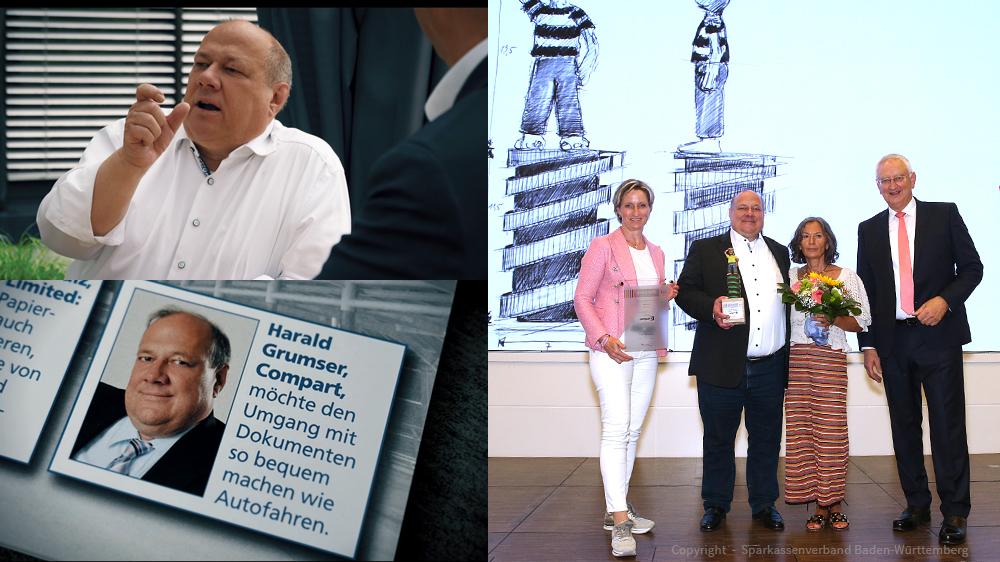
That July, he had received the lifetime achievement category of the Baden-Württemberg Founders' Prize. The recognition included the way he ran a workplace: support for parents with young children and German lessons for employees who needed them. Peter Schneider's tribute chose the phrase “the reconciliation of the different.” It suited the software, and the organization around it.
A founder makes room for other founders
Grumser's later work had a clear local centre. He chaired the advisory board of the Softwarezentrum Böblingen/Sindelfingen from 2019 and helped initiate AI xpress with Hans-Ulrich Schmid and Wolfgang Vogt. The centre opened in October 2021. It offered younger companies access to space, support and people who had already encountered some of the problems ahead.
AI xpress made mentoring part of its offer, naming Grumser among the experienced entrepreneurs available to help. The value of that arrangement is easy to understand. An early company has decisions to make before it has much experience making them. Access to someone willing to listen, question and introduce can alter the next step.
He also supported the association Landkreis Böblingen bleibt bunt, which worked for diversity and social cohesion. His commitments reached beyond the next software sale. They concerned who could take part in the region's working life, and whether experience accumulated in one company could become useful to people outside it.
After his death, colleagues and founders remembered the advice, the directness and the encouragement. Those recollections give his career a human scale. The document systems were designed to keep information moving between incompatible worlds. In his later years, Grumser spent time making another passage easier: the one between having an idea and having people around who could help it take shape.