On October 22, 1938, Chester Carlson made a copy in a makeshift laboratory in Astoria, Queens. The words on it were gloriously unromantic: “10-22-38 ASTORIA.” He had demonstrated a way to reproduce an image using electrical charge and dry powder. The obvious next step was finding a company that wanted it. Over the following five years, more than twenty turned him down.
- Xerox sells printers, presses, document software and managed IT.
- The money continues after installation through supplies, support and services.
- Its latest challenge: turn a larger portfolio into a steadier business.
Battelle Memorial Institute eventually backed Carlson. Haloid, a photographic-paper company, licensed the technology in 1947. Its president, Joseph C. Wilson, helped turn a stubborn laboratory idea into Xerox. Yet the first commercial machine, introduced in 1949, was slow and fiddly. It found a useful niche making printing masters. A breakthrough can begin by being useful for something smaller than its inventor imagined.
Twenty-one years to press a button
The 914, introduced in 1959, made automatic copies on ordinary paper. Its name referred to the largest original it could handle: nine by fourteen inches. The development bill reached $12.5 million, according to Xerox’s history, exceeding the company’s combined earnings over the preceding decade. The cleverness was making the process convenient enough for an office to use.
That distinction still explains Xerox. A customer needs a document delivered, an invoice processed, a print job finished. Buying equipment starts the relationship. Supplies, maintenance, financing and software keep it going. Xerox earns money from both the machine and the work required to keep that machine useful.
A product becomes a continuing customer relationship.
The printer has acquired chores
Today’s catalog stretches from office multifunction devices to production presses, document management and IT infrastructure. ConnectKey-enabled AltaLink and VersaLink devices can connect scanning and printing to cloud services. Apps add tasks such as document translation. The office printer has become an entry point into a company’s information systems, with the security responsibilities that implies.
For commercial printers, the proposition changes. Iridesse puts up to six colors inline, including specialty options beyond standard cyan, magenta, yellow and black. It is rated at up to 120 pages per minute. Metallic effects and white toner give a print provider additional work to sell. Speed matters, but so does having a reason for the customer to choose that job.
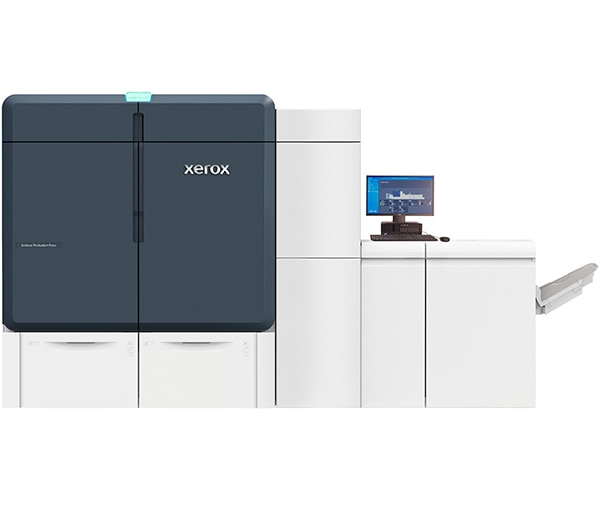
FreeFlow Core handles less photogenic work: checking files, arranging pages on sheets and routing jobs. Those steps can consume an operator’s attention before a press produces anything. This is Xerox’s particular expertise: connecting document preparation, equipment and ongoing service. Canon, Ricoh, HP and Konica Minolta compete across parts of that territory. Buyers should compare the whole working arrangement.
A campus is a better explanation
Consider IESE Business School. Xerox’s published case study describes 108 print devices serving about 5,000 users across Barcelona and Madrid. The assignment included production printing, distributed office machines, student payments and access tied to directory roles. Xerox also provided support, including on-campus personnel, and helped move the central server to a private cloud setup.
A pile of printers could not have solved that assignment. Someone had to connect the users, permissions, payments and repairs. For a school, hospital or law firm, that coordination can be the purchase. Xerox sits between the equipment manufacturer, the software provider and the service operator. Its advantage depends on making those responsibilities work together in the customer’s actual setting.
“We make work, work.”Xerox’s corporate promise
Buying a bigger answer
The company has spent heavily to widen that role. Its ITsavvy agreement, announced in 2024 at $400 million, added infrastructure and associated IT services. Xerox framed the purchase as a way to diversify revenue. Lexmark followed in July 2025, in a transaction valued at $1.5 billion including net debt and assumed liabilities. A former competitor became part of the portfolio.
These moves bought capabilities and customer relationships. They also made the results harder to read casually. In the second quarter of 2026, reported revenue rose 22%. On a pro forma basis, which includes the acquired business in the comparison, revenue fell 6.5%. Acquisition growth and underlying demand tell different stories.
Q2 2026 versus Q2 2025. The comparable view includes Lexmark in the prior-year base. Bar lengths show percentage magnitudes.
Louie Pastor, appointed CEO in March 2026, inherited that test. Xerox reported $13 million in quarterly GAAP net income, while profitability included a $105 million pre-tax tariff-receivable benefit. A larger top line alone cannot establish that the transformation is working. Service execution, comparable revenue and debt reduction deserve attention alongside it.

Copy the method. Check the fit.
The portfolio keeps moving. In September 2026, Xerox announced three production press platforms covering cut-sheet inkjet, continuous-feed inkjet and six-color graphic arts. It also announced a partnership with Flint Group Digital Xeikon. The approach combines press technology with distribution, workflow tools and service. For print shops, the practical question is which additional applications justify the expense.
There is a usable lesson here for other businesses: examine the chores surrounding your product. Where does a customer wait, retype information or call another supplier? Repeated friction may support a service or an automation tool. That is an interpretation of Xerox’s business, rather than a guarantee that bundling more things produces a better company.
For a buyer, start with workload. Count pages, manual handoffs, downtime and support requirements. Ask for a demonstration using your files. Compare contract terms, integration costs and local service coverage. A lightly used office may need a simple device; a busy print operation may justify an integrated system. Xerox’s offer makes sense when the coordination it removes is worth what the customer pays.