A fund supermarket sounds like a cure for a familiar annoyance: walk into a fund company and the shelves contain its own funds. Howbuy built a shop with other people’s products. Then it encountered the question that every supermarket leaves to the customer. Which things belong in your basket?
- The service: fund research, purchases and portfolio help across public and private markets.
- The customers: ordinary investors, qualified wealthy clients and institutions.
- The tension: research supports selection; sales and management fees support the business.
That question explains why Haomai Wealth Management, better known by its English brand Howbuy, is more interesting than a list of funds on a screen. Its history is a series of adjustments to the distance between having information and making a decision. Some adjustments were expensive. Others were surprisingly mundane.
The shop arrived before permission to sell
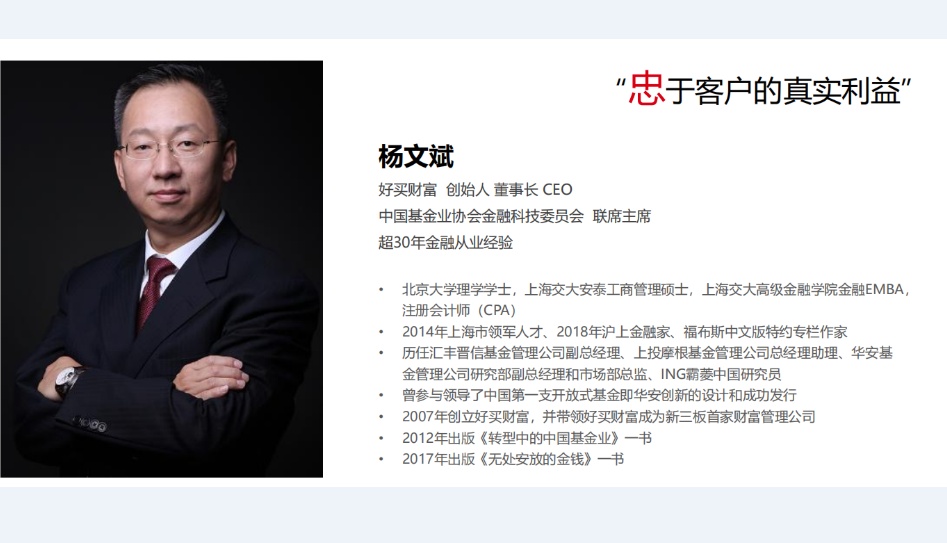
In his account of the company’s beginnings, founder Yang Wenbin credits a Charles Schwab autobiography with the supermarket idea. He registered Howbuy.com for $50 in 2007. The English name preceded the Chinese one. By the following year, however, the business faced capital pressure. Research services for banks brought in too little, and an independent public-fund sales licence was still years away.
Yang says he sold an investment property, fellow founders added money, and friends invested. Registered capital rose from RMB 10 million to RMB 20 million. The team also began assembling information about private-fund managers. Investors came looking for data; some became clients. The crisis changed both the financing and the route to customers.
The first thing to give way was the assumption that useful institutional research would produce enough income to sustain the enterprise. Howbuy’s response suggests a practical principle: find the customer whose next decision makes your research valuable. A report and a purchase can be neighbours without being the same product.
One connection, many fund managers
Howbuy’s fund-sales subsidiary obtained one of China’s first independent sales qualifications in 2012. Legend Capital invested that year. Tencent joined the next funding announcement in December 2013, alongside Legend. At the time, Yang described a distributor working with more than 70 public-fund companies. For an internet partner, a supermarket offered a convenient connection to many suppliers.
The attraction was also research. Howbuy already had databases, research systems and transaction infrastructure. Tencent supplied an internet relationship to a business with financial expertise. That sequence matters: Howbuy was not waiting for an investor to invent its selection process. It had something for distribution to amplify.
Yang’s earlier career included roles at Hua An, China International Fund Management and HSBC Jintrust. The founding group also includes Le Jiaqing and Tao Yi. Research and electronic distribution were familiar problems to these people before they became a startup’s departments. The firm occupies the space between a fund manufacturer and an investor who needs help comparing manufacturers.
忠于客户的真实利益
“Loyal to customers’ real interests” - Howbuy’s stated core value, translated.
Two very different front doors
For a retail investor, Howbuy’s visible offer is a website and apps. The public site includes fund screening, comparisons, diagnostics, portfolio records and calculators. Its Howbuy Fund and Savings Jar apps are transaction channels. A user can investigate a manager, compare products and place an order without arranging a meeting.
Private funds work differently. The company’s 2026 half-year report describes adviser-led sales for qualified investors, supported by electronic execution. It gives a RMB 1 million starting subscription, while some public-fund purchases can start at RMB 1. The contrast is enormous, but the eligibility requirements matter as much as the cheque.
Some purchases start here.
Starting subscription described in the 2026 report; qualification required.
Institutions form a third audience. They need fund selection and execution, often with human service alongside online ordering. Howbuy also manages fund-of-funds products through its New Equation business. Here the shop takes another role: it assembles portfolios of funds rather than simply offering individual products.
This combination distinguishes its proposition from buying directly from one manager. It also makes Howbuy more involved than a price-comparison table. A December 2025 company statement reported more than 10 million investors served and over 10,000 high-net-worth clients. Those are cumulative claims, not a count of people opening the app each morning.
When clicks stopped adding up
The economics are less romantic than the domain story. Howbuy earns subscription and purchase fees, shares of management fees, and performance-related fees. Revenue depends on purchases, assets remaining invested and product performance. The cost to a customer therefore depends on the fund and service selected; there is no single universal Howbuy price.
In a 2017 interview, Yang said advertising had been close to RMB 100 million in each of 2015 and 2016. Spending was then reduced to roughly RMB 20 million. Traffic had become expensive. Public-fund selling fees were falling. Howbuy paid more attention to retention, investor education and whether expected customer revenue justified acquisition costs.
That is a decision another business can copy without selling a single fund: measure the customer you acquire against the revenue that customer can plausibly bring. Cheap-looking digital reach can be costly. Repeat usage and an appropriate product mix belong in the calculation, alongside the price of the click.
The market still gets a vote
Research does not insulate the company’s earnings from markets. Its 2016 annual report described weaker purchasing appetite and a RMB 148 million decline in performance-related income. Competitive fee discounts added pressure. More recently, its August 2026 report showed first-half revenue of RMB 603 million, up 36.09%, and attributable net profit of RMB 234 million.
These figures describe the business, not a promise about clients’ returns. A researched fund can lose money; several funds can share the same underlying exposure. Private-fund eligibility, redemption terms and investment horizons also constrain who can use the service. Someone needing immediate access to cash cannot assume every product on the shelf will oblige.
Howbuy’s expanding family-trust and international-allocation services widen the basket further. The useful test remains specific: does the next purchase improve the whole portfolio? A supermarket earns its place when it helps a customer answer that question before reaching the checkout.