At Pomona College, the clinic acquired a second job. It opened in October 2020 to help protect a campus from COVID-19. By 2023, it had expanded into a no-pay clinic for a broader range of faculty and staff health concerns. A place built around an exceptional event had become useful for ordinary life. That is a good way to understand Hamilton Health Box: its most interesting intervention is making a medical visit easier to fit into the day.
- The idea: small primary care clinics with local staff and telehealth-connected providers.
- The buyers: employers and healthcare organizations seeking better access for their populations.
- The evidence: a promising employer case study, with results specific to that site.
The room that changes the journey
Pomona’s employee benefits page lists the sort of complaints that rarely make dramatic television: sore throats, ear infections, sprains, urinary tract infections. It also lists diabetes evaluation, blood-pressure monitoring and cholesterol screening. These are everyday reasons to seek care, and everyday reasons to postpone it when an appointment requires rearranging everything else.
In her 2025 State of the College address, Pomona president G. Gabrielle Starr described the clinic as a valued resource and reported an uptick in visits. She gave a shout-out to the campus nurse. The detail matters. A clinic is an address, but it is also a person whom patients recognize. Hamilton Health Box’s proposition gives telemedicine that physical point of contact.
A small clinic, a shared doctor
Founder Toby Hamilton came to primary care from emergency medicine and Emerus, the micro-hospital business he helped build. He founded Hamilton Health Box in 2019. His experience makes the company’s question understandable: which parts of healthcare must be present locally, and which can be supplied across a network?
For its employer offering, HHB describes a clinic of about 500 square feet. A clinical assistant works onsite during work hours; physicians and advanced practice providers oversee visits through telehealth. The remote provider supplies clinical expertise while the local room supplies something a video call alone cannot: a place for hands-on support and specimen collection.
+ specimen collection
+ continuity
The products extend beyond a freestanding box. HHB offers clinics in existing buildings, mobile formats and part-time arrangements. Its services include prevention, minor acute illness care, chronic disease management, diagnostics and access to behavioral health support. A photograph of the different formats makes the point rather nicely: the box is negotiable; the care operation is the business.
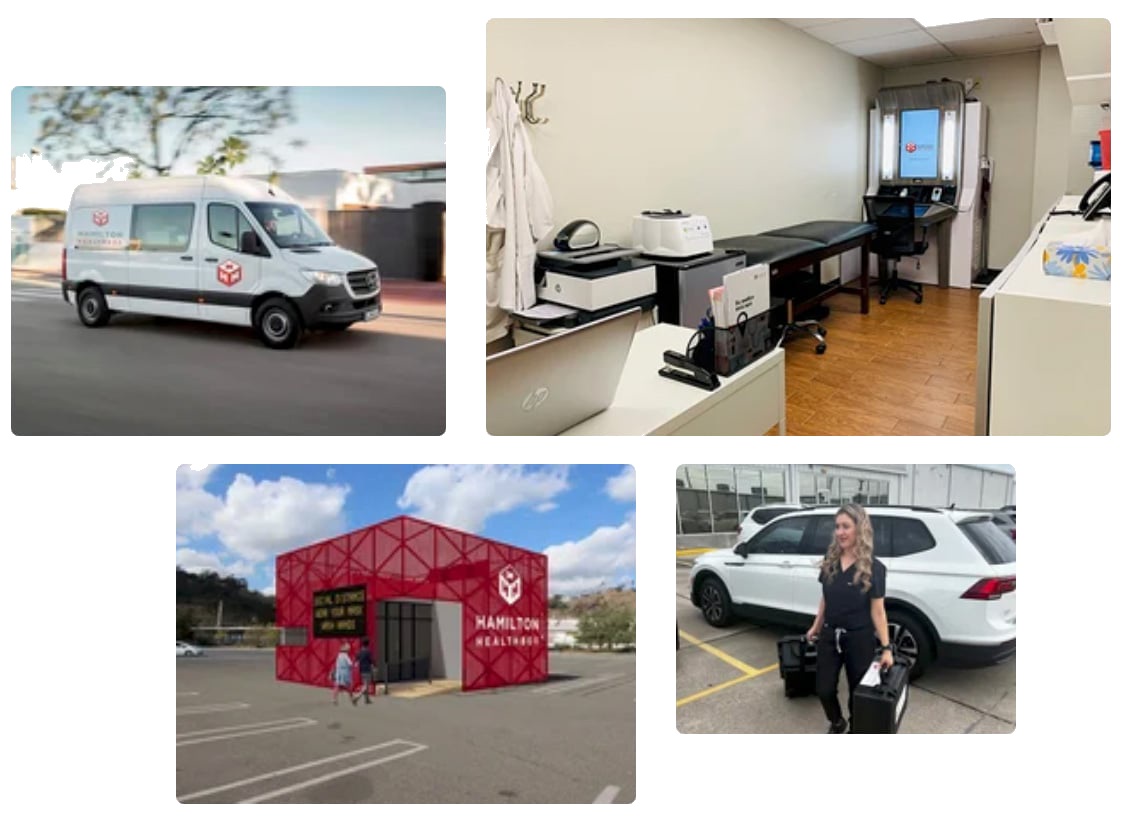
The employer buys access
Worksite clinics have long existed. The distinction here is the population that can support one. Memorial Hermann says such clinics have historically been reserved for employers with more than 1,000 employees per site. Its partnership with HHB, announced in March 2022, brings the offering to employers with as few as 100 individuals at a location.
The buyer pays a flat fee or a per-employee-per-month rate, quoted for its population. HHB advertises employer clinic visits with no out-of-pocket charge to employees and dependents. For a self-insured business, the attraction is straightforward: it has a reason to pay for accessible routine care if that helps contain later medical spending. The patient’s price and the employer’s cost are different numbers.
The first clinic was at Martin Preferred Foods in Houston. In 2022, local television reported that the food company offered basic care without copays through HHB, with physicals, labs and vaccines among the benefits. Texas Metro News separately described a relationship with Hardie’s Fresh Foods, involving more than 400 Dallas employees. These are workplace services with recognizable customers, rather than an app waiting for someone to discover it.
“We built that to be able to take that care to the jobsite and meet the customer where they are at.”Toby Hamilton · Houston Innovators Podcast, 2021
When more visits cost less
HHB’s published employer case study describes a site with roughly 320 onsite employees, too small for the standard worksite solutions its leaders had found. A clinic occupied a corporate office. The company reports a 46% increase in primary care visits and a 43% decline in emergency-room and urgent-care visits, compared with the preceding two-year average.
Different visit categories; bar lengths show the magnitude of each reported percentage change.
Reported medical savings were $132 per member per month. The pattern is the interesting part: more routine care alongside fewer expensive visits. This is a single-site before-and-after comparison, however, rather than a randomized demonstration that every clinic will produce the same return. A prospective buyer should ask how its own population, baseline claims and engagement differ.
From the worksite to the county line
The rural expansion translates the access problem into geography. HHB records its first rural clinic with Variety Care in Oklahoma in 2022 and a West Texas pod with Bravo Health in 2025. Its current rural page describes two pods serving six communities, in southwest Oklahoma and the Big Bend region of Texas.
Here the customer can be a hospital or a Federally Qualified Health Center. Clinics operate under the partner’s brand; referrals connect patients to its wider services. The small site becomes a local entrance to a larger system. That positions HHB as an operator helping existing providers extend their reach, with primary care feeding a broader network.
In May 2024, HHB announced a $10 million Series A led by 1588 Ventures. Memorial Hermann, Impact Ventures by Johnson & Johnson Foundation, the Texas Medical Center Venture Fund and the Sullivan Brothers participated. Rural expansion was the stated purpose. The financing buys room to expand; sustained clinic economics still have to do their own work.
For another operator, the useful lesson is to remove friction before demanding engagement. Put care within reach, preserve a human point of contact and make referrals work. The model still depends on local staffing, reliable remote connections and enough use to justify the expense. A compact primary care clinic also needs somewhere to send patients whose needs exceed its scope. Making the room smaller succeeds only if the network around it remains large enough.