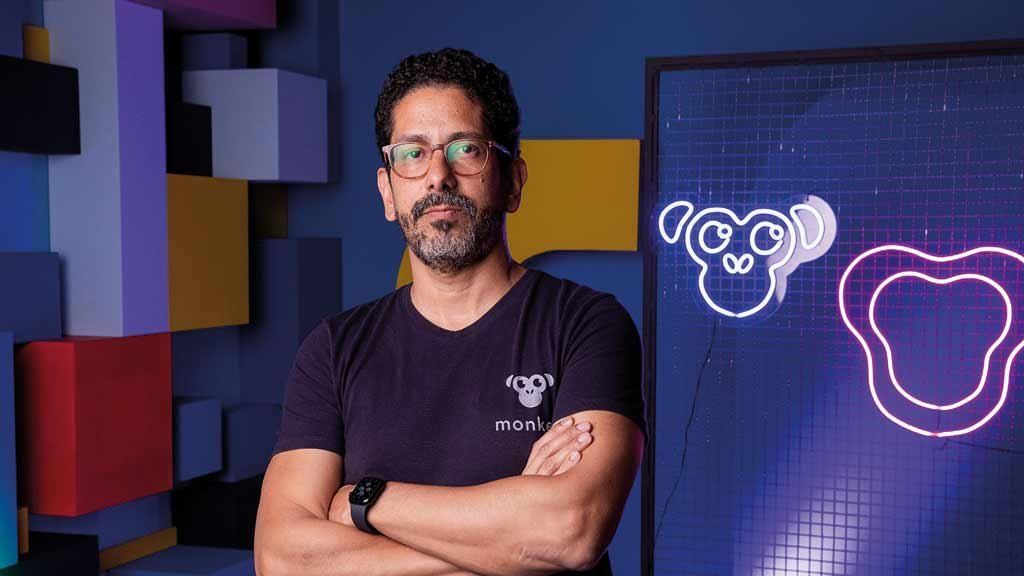
Just before New Year 2024, Gustavo Muller Medeiros changed countries. He and his family left São Paulo for Charlotte, North Carolina, where he would lead Monkey’s American expansion. The company’s business involved helping suppliers get paid sooner. Its chief executive was now doing some moving of his own.
There is something pleasingly concrete about that decision. International expansion usually arrives dressed in a diagram, with arrows crossing oceans and optimistic circles around cities. Muller gave it a home address. After years building a financial marketplace in Brazil, he put himself within reach of the next set of customers.
His story turns on an unglamorous interval: the stretch between a company delivering what it promised and receiving the money it earned. Factories, shops and suppliers live inside that gap. Muller has spent much of his entrepreneurial career trying to make the gap less expensive.
An education inside the machinery
Before Monkey, Muller worked in the institutions that decide how money moves. His career included Citibank, a partnership at XP Investimentos and co-founding Fisher Venture Builder. At XP, he was a director of capital markets. These were positions inside the financial system he would later approach as a technology entrepreneur.
That background places him in a particular generation of Brazilian founders. XP alumni were moving into new businesses as financial technology opened room for different ways to distribute services. Marcelo Maisonnave, Pedro Englert and Eduardo Glitz were among the investors backing ventures in that orbit. Monkey became one of them.
The shift was substantial, even if the subject remained money. A capital-markets executive works within an institution. A marketplace founder has to persuade several institutions, corporate customers and suppliers to participate in a shared process. An attractive idea is only the beginning. Everyone else must find a reason to join.
Putting the invoice up for competition
In 2016, Muller joined Bruno Oliveira and Felipe Adorno to found Monkey. Their stated purpose was to change access to credit for small and medium-sized businesses. The starting point was familiar: a supplier can sell to a large company and still struggle to obtain affordable financing while waiting for payment.
The buyer’s size and the supplier’s size can produce very different borrowing experiences. Yet the supplier’s invoice represents a payment expected from that same buyer. Monkey’s proposition was to bring the commercial relationship into the financing conversation, then invite multiple financiers to compete for the receivable.
By May 2017, Muller was explaining an early version as a reverse auction. Suppliers could offer receivables at a desired rate; interested banks or investment funds could accept or counter. A transaction depended on a match. The platform provided a place for those offers to meet rather than assuming every invoice would automatically find a buyer.
- 01An invoiceA corporate buyer owes its supplier.
- 02Competing offersFinanciers bid to provide cash early.
- 03Earlier paymentThe supplier accepts financing terms.
- 04The due dateThe buyer’s payment completes the cycle.
Illustrative process, not a financing offer. Terms depend on each program.
The name carried a small joke into a serious market. Monkey combines the English words money and key. It also supplies an animal mascot, a useful advantage in an industry already comfortable with bulls and bears. The invoices, mercifully, did not need a sense of humor.
By December 2018, Muller was discussing the executive hiring needed to support a larger corporate client base. Expansion had an organizational cost: people had to manage the additional relationships. His plans connected the number of companies on the platform with the team required to serve them.
In a 2020 video conversation with Tiago Alves, he returned to efficiency. Technology, he explained, could improve an existing process and let more people use it. The emphasis was on understanding a customer’s difficulty before changing the process around it. It was a modest-sounding description of work with consequences for an entire chain of payments.
The bankers become backers
Monkey’s early network included people who knew established finance from the inside. In a public reflection on the company’s funding, Oliveira thanked investors including Maisonnave, Englert and Glitz, alongside Wayra Brasil, Parallax Ventures and others. Building the marketplace involved relationships as well as code.
In February 2021, Quona and Itaú Corporate Venture Capital, managed by Kinea, announced a US$6 million Series A. Monkey was the first investment for Itaú’s corporate venture initiative. At the time, the business connected large companies, their suppliers and 22 banks and financial institutions.
Series A announced by Quona and Itaú Corporate Venture Capital, managed by Kinea.
The investment made the partnership model tangible. A bank-backed venture fund was supporting a business that invited financial institutions into competition. For Muller, working with the incumbents was part of building the market. Their capital, customers and participation could help turn a mechanism into a functioning network.
The formal paperwork provides a quieter milestone. A February 2021 US securities filing for Monkey Cayman Ltd bears the signature of Gustavo Muller Medeiros as chief executive officer. Behind the shortened Gustavo Muller used in interviews sat the full name, attached to the legal work that accompanies raising money.
More than one kind of waiting
As Monkey grew, Muller described a broader role for the company. By 2018, it had begun treating corporate clients as partners and extending its work into process controls, reverse auctions and platforms carrying a client’s own branding. The software could support a financing program rather than simply introduce two counterparties.
In 2022, the discussion widened to financing the customers of large companies, alongside their suppliers. SalesPlus addressed accounts receivable. Spike addressed card receivables, with infrastructure for banks and payment acquirers as well as a marketplace. The products occupied different positions in the commercial cycle.
Muller’s explanations were practical about sequencing. In an interview that year, he described prioritizing the option to obtain cash at a lower cost before using a card receivable itself as a means of payment. A technically possible feature still needed to fit what participants were ready to use.
He also described holding back customer growth rather than taking on problems the business was not ready to manage. That detail offers a less theatrical view of entrepreneurship: sometimes the useful decision is to delay a sale while the system catches up. Growing a financial platform means being responsible for what happens after someone signs.
Relationships have to travel too
The move to Charlotte followed work beyond Brazil, including expansion into Chile. The American effort put Muller in a new setting while Oliveira, Adorno and other colleagues continued building the wider business. María Virginia Torti, a partner focused on Latin America, was among the executives working on regional relationships.
Public traces of the expansion are pleasantly specific. In 2024, Muller visited Amazon Web Services in New York to discuss growth and internationalization. In 2025, he traveled to India with Adorno at the invitation of Quona and DEG. The destinations describe a founder spending time with technology partners, investors and other entrepreneurs.
The funding followed the ambition. In 2024, Monkey announced a R$67 million Series B led by L4 and German development-finance institution DEG, with Kinea and Quona participating. Its announced uses included technology development and expansion in Mexico and the United States.
A familiar customer can help open a new country. Multinationals already operate across borders; banks do too. But a working relationship in one market still has to become an operational relationship in another. Local procedures, commercial habits and trust are part of the job. A platform can travel faster than the agreement to use it.
“It’s broader than financing. It’s a coordination problem.”
Gustavo Muller, July 2026
The next argument is about coordination
By July 2026, Muller was talking about the cash caught inside companies as a problem extending across departments. Treasury, procurement, operations and suppliers can pursue different objectives with disconnected information. His argument placed the movement of money alongside the movement of data and the decisions people make with it.
That perspective broadens the question behind Monkey. More available financing helps, but companies also need visibility into obligations and a way to coordinate the parties involved. The attention moves from a single transaction to the operating arrangements surrounding it. For a founder building connective software, that is substantial territory.
Brazil remains part of that territory. In a December 2025 interview, Muller described digital trade receivables, known as duplicata escritural, as an opportunity to improve financing access for medium-sized companies. He expected the effects to develop over time. It was an outlook about the next phase of the market, rather than a completed result.
Adorno’s tenth-anniversary reflection offers a companion view from the technology side: the founders began without a manual, and new operations tested what they had just built. The team grew; the challenge became international. That account gives the polished word “platform” some of its working texture.
Muller’s public career keeps returning to the same transaction. Someone has supplied the goods. Someone else owes the money. Around that ordinary promise sit institutions, software, negotiations and a calendar. He moved to Charlotte to build another set of connections around it. The supplier is still waiting; he would like to improve the terms.
Follow the conversation
Interviews, profiles and the company’s own channels.