A teacher sees the answers arriving on a screen. Some students have understood the lesson; others need another explanation. For Guido Kovalskys, that ordinary exchange became a business proposition worth years of attention. Nearpod could put a lesson on students’ devices, ask them to respond, and let the teacher see what was happening while there was still time to act. The interesting part began after the slide appeared.
Kovalskys came to education with experience building companies and remarkably little experience of schools from the inside. He admitted as much in a 2016 conversation with Steve Blank: “I was clueless about how the education system worked other than as a consumer”. An unusual admission for someone selling classroom software, perhaps. Also a useful starting point. A person convinced he already understands a school is unlikely to spend much time discovering what he has missed.
He co-founded Nearpod with Felipe Sommer and Emiliano Abramzon in 2012. The friends had worked together before; this time, their attention settled on the devices entering classrooms and the teachers expected to make something worthwhile happen with them. A tablet was easy to purchase. A useful lesson required rather more judgment. There was room for a company in the distance between those two things.
Buenos Aires, Berkeley, and a familiar face
Kovalskys grew up in Buenos Aires and moved to the United States in 1996 to attend business school at Berkeley. His family history crossed several borders: a Sicilian mother, a father whose parents came from Lithuania and Poland. An economics degree from the University of Buenos Aires preceded his MBA. He belonged to Berkeley’s class of 1998, then worked at McKinsey in San Francisco.
The connection to teaching reaches back further than Nearpod. Berkeley’s list of Outstanding Graduate Student Instructor Award recipients includes Kovalskys, at the Haas School of Business, in 1998. It is a small entry in a long university document, but a pleasing detail in the biography of someone who would later spend his working days thinking about teachers. His business education had included standing on the other side of a classroom.
Sommer was a particularly familiar collaborator: the two had attended the same high school and universities. By the time Nearpod arrived, the founders’ friendship and business experience were already well established. This was a new undertaking with old colleagues, carrying the advantages and obligations of people who knew one another before there was an education company to run.
The continuity makes the founding story feel less like an isolated flash of inspiration. Long before Nearpod, these relationships had survived other work. The new company would ask its founders to learn a different market together. Familiarity could help them begin; the people in schools would still have to show them whether their idea belonged there.
Their earlier work developing interactive learning content had included customers such as Disney, Nickelodeon, LeapFrog, and Barnes & Noble. That experience offered an opening into classroom software. They knew how to make digital material respond to its audience. Now they had to understand an audience whose day was organized around lesson periods, different levels of understanding, and a roomful of competing claims on attention.
The founder goes back to school
Kovalskys became a fellow and lecturer at Stanford’s d.school. His education in design thinking involved hundreds of hours observing classrooms and repeated prototypes. The setting mattered: a feature could make sense in a meeting and become awkward when a teacher tried it with students. Watching that happen was part of the work. The classroom supplied a test that a persuasive presentation could never quite reproduce.
He spent time in schools each week, learning about teachers’ demands and revising the product around what he saw. In 2019, he described the pull of education as “addicting; it was almost like education absorbed me”. His stated interest was in problems that felt meaningful, large, and difficult. Education offered all three without requiring much of a search.
In his own 2015 account of Nearpod’s development, Kovalskys put interaction at the center. Teachers could deliver material, ask questions, collect answers, and adjust instruction. Students could participate from the devices in front of them. The product’s value depended on what those exchanges allowed a teacher to do next. A correct answer might permit the lesson to move on; a cluster of wrong answers might ask it to pause.
The commercial model made teachers contributors as well as customers. Through the Authors Program, educators could publish and sell lessons, with materials reviewed before entering the store. The company also worked with content partners. A teacher who had made something useful for one room could share it with another. Software distribution gave that familiar professional exchange a larger address book.
“My passion is for solving problems that seem very meaningful”
Guido Kovalskys · 2019
A field trip with a return ticket
Nearpod introduced its virtual-reality offering in January 2016. A classroom could visit a distant place through panoramic imagery, then return to the lesson around it. Kovalskys’s explanation was strikingly bounded for a technology launch: the experience should support a sound lesson, encourage engagement, and work across devices. The excursion had a purpose beyond giving everyone something new to look at.
He recommended using the VR activities for five to ten minutes within a class. Headsets were optional. The practical implication was considerable: an experience could work on equipment a school already had, and a teacher could make space for it without surrendering the entire period. Even a journey across the solar system had to respect the timetable.
Access also needed money and support. Nearpod’s inaugural VR grant program selected 50 schools worldwide in 2016, offering resources including lesson plans, professional development, and individual assistance. More than 300 schools applied. Kovalskys helped judge the entries alongside Reach Capital’s Jennifer Carolan and River Studios’ Drew Olanoff. The program paired the appeal of a new tool with the less photogenic work of helping someone use it.
Recommended VR activity length. Headsets optional.
The company grows; the conversation stays
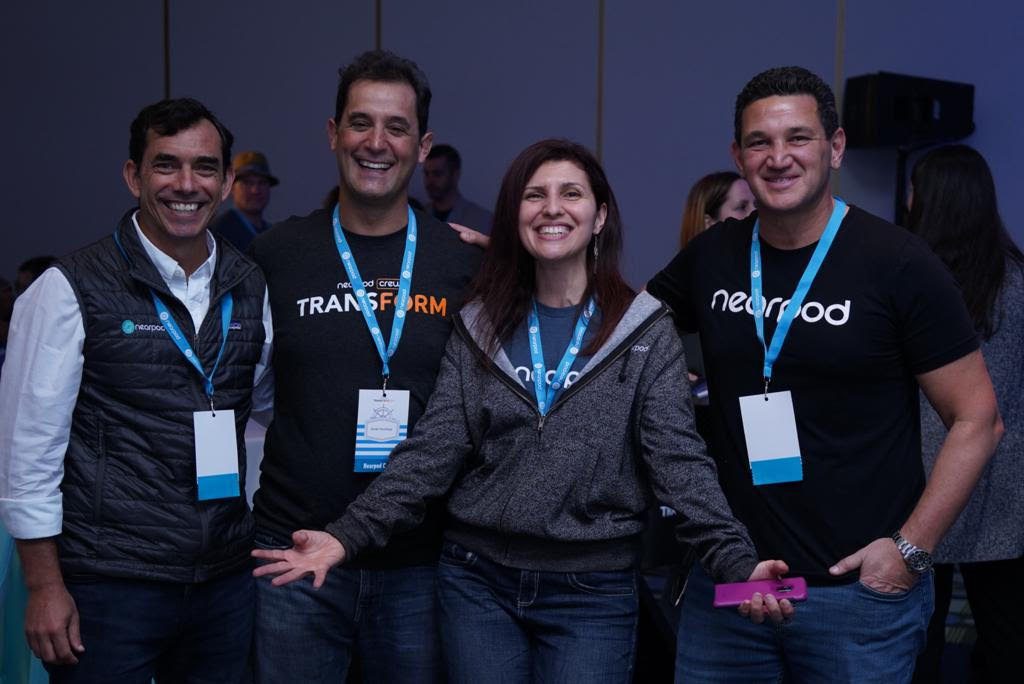
Nearpod’s South Florida operation grew from modest beginnings. By March 2019 it had 142 employees, and its lesson library contained more than 7,000 offerings. The company held its first Transform user conference that year, bringing educators together around student engagement. Its co-founders appeared in a photograph alongside one of their teacher advocates, or PioNears. The people using the product were visibly part of the company’s public life.
The growth also brought recognition outside schools. Nearpod placed at number 297 on the 2016 Inc. 5000 and number 942 in 2017. In 2018, the three co-founders were selected as Endeavor Entrepreneurs. These were different kinds of validation: a business-growth ranking, then membership in a network of entrepreneurs. Neither changed the daily requirement to produce something a teacher could use.
Kovalskys had also been thinking about where technology should stop. In a 2017 interview, he emphasized the social work of school: children learn to interact with peers and adults, negotiate rules, and develop capacities beyond the academic curriculum. He expected combinations of independent work, shared instruction, and projects to become more common. His discussion also returned to infrastructure. Devices, furniture, and the arrangement of a room could shape what teaching was possible.
A walk leads to hip-hop
One of Nearpod’s consequential business conversations happened on a hike. At a Reach Capital retreat in 2018, Kovalskys walked with Alex Rappaport, co-founder of Flocabulary. The companies already knew each other through an earlier content partnership. Teachers had liked the hip-hop videos in Nearpod’s library and wanted them back after that arrangement ended.
Rappaport was preparing to raise funding and build a sales operation. Nearpod already had a distribution network. Their conversation opened another route, and in April 2019 Nearpod acquired Flocabulary. The brand would remain separate, and its team would join the company. A discussion about growth had found a practical overlap: content on one side, established routes into schools on the other. The soundtrack was an unexpected bonus.
The larger transaction came in 2021, when Renaissance acquired Nearpod for $650 million. By then Pep Carrera was Nearpod’s CEO. The company’s acquisition announcement described 19.5 million lessons launched during 2020 and approximately 1.5 billion real-time insights collected about student learning. Those figures describe the scale of the platform that grew from the founders’ early work; the chief executive’s chair had already passed to someone else.
Annual figures reported in the 2021 acquisition announcement.
Old classmates, another trail
Kovalskys’s connections continued beyond the operating story. Endeavor Miami acknowledged him and his co-founders for sharing experience as mentors. In April 2025, the organization again included Nearpod’s founders in its Outliers announcement. The company had become part of a local entrepreneurial history as well as an education business, with people who could pass on the experience of building it.
A more personal update appeared in Berkeley Haas’s summer 2025 magazine. Kovalskys and three MBA classmates described a tradition of meeting every other year for an outdoor trip. Their adventures had moved from sailing to cycling. In 2022 they rode in northern Spain; the newer outing took them to a remote Patagonian lake for trekking, fishing, and biking. The classmates still had places to go together, decades after graduation.
There is something fitting about that final scene: old friends, a change of terrain, a reason to keep moving. The public story of Kovalskys contains plenty of transactions and measurements. Its revealing moments are often smaller. A founder spends another week in a school. Teachers ask for a piece of content to return. Two entrepreneurs take a walk. The next idea has a habit of arriving while someone is paying attention to the person beside him.