Consider the invitation to a job interview. It contains a time, a link and perhaps a cheerful sentence. For the company, this is one event in a carefully arranged sequence. For the candidate, it can be the entire map. Who comes next? What will they ask? How many conversations remain? The organization has a process. The person outside it has an inbox.
Guide built its business around that mismatch. Its candidate portal gathers the interview plan, preparation materials, interviewer biographies and messages into a branded home base. Now its AI recruiting coordinator, Aria, also helps arrange the meetings behind that experience. The proposition is easy to grasp: make the machinery less demanding for recruiters and the journey less mysterious for candidates.
- For talent teams: scheduling, candidate communication and preparation in one workflow.
- For candidates: a clearer view of the process and the people involved.
- The buying question: does your hiring stack fit, and where does coordination actually consume time?
The missing half of the interview
An applicant tracking system keeps the employer organized. Guide gives the candidate a view of the experience unfolding inside it. Templates can vary by role or location, and preparation can arrive as the candidate reaches the relevant stage. Recruiters can reuse material without sending everyone the same undifferentiated packet.
This matters because interview preparation is also information about the employer. A useful biography says someone thought about the meeting. A clear sequence suggests the company respects the candidate’s time. Guide makes those gestures repeatable. Whether they are persuasive still depends on what the company puts into them.
They had solved the other end
Troy Sultan and Austin Cooley had already spent years building Resource, a sourcing business launched in 2016. Their observation was that talent teams increasingly struggled to win people they had found. In 2021, Gem acquired Resource, and the founders announced Guide as a separate company. One Medical, GitLab, Reddit and Glossier were among the early users.
The financing followed: Guide announced an $8 million seed round in March 2022, led by First Round Capital and Spero Ventures. By September, it reported reaching more than 100,000 candidates and had received Greenhouse’s Customer-Preferred Partner recognition. The candidate-facing layer had found a place beside the employer’s existing system.
The founders later offered a less tidy account of product building. In a June 2025 Supra Insider conversation, they discussed bloated, idealistic bets and excessive attachment to frameworks such as Jobs-to-be-Done. They described moving toward smaller improvements, faster validation and closer contact with customers through founder-led sales and Slack.
Sultan also discussed stepping back from product leadership so Cooley could own the product vision. The correction was practical: reduce the distance between a customer’s immediate problem and something the team could ship. That is a useful detail for anyone tempted to confuse an elaborate roadmap with progress.
Give the calendar a memory
Today, Guide sells into the working day of recruiters and recruiting coordinators. A panel interview brings together availability, interviewer qualifications, workload, time zones and the possibility that somebody declines. Aria handles scheduling work around those constraints. The platform also supports interviewer pools, training arrangements and shared task queues.
Its expertise lies in these recruiting details. A generic booking link can offer an available appointment. A recruiting coordination system must assemble a sequence with the right people, then deal with changes. Guide combines that operational work with the portal where the candidate sees the result.
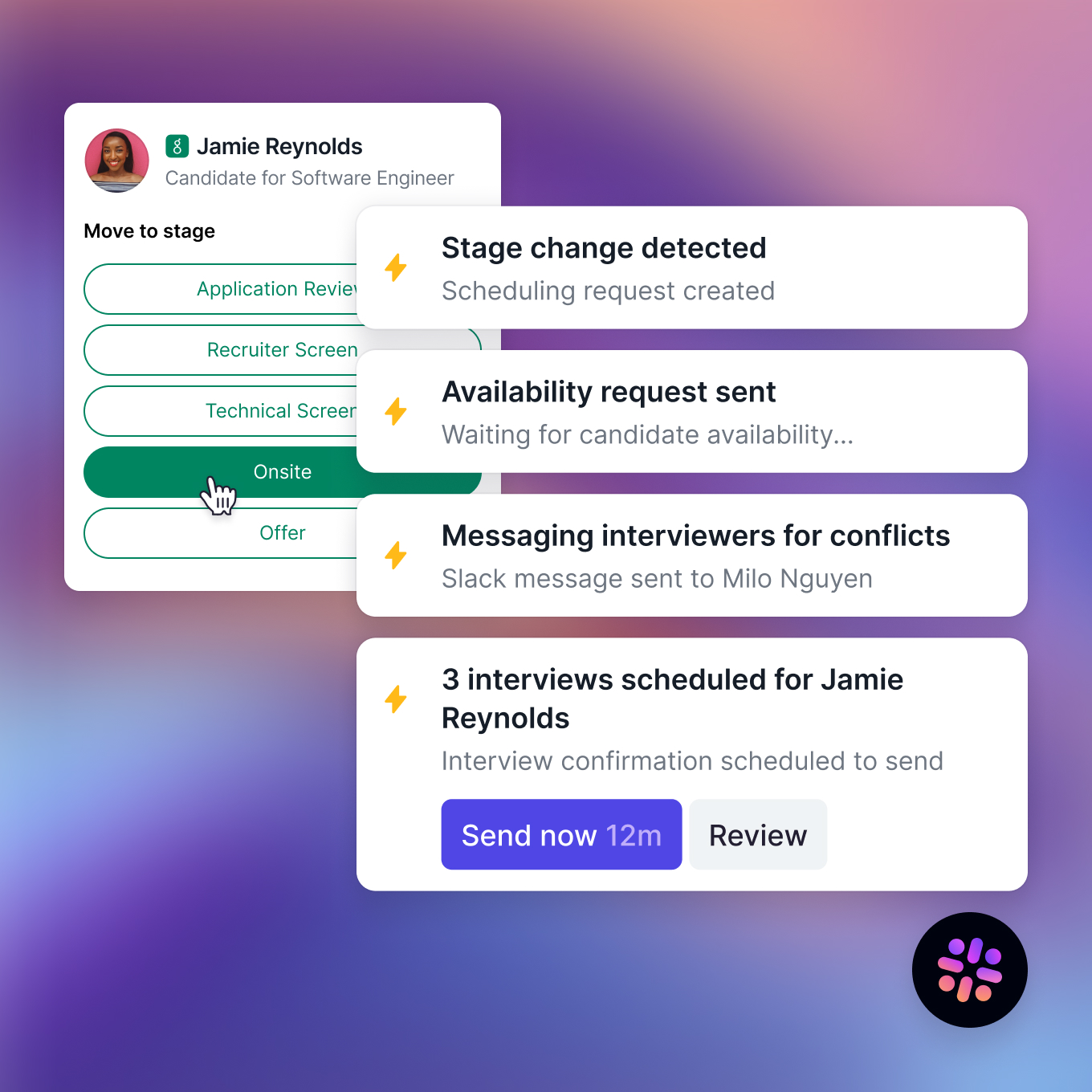
Messaging keeps communications connected to the journey. Surveys add a way to hear from candidates during it. Guide’s Live Surveys anonymize responses and hold the feedback until after the hiring decision. That design addresses an obvious tension: someone still competing for a job may hesitate to criticize the process.
- 01Stage changes
- 02Coordinate people
- 03Prepare candidate
- 04Listen & improve
One week, then two months
MURAL’s experience makes the operating idea concrete. Its talent team saw offer acceptance soften in some departments while hiring took longer. Candidates had questions about preparation and upcoming meetings; information was scattered through email. The team also struggled to gather useful feedback from surveys sent after interviewing ended.
“We started by piloting Guide and we were live in about a week.”Yadira Hernandez, Talent Partner at MURAL
MURAL expanded across departments over roughly two months, adjusting templates along the way. It connected Guide to its ATS and collected feedback throughout the process. Its team even used a MURAL board to organize suggestions. The software became part of an ongoing editorial job: improving what candidates were told.
Customer-reported changes in Guide’s published case study; no controlled attribution to the software alone.
Those results are encouraging, but the method is more portable than the percentages. Pilot with a manageable group. Let coordinators improve the material. Ask questions while the experience is happening. Expand after learning something. Buying the tool is only one part of that sequence.
The bill follows the company
Guide’s August 2026 comparison describes flat pricing tied to full-time headcount, including seats and modules. Buyers get a quote. The same page gives a useful operating-cost example: deployments at companies of roughly 300 to 500 employees involved about eight hours of customer setup across three weeks of onboarding.
That comparison names GoodTime as a direct alternative and positions Guide around coordination inside the ATS, candidate communications and adjustable AI autonomy. It also draws a clear boundary: Google Workspace with Greenhouse or Ashby, with Microsoft 365 unsupported as of August 2026. Compatibility deserves an early conversation.
For a team with complicated panels and repeated handoffs, the combination has an intelligible purpose. For an occasional hire with a simple schedule, there may be less coordination to recover. And no portal can supply a decision the company has not made. Guide’s useful challenge to employers is to make the next step clear enough that a candidate can actually take it.