Waiting is an expensive business. Someone wants to hire. Someone wants to start work. Between them sits a background check, moving at a pace neither party has chosen. Gregg Gay spent much of his working life on that awkward stretch of road. With his co-founder Connie Clore, he built Asurint around the proposition that the machinery behind a hiring decision could work better.
It is an unglamorous place to look for an entrepreneurial career, which is part of its appeal. Court records do not offer the theatrical possibilities of a consumer gadget. Yet the consequences are wonderfully concrete: a recruiter gets an answer; a candidate gets to move forward; an employer spends less time chasing information. Gay’s career makes a case for taking an ordinary administrative irritation seriously.
His route into the field began in public accounting at Coopers & Lybrand, followed by work as an investor and executive in early HR technology and outsourcing businesses. By the time Asurint was taking shape, he had experience on several sides of a growing company. The accountant had become an operator, with a particular interest in the business of employing people. ↗
Before the checks cleared, the savings went
Gay and Clore met at a small background screening company in Cleveland. Both had moved there for the job. When they decided to create a business of their own, they had industry experience but little of the local network that makes a new venture easier. Noncompete agreements imposed another wait. They needed investors, and they needed their contractual restrictions to expire. ↗
The delay had a financial price. The pair went without income and drew down their retirement savings before securing enough investment to open. There was also the risk of time itself: after years away from the market, would the solution they had imagined still be relevant? It is a less decorative version of the founder story, with the calendar and the savings balance doing most of the talking.
Then came another test. In a recollection published with the 2017 Aggie 100, Gay and Clore described launching before the 2008 recession with little cash and a short runway. They told employees what was happening. Pay was reduced; the team remained positive and committed. Their account put candour at the centre of survival. A business can make many promises, but a candid explanation of its finances has a special way of commanding attention. ↗
“Pay was cut but our team stayed positive”Gregg Gay and Connie Clore, 2017 Aggie 100 recollection
The accountant’s case for a technology company
Growth eventually made the proposition visible in the accounts. Asurint’s annual revenue rose from $6.5 million in 2010 to $15.9 million in 2013, a 146 percent increase. In 2014 it appeared on the Inc. 5000 at number 2,581. For a business concerned with speeding up other organisations’ paperwork, there was satisfaction in producing some persuasive paperwork of its own. ↗
A further snapshot in Crain’s 2016 growth rankings recorded $22.8 million in 2015 revenue, 158 full-time employees worldwide and 135 locally. Those figures describe a particular moment, but they also give the story scale. The venture had become a Cleveland employer with an operating organisation to sustain, rather than simply an attractive idea waiting for its chance. ↗
In March 2017, Asurint secured a minority investment from North Bridge Growth Equity. The intended uses were practical: add talent and expand its technology-based screening services. Gay’s description of the business was economical: “first and foremost a technology company.” That choice of identity mattered. He was asking investors to look at the underlying system and the potential to improve it. ↗
The growth continued into another set of rankings. In 2020, Asurint made its sixth appearance on the Inc. 5000, reporting 92 percent revenue growth over three years. Gay connected the recognition to client value and the team’s daily work. The detail worth keeping is the repetition: an organisation has to deliver through many ordinary working days to appear on a growth list more than once. A launch is an event. An operating company is a succession of obligations. ↗
A county at a time
The system’s progress could be measured geographically. In October 2018, Asurint said its instant-clear capability covered counties representing approximately 92 percent of California’s population. Gay described work with courts that lacked electronic case management, including assistance with the structure of their data. The work behind a quick answer could be painstakingly local. ↗
There is a pleasingly modest unit of progress here: the county. Technology talk tends to favour the boundless. Court information brings it back to a particular jurisdiction, a particular record and a particular way of accessing it. Gay’s business had to meet that reality where it lived. A faster screen began with the less photogenic work of making information usable.
By August 2019, the company reported instant-clear coverage in 81 Ohio counties representing 98 percent of the state’s population. Based on July search results, it said more than seven in ten candidates could be cleared instantly. These were specific claims about searches in covered jurisdictions. An instant clear meant no criminal history result returned within the scope of that search, an essential qualification when speed is the selling point. ↗
The people behind a quick answer
Accuracy gave the speed argument its necessary weight. In a 2021 interview, Gay described confirming or correcting inaccurate records as a personal duty. His short formulation was “We have a responsibility here.” A background report concerns a person whose prospects may depend on the answer. An efficient process still needs someone willing to respond when the information is challenged. ↗
His leadership story also includes the people given room to handle specialist work. In 2018 he welcomed Brent Sisson as chief financial officer, pointing to the fresh perspectives and financial experience Sisson would bring. For a founder who began in accounting, bringing another experienced finance executive into the company is an instructive detail. A growing organisation needs expertise beyond the founder’s own desk. ↗
Kelly Uebel’s work offers another example. As general counsel, she oversaw Asurint’s professional accreditation and developed its compliance standards. When she became chair of the Professional Background Screening Association in 2021, Gay publicly celebrated her contribution and supported her industry leadership. The company’s credibility depended partly on colleagues who understood the rules as closely as others understood the software. ↗
Customers supplied a separate verdict. In 2022, Asurint received its ninth HRO Today Baker’s Dozen recognition, placing sixth among overall enterprise screening leaders. The ratings drew on customer feedback across service breadth, deal size and quality. Gay used the occasion to describe an ongoing effort to ask clients what they needed and refine the support surrounding the technology. Repeated business is a rather stern form of applause. ↗
Make the recruiter’s day less complicated
A screening tool also had to fit the working day. Asurint’s Greenhouse partnership joined background checks to the software recruiters already used. Gay connected that integration to competition for candidates and the need to act quickly. The point was easy to understand: fewer interruptions between finding a person and completing the steps needed to hire them. ↗
The same idea appeared in the company’s 2022 SAP certification, which connected its background check integration with SAP SuccessFactors Recruiting. An integration can sound like an item for a technical appendix. For an employer, its appeal is more domestic: less moving between systems, fewer loose ends, a process that feels as though its parts have met one another before. ↗
Asurint’s AkkenCloud collaboration made that convenience explicit, allowing staffing users to order checks, receive notifications and review results within familiar interfaces. Its PRADCO partnership approached a different part of the hiring decision, bringing pre-hire assessments alongside background screening. Together, those efforts show a business looking beyond the individual search to the broader decisions employers were trying to make. ↗
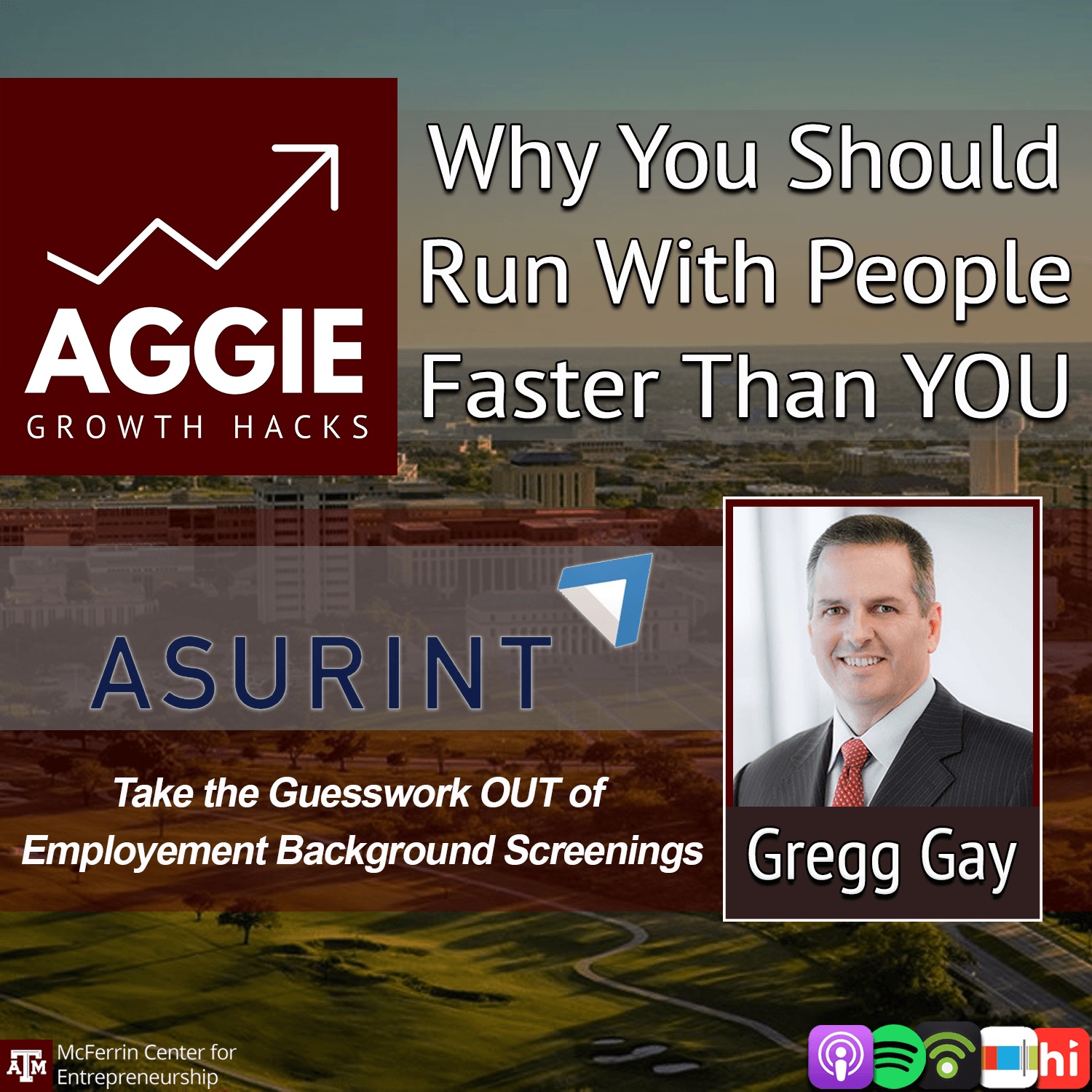
Gay carried that interest in growth and company culture into a June 2021 Aggie Growth Hacks conversation. The episode’s title invited listeners to run with people faster than themselves. Its topics ranged from client value and growth challenges to the Aggie network. The title is a useful invitation for anyone building a team: there are advantages to company that makes you pick up the pace. ↗
The next pair of hands
On March 4, 2024, Alla Schay became Asurint’s CEO. Gay was identified at the transition as its former CEO, executive chairman and co-founder. He endorsed her operational experience and attention to clients. Schay, in turn, publicly thanked him and the board for their support during her arrival. The founder’s work now included helping somebody else take charge. ↗
In December 2025, A&M Capital Partners acquired Asurint. Guidepost Growth Equity, which had invested in 2017, sold its shares. The deal introduced a new owner to a company already under its successor CEO. Gay expressed pride in the business and confidence in the team leading it forward. His emphasis had moved from building the organisation to seeing it continue. ↗
That is an apt final turn for a career spent examining delays. At the beginning, Gay and Clore waited for restrictions to expire and investors to arrive. As operators, they worked on the waits imposed on employers and applicants. At the handoff, the business was ready for another leadership chapter. The achievement lies in those ordinary transitions made possible: a record retrieved, a decision reached, a company able to carry on.