A Nigerian airline once attached its name to an aircraft commitment with a list price of $11.7 billion. When Green Africa finally carried its first paying passengers, it did so with a fleet of three leased turboprops. The distance between those two facts is where the interesting business lives.
- Green Africa sells domestic flights in Nigeria, with affordability at the center of its pitch.
- Its three fare bundles charge differently for baggage and flexibility.
- A 2025 lessor dispute interrupted flights; owned aircraft became part of the next chapter.
For a traveler, an airline is a departure time and a price. For the person running it, it is a chain of agreements: aircraft, financing, certification, people. Green Africa is an unusually useful case because its public history lets us see both sides of the ticket.
A very large order.
A much smaller launch.
Babawande Afolabi’s preparation included Morgan Stanley, Stanford and American Airlines. At Morgan Stanley, he encountered the low-cost airline model and wondered about its application in Nigeria. That question became a company in 2015. He expected to begin operations within a year. The first commercial flight left Lagos for Abuja on August 12, 2021.
Money arrived in stages. Friends, classmates and former colleagues supplied seed backing. Kuramo Capital made an institutional investment, and Green Africa announced its Series A in June 2018. An advisory board brought experience from American Airlines and VivaColombia. Expertise was being assembled alongside capital.
Then came the aircraft announcements. In December 2018, Boeing described a commitment for up to 100 737 MAX 8s: 50 aircraft plus 50 options. That $11.7 billion figure was a list-price valuation of the proposed deal. It was never a statement of Green Africa’s funding or cash spent.
Commitment, including options
Memorandum of understanding
The fleet that supported launch
Different plans at different moments. These numbers do not add up to an airline’s fleet.
The 737 MAX grounding derailed the Boeing plan. An Airbus memorandum for 50 A220-300s followed in February 2020; Green Africa says pandemic conditions subsequently deferred deliveries. The initial machinery changed twice before passengers could use the service.
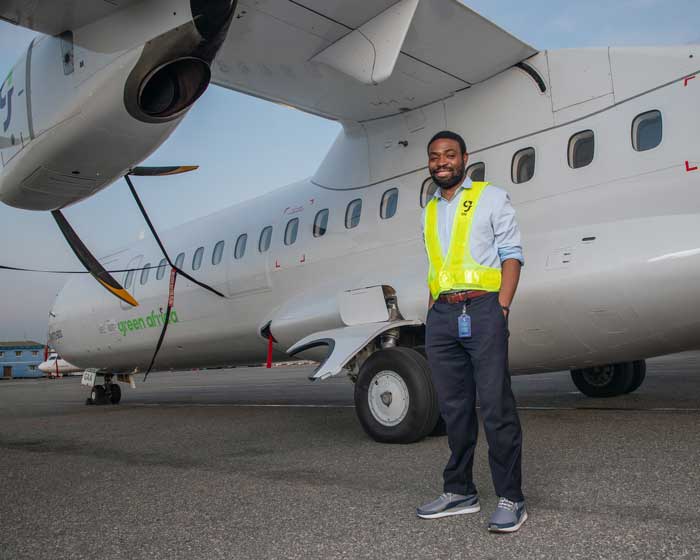
ACIA Aero Leasing supplied the three ATR 72-600s that supported the launch. The proposition had become concrete: short-haul connections between Nigerian cities, sold as value air travel. It offered an alternative within the domestic airline market and, for some journeys, to the road.
Your suitcase is part of the business model
The product is easy to understand once you put a suitcase beside it. Green Africa’s published fare categories all include 7kg of cabin baggage. gSaver includes no checked baggage. gClassic includes 15kg. gFlex includes 23kg, with more generous seat-selection and change provisions.
All three include 7kg cabin baggage. Published fare rules; check conditions when booking.
Someone making a brief visit with a backpack buys a different bundle from someone carrying a large case. Both occupy the same aircraft. The airline earns ticket revenue while selling selected extras: additional baggage, preferred seats and gCafe vouchers for prebooked snacks and drinks.
There is a useful discipline here for the customer. Compare the complete trip. A low entry fare can be sensible when you travel light and your plans are settled. Add luggage or need flexibility, and the relevant comparison changes. gSaver and gClassic are non-refundable under the published voluntary-cancellation rules; gFlex provides a future-use coupon rather than an ordinary cash refund.
Green Africa sits among Nigerian domestic alternatives such as Air Peace, United Nigeria Airlines and ValueJet. Its pitch centers on affordable access. Its fare architecture makes that pitch tangible, although the right choice still depends on the route, departure and total price available for your trip.
Check-in is another small decision with a price attached. Published rules open online check-in 24 hours before departure for gSaver and 48 hours before departure for the other two bundles; all close three hours before departure. Airport check-in attracts a transactional fee for gSaver and gClassic, while gFlex includes it. A traveler who understands those rules can compare the bundles before arriving at the airport, when the decision is less convenient.
The day the lease became the story
Leasing helped Green Africa enter service without first owning its launch fleet. In late March 2025, the dependency became visible to passengers: a dispute with its aircraft lessor interrupted operations. Aviation Week reported that the leased ATR fleet had been repossessed. Aircraft availability had become the immediate constraint.
In April, Green Africa announced its first owned aircraft, an ATR 72-500 registered 5N-GAB. Access Bank supplied a naira debt facility to finance part of the purchase. In February 2026, it announced a second owned aircraft, ATR 72-600 5N-GAC, again with partial Access Bank financing and entry into service subject to regulatory approval.
“I didn’t have a Plan B.”Babawande Afolabi, speaking to Illinois Wesleyan University in 2022
Ownership changes the relationship between the airline and the equipment on which every sale depends. Local-currency borrowing also removes one potential mismatch when debt payments and ticket receipts are both in naira. That is the economic logic of the arrangement, rather than proof that the business has become insulated from currency pressure.
Buying aircraft brings its own obligations. A plane still needs maintenance, insurance, crew and regulatory clearance. Debt still needs servicing. Ownership cannot, by itself, produce punctual departures or enough paying passengers. It changes one source of dependence while leaving the operating job intact.
Make the ordinary dependable
Inside the company, employees are gTalents, collectively the gTeam. The five customer promises include safety, affordability, service, reliability and fun. Even its 2026 staff event borrowed those names for its teams. The vocabulary is cheerful. Delivering the promises is an exacting daily exercise.
The useful thing another founder can copy is the distinction between a customer problem and the first proposed solution. Green Africa kept pursuing affordable Nigerian air travel while changing aircraft plans and financing arrangements. That approach needs patient capital, workable routes and regulatory permission. Without those conditions, repeated adaptation can simply become repeated delay.
A traveler ultimately needs less drama than an entrepreneur. A bookable seat. Clear baggage rules. An aircraft available to operate the flight. Green Africa’s original ambition becomes valuable each time those ordinary things line up.