In 2008, Bimbola Adisa was working in investment banking in Chicago when his father called from Nigeria with a familiar grievance: the electricity in Lagos had gone off again. A family conversation carried a business problem across the Atlantic. Adisa was employed at Deutsche Bank. Back home, reliable power remained something people had to arrange for themselves.
The complaint had staying power. Adisa left banking and began building Beacon Power Services, travelling to Lagos as he worked on the business. The early proposition included solar power for commercial customers and portable generators for retail kiosks. It addressed the practical arithmetic of keeping a business open when the grid could not be counted on.
“I’ve always felt a draw to Nigeria,” he said. Born there and raised in the United Kingdom, he had built a career abroad without losing that connection. His return to the power problem brought together two forms of knowledge: how energy businesses work on paper, and what their shortcomings mean to someone waiting for the lights.
By 2014, Beacon was working with the restaurant chain Kilimanjaro and producing portable solar generators for mobile-phone retailer RLG. These were businesses with things to sell, hours to keep and equipment to run. For them, an energy proposal had to survive a less forgiving examination than a conference presentation: would it work during the next trading day?
A waiting room, then a different kind of network
Adisa had another family memory that helped explain his ambitions. Relatives once travelled to a NITEL office to telephone family in England. They waited for an official to announce that their call was ready. An ordinary conversation required a journey, a queue and permission from the machinery around it. The inconvenience was built into the system.
The later transformation of telecommunications gave him a way to think about electricity. Infrastructure that people had learned to tolerate could change. He wanted a comparable change in power, and his outlook extended beyond Nigeria. His question about taking on the work was disarmingly brief: “Well, why not me?” It is an entrepreneurial question with remarkably little ornament.
His preparation was technical as well as financial. He studied aeronautical engineering at the University of Salford and later earned an MBA at Northwestern’s Kellogg School of Management and a master’s in manufacturing management at its McCormick School of Engineering. His career included British Airways and Rolls-Royce before investment banking.
That sequence matters to the shape of the business he eventually built. Engineering asks how a system behaves; manufacturing asks how it operates repeatedly; finance asks whether the numbers can sustain it. An electricity distributor has to answer all three. A working transformer, an accurate customer record and a collected bill belong to the same commercial problem.
“Well, why not me?”
Bimbola Adisa, on taking on the power problem
The transformer has acquired new neighbours
As Beacon’s work developed, Adisa focused on the electricity distribution network. A growing city can change around infrastructure installed for a much smaller population. In a 2022 interview, he used the example of a neighbourhood whose equipment had originally served ten homes and now had a hundred. The streets had changed faster than the system serving them.
This is a useful way into his argument because it replaces an abstract shortage with a specific mismatch. The equipment has a location and a capacity. The households have demands. Somewhere between those facts, a utility must work out what needs repair, what needs replacement and what can be managed better. Missing information makes each decision harder.
Beacon’s CAIMS system builds a connected record of customers and assets, including transformers and low-voltage poles. It gives the utility a digital map and supports the tasks that follow: new connections, installations, surveys and maintenance work orders. Mapping is part of the operational work. The result has to help somebody send a team to the right place.
Adora adds visibility into the network’s performance. Xepp gives consumers tools to track consumption and make payments. The names are more cheerful than most electricity bills, but their jobs are sober. Together, the products connect knowledge of the network with decisions about its operation and the customer’s experience at the end of the wire.
Customers, poles and transformers on a connected digital map.
Network visibility to support grid operations and decisions.
Consumption tracking and payments for the customer.
The chief executive is only one of the users
One piece of advice stayed with Adisa. A utility chief executive told him that a product’s success depended on the employees who would use it. A persuasive demonstration to the boss would accomplish little if the working team could not use the software or make it part of its routine. Adisa recalled the exchange in a 2023 podcast conversation.
It explains his insistence on local presence. He warns founders against assuming that a product built for users in San Francisco will fit users in Lagos or Dakar. Understanding the customer requires time with the people doing the work. A similar-looking problem can demand a different approach when the institutions, habits and practical conditions change.
There is a pleasing restraint in that advice from someone selling software. The route to a useful digital system runs through human conversations. Who enters a record? Who checks an outage? Who follows a work order? The interface is only part of the answer. A product earns its place when the ordinary working day becomes easier to manage.
His collaborators also reflect that mix of skills. Beacon’s leadership includes chief technology officer Yemi Adegoke and chief strategy officer Christine Adejorooluwa. In public conversations, Adisa moves between the engineering of the grid and the economics around it. The subject demands both. Electricity that cannot be delivered reliably gives the customer a problem; electricity that cannot be accounted for gives the utility another.
Finding investors who can wait for a utility
Building for electricity companies presents a particular financing challenge. Sales can take time, and growth can require substantial spending before the next contract produces its return. Some venture investors passed on Beacon for those reasons. Seedstars Africa Ventures was introduced to Adisa in 2021 and took a different view of the opportunity.
The company announced a $2.7 million seed round in August 2022. In November 2024, it announced a Series A led by Partech, with Finnfund, Gaia Impact, Proparco and returning investors among the participants. The announcement left the amount undisclosed. The purpose was concrete: develop products, strengthen existing operations and expand into Eastern and Southern Africa.
By that later round, Beacon employed more than 200 people across Ghana, Kenya, Nigeria, Zambia and the United States. That footprint made the original cross-border connection into an organisational fact. A company tackling distribution needs people near its customers as well as the technical and commercial capacity to support them.
In January 2026, a debt facility arranged by Symbiotics added a different kind of support. It was intended to finance smart meters for grid assets, including substations and transformers, across Nigeria, Ghana, Zambia, Tanzania and Togo. Software needs readings from the physical network. The finance, in this case, helped pay for the equipment that makes those readings possible.
Announced seed financing
Led by Partech; amount undisclosed in the announcement
Back on stage, still talking about distribution
At the Africa Forward Summit in Nairobi in May 2026, Adisa returned to a point he had been making for years: electricity debates devote substantial attention to generation, while distribution deserves more attention. His position is readily understood. New power has to travel through a network, reach a customer and become a service the utility can afford to maintain.
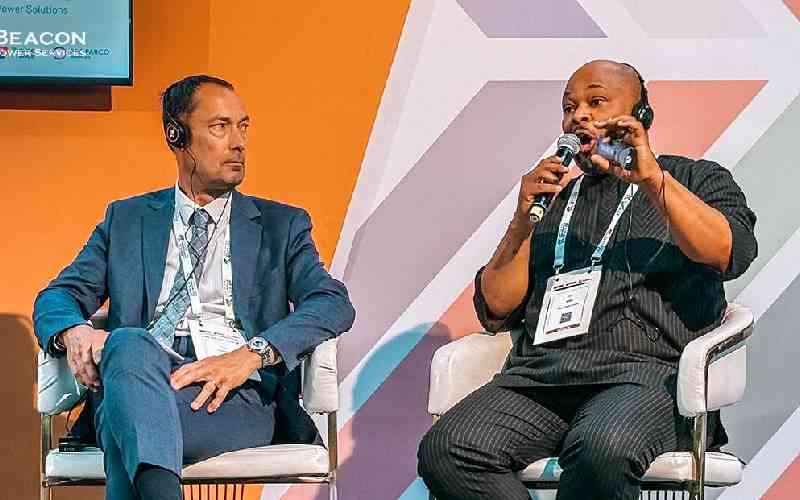
The summit programme placed him on an energy panel alongside executives from EDF Power Solutions, Rubis Energy and Aeolus. The conversation covered secure supply, industrialisation and the energy transition. Adisa’s contribution carried his particular preoccupation into that wider discussion: the condition of the system between producing electricity and using it.
He also set out his thinking in an article published in May 2026. He argued that an electricity connection alone is an inadequate measure of progress when the supply remains erratic. He described Adora as capable of analysing more than a billion grid data points daily. The scale is striking, but the intended use is everyday situational awareness for operators.
By July, the work had acquired two further institutional connections. A European Bank for Reconstruction and Development project, approved on July 8 and listed as disbursing, provided for a loan of up to $10 million to support smart metering and solutions for six Nigerian distribution companies. Later that month, Beacon announced a partnership supporting the Association of Power Utilities of Africa’s scientific committee.
The measure is an ordinary evening
Adisa’s aspiration has remained recognisable through these changes: more dependable electricity for African cities, delivered by utilities with a better understanding of their networks. The business has grown from early commercial energy projects into software, data collection and grid monitoring. The original complaint still supplies a useful test of all that sophistication.
A customer is unlikely to celebrate a beautifully organised asset database for its own sake. The reason to care is what the database allows someone to do: locate equipment, account for consumption, organise repairs and understand where electricity or revenue disappears. Each task helps move the promise of a connection closer to a service people can plan around.
There is ambition here, though much of the work takes an unglamorous form. It involves customer records, meter readings and the patient business of making tools usable. Adisa’s career makes room for that kind of detail. The aerospace training and the banking experience have found a shared destination in the distribution network.
The family telephone story offers a fitting ending. Once, a call to relatives abroad required waiting in an office. Later, a call from his father helped redirect his career. Now his company works on the infrastructure that determines whether other people can carry on with their evening. The conversation has travelled a long way. Its subject remains close to home.
Continue the conversation
Read and listen to Adisa discussing the work, the customers and the grid.
- Beacon Power Services website
- Bimbola Adisa on LinkedIn
- Watch: Voices for Change interview
- Listen: MCJ, building and financing in Africa
- Listen: Energy and Africa interview
- Read: Adisa on AI and grid reliability
- Read: His 2014 Green Awards profile
- Read: The family telephone story
- Read: Electricity distribution in Nairobi
- Beacon Power Services company profile