Somewhere inside a Salesforce account, a perfectly competent employee is about to make a terrible click. A bulk update will overwrite the good values. An integration will duplicate a thicket of records. An administrator will delete a parent record and discover, half a heartbeat later, that Salesforce’s cascade rules brought the children along for the ride. GRAX exists for that moment. It continuously copies business data, metadata, attachments and their changing versions so the customer can travel back to the last sane state.
That is the useful, unromantic core of the Boston company: backup, archive and recovery for enterprise applications, especially Salesforce and Veeva. But GRAX’s more interesting argument begins after the emergency is over. A backup is usually treated like a fire extinguisher - necessary, inspected occasionally and otherwise ignored. GRAX wants the same historical record to become a working dataset for compliance teams, analysts, developers and AI systems.
The company’s bet rests on a distinction that is easy to miss. A current CRM record tells you what a customer looks like now. A series of versions can show how the relationship changed: which fields moved before a renewal, what support activity preceded churn, or how a pipeline developed quarter by quarter. Preserve the sequence and yesterday stops being digital attic dust.
“One of the fundamental beliefs we have is not holding a customer hostage from their data.”Joe Gaska, GRAX founder
The product is an undo button with a memory
GRAX connects to a Salesforce organization through a dedicated integration user, reads its schema and writes copies into infrastructure the customer controls. That last phrase is the company’s organizing idea. A buyer can deploy in AWS, Microsoft Azure, Google Cloud, Kubernetes or on-premises. The data can remain inside the buyer’s security perimeter rather than taking a sightseeing trip through another vendor-owned cloud.
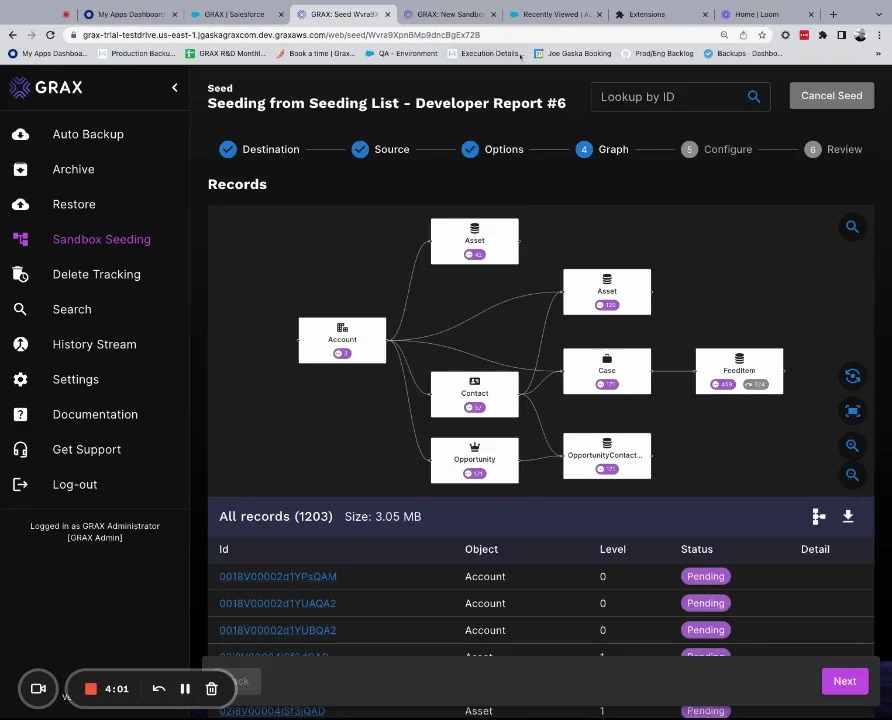
Backup & Restore handles continuity. Data Archive moves older records out of the live application while keeping them searchable and restorable. Time Machine lets users inspect versions inside Salesforce. Sandbox Seeding copies selected record hierarchies into test environments, with anonymization and an undo function. Data Replication and the built-in Data Lake make history available in Parquet, a format familiar to modern analytics tools. GRAX Insights adds prebuilt reporting; Data Lakehouse puts a query-ready layer on top. In 2026 the company previewed GRAX AI, a zero-code interface meant to turn governed history into reports, business answers and assistants.
Who pays, and what does it cost?
The natural buyers are Salesforce administrators, data-platform teams, security leaders and compliance officers. The appeal rises in pharmaceuticals, healthcare, financial services, government and other environments where a missing record is not merely annoying; it can become an audit problem. Publicly referenced customers include Jazz Pharmaceuticals, Mölnlycke, Meret Solutions, ServiceSource, Sabre, the American Red Cross and the Salvation Army. After Ascendx combined GRAX with CapStorm in 2025, the organization said it served more than 500 enterprise customers across 40 countries.
GRAX sells Standard, Business and Enterprise packages. The entry package covers daily backup, recovery, sandbox seeding and native insights. Higher tiers add continuous protection, archive policies, a Parquet data lake and, at the top, the Data Lakehouse. There is no public dollar menu; prices are quoted. A serious cost calculation also includes the cloud account where the software runs, storage, compute, an appropriate Salesforce integration user and the people who operate the environment. Premium round-the-clock support costs extra. Data custody is not free - it swaps some vendor dependence for customer responsibility.
The moment backup became raw material
GRAX did not abandon recovery for a fashionable AI costume. It widened the job of the data it was already collecting. Early customer demand also shaped the architecture. The company introduced a virtual appliance after hearing that enterprises wanted managed convenience without letting sensitive data leave isolated, customer-owned compute and storage. The compromise is revealing: make deployment easier, but do not relax the custody principle.
The analytics move followed the same logic. In 2022, an AWS Marketplace launch connected Salesforce history in S3 with Redshift, QuickSight and SageMaker. In 2024, GRAX launched Data Lakehouse and Insights, promising same-day availability and reporting without bespoke ETL code. A 2026 AI preview put a conversational layer over that governed history. The product surface changed; the underlying asset did not.
Jazz Pharmaceuticals offers the cleanest picture of the target customer. The global drugmaker needed Salesforce data and metadata replicated into its own AWS environment for analytics across 13 offices in eight countries. GRAX’s public case study says the deployment kept data within Jazz’s security boundary, detected schema changes automatically and made it queryable through tools including Athena and Redshift. The win is not a cinematic rescue from deletion. It is quieter: fewer custom extraction chores, clearer custody and an analytics pipeline that does not forget the past.
The market is crowded; the constraint is the pitch
GRAX competes with Own, now part of Salesforce, as well as Odaseva, Veeam, Druva, Spanning, Gearset, CloudAlly, native exports and home-built pipelines. Basic backup features converge quickly: schedule copies, search records, restore them. GRAX tries to separate itself on architecture. The customer owns the storage, keeps access to history and can use the data beyond recovery. Its archive, sandbox and analytics tools share the same captured foundation.
That position sharpened after Ascendx acquired GRAX in October 2025 and paired it with CapStorm, whose strengths include near-real-time Salesforce replication and recovery. Ted Pappas became chief executive of the combined organization. Gaska moved from GRAX CEO to chief product officer, and co-founder Christopher Haley became chief operating officer. The deal amount was not disclosed. The combined thesis is broader than backup but still pleasingly narrow: move enterprise application data into environments customers control, then protect it and activate it there.
Start with the compulsory problem. Recovery earns budget and trust before analytics asks for either.
Find the valuable exhaust. A complete backup already contains versions, lineage and relationships.
Turn architecture into positioning. Customer-controlled storage makes sovereignty tangible.
Reuse one foundation. Archive, test data, reporting and AI should not each build a new pipeline.
What a reader can steal - and when not to
The transferable idea is not “build for Salesforce.” It is to look for an expensive obligation that quietly produces a reusable asset. Compliance logs can become operations intelligence. Fraud reviews can improve underwriting. Support transcripts can become product research. Solve the mandatory job well, preserve the by-product in a portable form, then let a second customer team put it to work.
There is another lesson in GRAX’s product ladder. Backup, archive, restore, sandbox seeding, reporting and AI appear to be separate categories. They become coherent when each operates on the same versioned history. That allows expansion without a random collection of features. The company can sell a safety net to an administrator and, later, a data feed to an analytics team.
Works best when
- Salesforce or Veeva is operationally critical.
- Audit history and recovery speed matter.
- The buyer already runs a governed cloud environment.
- Historical CRM data has analytical value.
Probably too much when
- The organization is small and exports are enough.
- There is no team to manage cloud infrastructure.
- The buyer wants the lowest upfront price.
- Old versions add cost but little decision value.
The conditions matter. Bring-your-own-cloud is compelling for a regulated enterprise that already has security policies, storage standards and data engineers. For a small nonprofit or a tidy Salesforce shop, it can be a lot of machinery. Native exports or a simpler managed backup may cost less and demand less attention. Historical data can also amplify stale definitions and poor hygiene; an AI system fed every version of a confused CRM does not become wise. It becomes thoroughly informed about the confusion.
Still, GRAX has found a durable question beneath the AI cycle: who controls the record of how a business changed? The company’s answer is deliberately literal - the customer, inside the customer’s environment, with enough fidelity to recover an accident and enough openness to ask a new question later. The undo button pays for the memory. The second job is where the upside lives.