Consider the moment a golf car leaves the clubhouse. The customer has paid. The staff have smiled. Now the customer and a valuable piece of equipment disappear into a landscape designed to keep people pleasantly occupied for hours. From the golfer’s seat, this is freedom. From the operator’s desk, it is a rather expensive exercise in hoping.
GPS Industries found a business in that separation. Its work puts information into the car and brings information back out. The golfer gets help with the round. The course gets a way to manage what happens after the handover. A small vehicle becomes a place where hospitality, maintenance, and software meet.
- Two views of one car: guidance for the player, fleet oversight for the operator.
- A business rebuilt: the 2009 formation followed an older company’s financial crisis.
- A route to customers: Club Car was a partner before the 2017 acquisition.
- A recurring bill: connected-fleet packages combine equipment with ongoing services.
The car knows where the customer went
The niche is more specific than the company’s name suggests. GPS Industries, usually shortened to GPSi, developed telematics for low-speed fleets, with golf at the center. Telematics is the business of getting useful information from a vehicle to someone who can act on it. In this setting, that person might be a marshal, a golf professional, or the employee getting tomorrow’s fleet ready.
Visage is the product to follow. It connects the on-course experience with fleet management. Vehicle location can help a course understand the progress of a round. Controls can enforce designated areas. Operating information helps staff decide where attention belongs. The question becomes less “Where is that car?” and more “What should we do about it?”
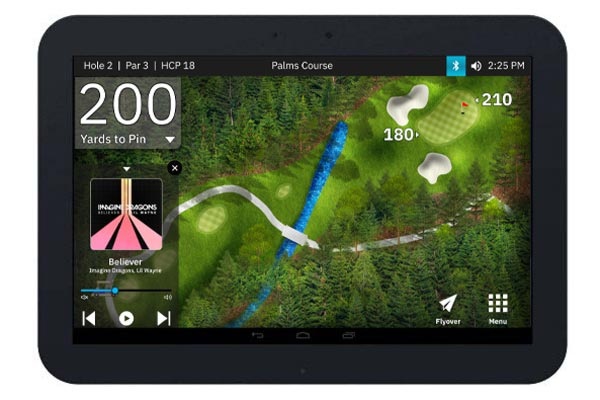
That is a different proposition from selling a golfer a distance-measuring device. A personal GPS watch answers a player’s question. Fleet technology has to answer the club’s questions too. Its buyer is the operation carrying the costs, even when the person enjoying the screen is somebody else.
2009 was a restart, not a blank sheet
The company dates its formation to 2009. Yet an earlier GPS Industries, Inc. had been selling golf technology for years. Its corporate roots ran back to 1996, and its Inforemer equipment belonged to an earlier generation of course systems. Treating the two histories as one clean startup tale would conceal the part that makes the business interesting.
The predecessor’s finances were already strained. Its 2008 accounts reported roughly $13.5 million in revenue and only $1.7 million in gross profit, alongside about $10.5 million in selling, general, and administrative expenses. Those are figures from the old public company, not present-day GPSi. Even so, the imbalance gives the later restructuring some weight. An installed product was insufficient protection against a difficult balance sheet.
Selected accounting figures, not a complete profit-and-loss statement. Gross profit is revenue after cost of goods sold.
In August 2009, the predecessor announced Chapter 11 reorganization. Management blamed the collapse of credit markets, declining consumer confidence, and reduced discretionary spending. The response included reducing indebtedness and funding flexible customer financing. Greg Norman and other senior noteholders were to exchange secured debt for equity; Falconhead Capital would supply financing and management involvement.
The new combination brought together existing GPS businesses, including ProLink, with Club Car remaining an important partner. This was a change in financial structure and commercial route as well as company identity. The lesson is uncomfortable but useful: a technology supplier can need a new way to finance and distribute its product before it needs another feature.
Distribution arrived on four wheels
Club Car gave GPSi a relationship with the machine itself. The Precedent i3, introduced in 2014, integrated GPS into the golf car. The manufacturer’s vehicle and the software supplier’s system could be considered together by the same course. For a buyer, that arrangement puts the screen, the car, and the service conversation closer together.
In 2017, Ingersoll Rand, then Club Car’s parent, acquired GPSi. Contemporary reporting described more than 70,000 vehicles connected through Visage across 50 countries. The acquisition followed years of cooperation. GPSi’s commercial partner had become part of its ownership story.
The market was moving in a similar direction elsewhere. Textron bought TKVGPS in January 2017 for its golf business, which includes E-Z-GO. Connected fleet management was becoming something vehicle manufacturers wanted inside their own offerings. A sensible comparison therefore includes compatibility, vehicle controls, support, and contract terms, alongside the attractiveness of the display.

The fairway has a till
There is a second reason to put a screen where the golfer sits: the club can communicate while the customer is still using the service. A timely restaurant message has a different job from a battery alert, but both benefit from arriving during the round. GPSi’s specialty was to accommodate these competing demands in the same connected fleet.
The expansion beyond golf made the idea easier to see. In 2015, Club Car described Visage Resort Edition at Casa de Campo in the Dominican Republic: 80 guest vehicles spread across a 7,000-acre property. Maps and two-way communications helped manage the fleet. The screens also promoted events, excursions, and even property listings as vehicles passed the homes concerned.
A separate course example shows how physical location becomes advertising inventory. Cranberry Highlands’ outing brochure offers GPS hole sponsorship at $360 per event, with a full-screen advertisement appearing as a car approaches the tee. That is the course’s advertised price, not money automatically earned by GPSi. The distinction matters: software provides a selling opportunity; somebody still has to sell it.
A monthly bill deserves monthly arithmetic
GPSi’s business combines connected equipment with recurring services. One unusually concrete example appears in a February 2025 proposal for Cleveland Heights Golf Course in Lakeland, Florida. For 100 vehicles, a Visage technology rental package with golfer experience and one selected fleet module was quoted at $40 per car per month. A package with both tracking and control was quoted at $53.
Those offers included field installation and listed optional additions separately. They were technology quotations, distinct from buying the golf cars. At the quoted rates, 100 cars mean $4,000 or $5,300 a month before optional additions. They are a useful historical example, not a promise of today’s price or proof that either package was purchased.
Uses the February 2025 Lakeland quotation. Optional additions and vehicle acquisition excluded. Actual terms require a quote.
The operator’s calculation should be just as concrete. What is avoided turf damage worth? Which service interruptions can staff address earlier? Do on-screen orders produce additional gross profit after food and labor costs? Count the outcomes the club can measure. A charming dashboard does not pay an invoice by itself.
The useful part happens after the alert
Connectivity was its own practical constraint. A Vodafone case study describes GPS Industries needing reliable data transmission, consistent pricing, and simpler management across countries. A managed IoT platform and single-SIM approach supported that requirement. The glamorous feature depended on the unglamorous business of keeping a connection manageable.
- 01 / ObserveThe vehicle sends location or operating information.
- 02 / DecideThe course sets a rule or a member of staff responds.
- 03 / ActA message, control, or service action changes the situation.
Conceptual workflow. The diagram does not represent a measured performance result.
A course considering this approach can copy the discipline: map the areas that need rules, assign responsibility for messages, and identify the costs worth reducing. Check communications coverage and vehicle compatibility before committing. A thinly used fleet, poor connectivity, or staff with no time to act on information can make the economics unattractive. These are purchasing considerations, not documented GPSi customer failures.
“Club Car Connect and Visage gives us that control back.”
Steve Marino / Director of Golf, The Golf Club at Yankee Trace / Club Car’s 2026 brochure
The product outlasts the name on the door
Today, the old GPS Industries website directs visitors into Club Car’s connected-technology pages. Club Car says its Connect offering with Visage is installed at more than 2,300 courses worldwide. That is the footprint of the current offering, rather than a new standalone GPSi customer count.
Company records tell a narrower story. Florida lists GPS Industries LLC’s foreign registration as inactive following a January 2026 withdrawal filing. Such a filing does not establish that its products stopped operating. It is worth keeping the registration, the acquired business, and the continuing technology distinct.
The appeal of GPS Industries’ work remains very ordinary. A golfer wants to enjoy the next hole. A course wants its cars, staff, and customers to get through the afternoon in good order. The connected golf car gives them a shared point of contact. For a business built around people driving away, that is a useful place to put a manager.