Before Goutham Rao tried to give an enterprise an AI colleague, his father gave him a Commodore 64. Rao grew up in Brooklyn, learned BASIC, and acquired the sort of interest in computers that tends to survive the computer itself. Years later, after helping build companies bought by Citrix, Dell and Pure Storage, he returned to a familiar question: how much useful work could you persuade a machine to do?
The scale had changed considerably. His current company, NeuBird, tackles the investigation work that follows an alert in a production system. That means finding the connection between a symptom and its cause across logs, metrics, configuration changes and other evidence. Somewhere in that accumulated record is an explanation. Unfortunately, explanations do not arrive wearing name tags.
Rao, usually called Gou, is NeuBird’s co-founder and CEO. He started it with Vinod Jayaraman in 2023, following their work together at Portworx. The proposition joins two parts of his career: an engineer’s interest in what software can accomplish, and a founder’s interest in whether anyone needs it badly enough to buy it.
A chess program meets its opponents
Rao’s early life took him from the United States to India. He studied engineering in Bangalore, and one of his early programming ambitions involved chess. After playing with friends, he wanted to build a program that could beat a person. He experimented with the minimax algorithm, which evaluates possible moves and countermoves. The growing number of possibilities made the program slow; human players could still beat it.
It is a pleasing beginning for someone now building AI for complicated systems. The computer had a method. The opponent had other ideas. Long before the current market for AI agents, Rao had encountered the difference between describing an intelligent procedure and making it useful under real conditions.
He went on to earn a master’s degree in computer science at the University of Pennsylvania. His subsequent technical work included operating systems architecture at Intel and roles at Lockheed Martin. These are the less photogenic foundations of a technology career: the machinery underneath the application, where a mistake can travel a long way before anyone notices it.
Today his public biography credits him with more than 50 issued patents across networking, storage and security. The subjects help explain his choice of problems. His companies have repeatedly worked below the surface, in the systems that let other people’s software run, connect and keep its data.
Three buyers, a recurring cast
Net6, where Rao was co-founder and CTO, built secure networking technology and was acquired by Citrix in 2004. He subsequently became CTO of Citrix’s Advanced Solutions Group. Ocarina Networks followed, with Rao as co-founder, CTO and chief architect. Dell acquired Ocarina in 2010, and Rao later served as CTO and executive director of its data protection division.
Portworx brought him into the world of containers and Kubernetes, the software used to coordinate them. Containers made applications easier to package and move. Their data still needed somewhere dependable to live. Rao served as Portworx’s CTO, working with co-founders including Murli Thirumale and Jayaraman on storage designed for that environment.
In September 2020, Pure Storage announced its agreement to acquire Portworx for approximately $370 million in cash. The figure belongs to the company transaction, but the more revealing detail is the continuity of the people. Rao and Thirumale had already worked together through Net6 and Ocarina. Jayaraman became another returning collaborator.
- 2004Net6 → CitrixSecure networking
- 2010Ocarina → DellStorage optimization
- 2020Portworx → Pure StorageKubernetes data services
- 2023NeuBird foundedAI for IT operations
That continuity matters in enterprise software. A new company may require a new market, product and pitch, while the people making difficult decisions have already seen one another through previous attempts. Rao’s biography reads partly as a succession of technologies and partly as a record of working relationships that survived acquisition announcements.
Sell the idea before polishing the engine
Rao and his collaborators developed a method they call SDBS: sell, design, build, scale. Prospective customers help shape a product before the team commits to building it. An early prototype can be deliberately unfinished, provided it makes the experience clear. In 2016, Portworx even hired salespeople nine months before it expected to have a sellable product, measuring demonstrations and proofs of concept.
“We’re big believers in designing the UI first, and saving the hard stuff for later.”
Goutham Rao
There is an engineer’s pragmatism in that sequence. Doing the hard work first feels productive. Discovering afterward that the customer wanted something else is an expensive way to become better informed. A rough demonstration gives the customer something to disagree with while disagreement is still cheap.
Portworx ultimately chose the developers adopting containers as its audience. Rao’s experience at Dell had given him a view of enterprise storage; the opportunity was to rethink it around a changing application environment. The company went on to serve more than 100 customers, including Comcast, GE and Lufthansa, before the acquisition.
The detective work left behind
By NeuBird’s arrival, the next problem was becoming legible. Modern applications produced abundant operational evidence, yet engineers still had to assemble it into an explanation. A service could slow down in one place because of a change somewhere else. The alert identified a symptom. Finding the responsible dependency required another round of investigation.
NeuBird’s original product, Hawkeye, was designed to act as an AI ITOps engineer. Its launch materials used a shopping-site example: a team notices poor performance, then has to bring together people from several disciplines to investigate. The proposed alternative was to ask a question and have the software examine the operational evidence, explain likely causes and suggest a fix.
The appeal for Rao was closely connected to experience. He and his co-founders had seen the complexity of telemetry data and noticed what language models were beginning to do with information. The early idea was to reproduce parts of an experienced engineer’s investigative work. The valuable output would be an explanation someone could use.
In a 2023 essay on Kubernetes, Rao had already described enterprises moving data into the environments where it best served their applications. NeuBird takes up a neighboring concern: once the application and its data span many moving parts, who can follow the relationships quickly enough when something changes? His career keeps returning to the consequences of a new way of building software.
A conceptual workflow, not a performance benchmark.
An AI colleague needs boundaries
Rao’s ambition extends beyond a system that answers questions. He has described AI moving toward predicting problems and resolving them before they spread, with agents collaborating across operations and security. He also identifies transparency and human oversight as practical requirements. An engineer responsible for a running service needs more than a confident paragraph.
This is where the colleague analogy becomes useful. A colleague needs access to the relevant information, memory of previous work, and an understanding of who may authorize a change. Giving a system the ability to investigate raises one set of questions. Allowing it to modify production raises another. The distinction becomes very concrete when the production system is yours.
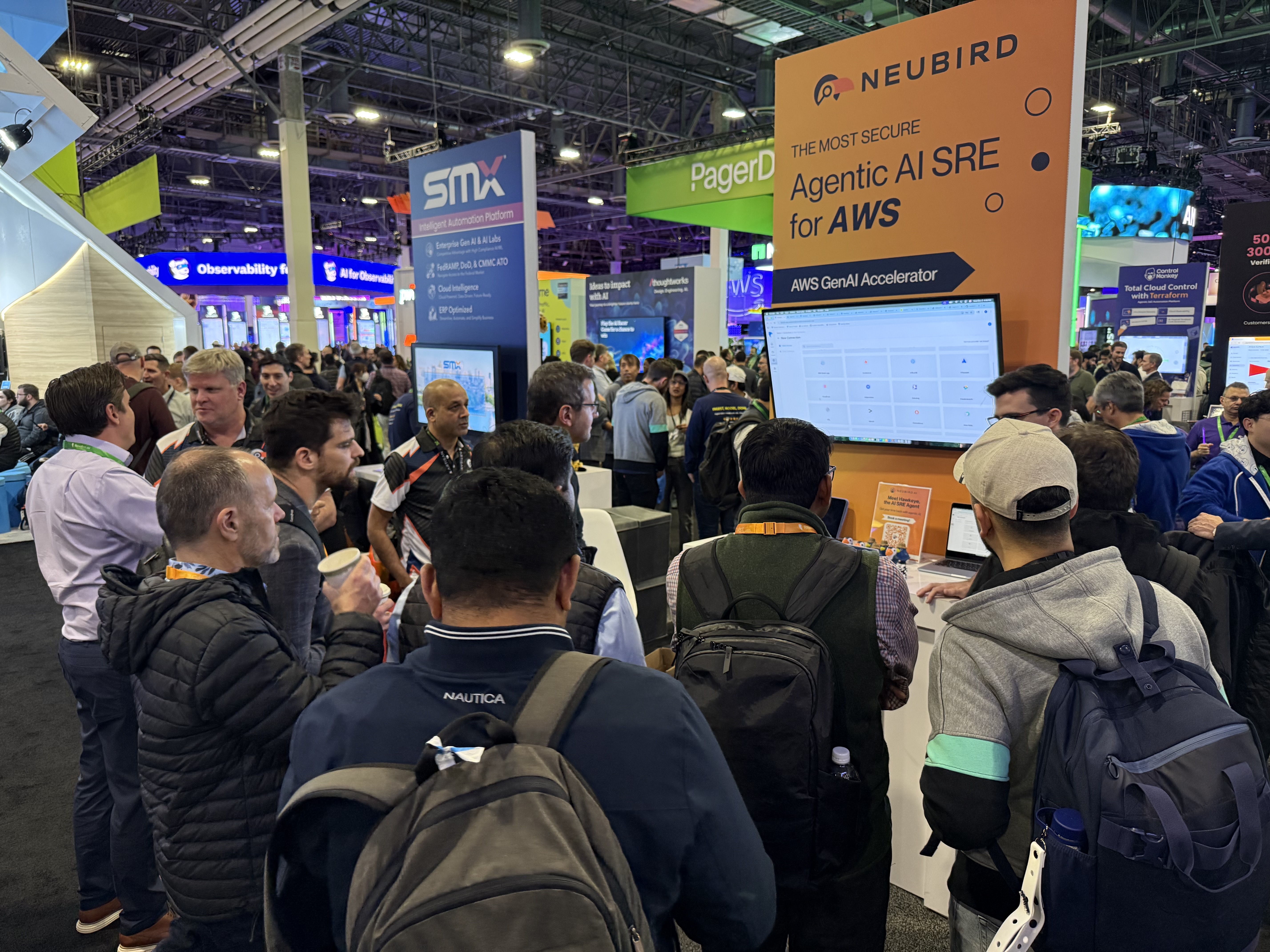
His public conversations keep returning to these details. At AWS re:Invent in December 2025, he discussed context engineering and collaboration across systems. A November podcast conversation covered access control, earning trust for autonomous agents and versioning agent behavior. These are the procedural concerns that sit underneath a seemingly simple promise to make operations faster.
NeuBird’s financing has given that work room to continue. Mayfield led its $22 million seed investment in April 2024. In April 2026, the company announced a further $19.3 million round led by Xora Innovation, bringing its stated total capital raised to $63.8 million. Funding is a measure of backing; the engineering task remains getting the investigation and the permissions right.
The next version remembers
On October 14, 2026, Rao announced general availability of NeuBird’s Agentic Reliability Center, or ARC, beneath its Production Ops Agent. The framework organizes the work around accessing evidence, remembering what has been learned and serving people and other agents within defined controls. It queries telemetry where it lives and retains verified conclusions and remediation patterns.
The proposal is that an organization should benefit from having solved a problem before. It also makes authority configurable: an agent may suggest a response, prepare a recommendation or take permitted action, with human authorization for critical production changes. For Rao, the next stage of the AI colleague involves institutional memory and a clear chain of responsibility.
Away from the company, Rao has spoken about travel and family life; he is married and has two children. Those details sit beside a professional record full of operating systems, storage layers and technical demonstrations. The scale of the machinery has grown since BASIC, while the activity remains recognizable: making software do something useful for a person.
The early chess program tried to calculate enough moves to win. NeuBird faces a different test, one played inside systems that keep changing while the investigation runs. Rao’s latest wager is that software can take on more of that detective work, remember what it discovers, and still leave someone clearly accountable for the next move.