The least glamorous part of artificial intelligence is everything around the intelligence. A model can draft an answer in seconds. Inside a bank, factory or retailer, however, that answer still has to find trustworthy data, pass through a permissioned doorway, trigger the right system, leave an audit trail and survive the night shift. IWConnect has spent two decades learning that surrounding work. Now it is packaging the lessons into an AI business.
The privately held technology company began in Bitola, North Macedonia, in 2004. Founder and managing partner Aleksandar Memca has described returning to the city to create opportunity around its technical talent. The early scene was modest: a few programmers in a ground-floor room, sharing a dial-up connection and competing for international work against far larger outsourcing markets.
By the company's account, the team passed 50 people in 2007, 100 in 2016 and 200 in 2021. Today IWConnect says it employs more than 300 people across North Macedonia, Serbia, the Netherlands and the United States. Bitola remains its headquarters. The geography matters because the company's story is partly about exporting difficult engineering work from a city rarely placed on enterprise software's familiar map.
01. The plumbing is the proposition
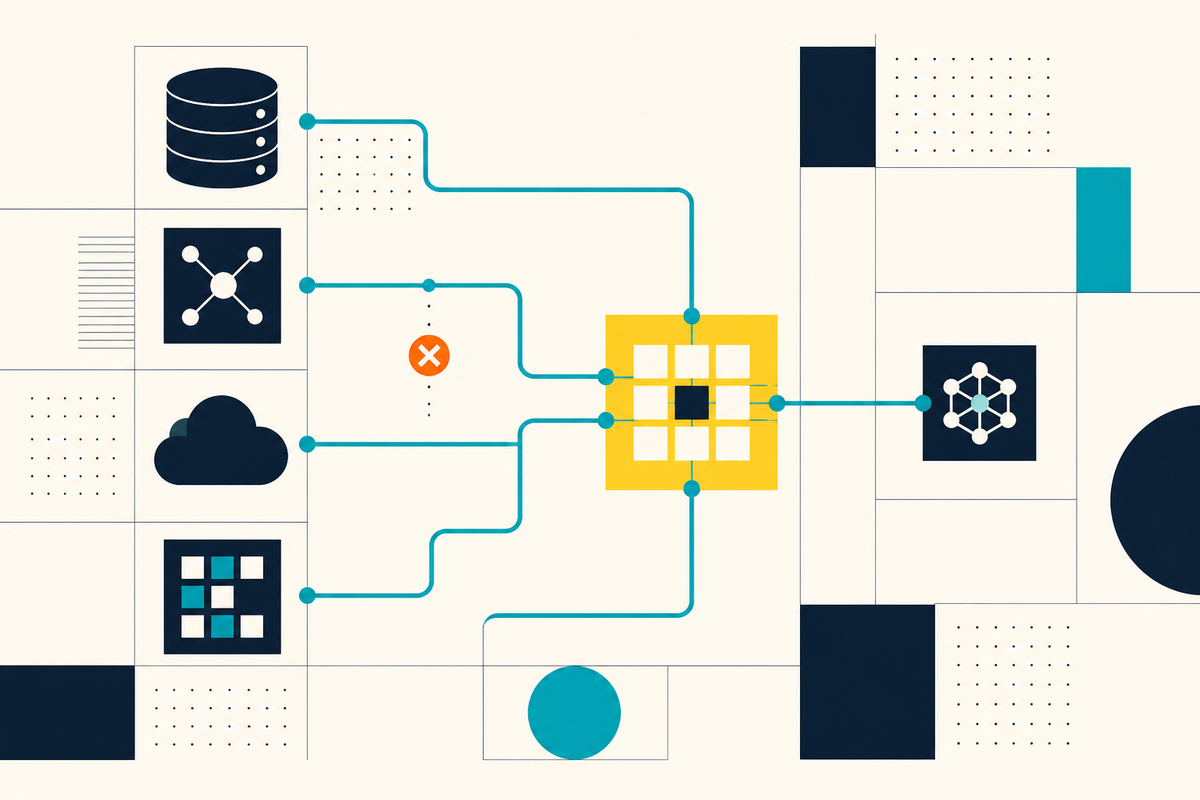
IWConnect is easiest to understand as four practices arranged in sequence. First, an AI Center of Excellence helps organizations choose use cases, set governance and move experiments toward production. Second, data and integration teams connect applications, APIs, event streams and warehouses. Third, application engineers build or modernize the software employees and customers touch. Fourth, cloud and managed-services teams operate the result, including 24/7 monitoring and support.
That sequence separates IWConnect from a pure AI studio. It is willing to start below the model, where data definitions disagree and decades-old applications refuse to cooperate. The company works across SnapLogic, MuleSoft and Boomi for integration; Snowflake and Databricks for data; Java and .NET for applications; and major cloud and model providers. Its stated position is vendor-agnostic: use what fits the client's stack and preserve the option to change later.
The problems arrive in combinations. A retailer does not merely have an error-classification problem; it has noisy alerts, several integration owners, inconsistent labels and customers waiting behind the failure. A manufacturer combining acquisitions needs more than a new warehouse; it needs lineage, common definitions and a repeatable way to bring the next plant aboard. A bank may have a fast decision model trapped behind slow calls to seven systems. IWConnect's pitch is that solving the whole chain produces a business result where optimizing one component does not.
This is sold as B2B consulting, engineering and managed responsibility, not principally as a self-serve software subscription. A client may hire a team for a data platform, application build or cloud migration, then retain IWConnect to operate the environment. Proprietary products and accelerators shorten delivery, but the people, implementation and ongoing service remain central to the commercial relationship.
For a buyer, the practical attraction is fewer contractual seams. When a pipeline fails after an application release, the integration provider cannot simply point at the developer while the cloud operator points at both. IWConnect can own more of that boundary. The counterweight is dependence on one services relationship, which makes architecture portability and documentation especially important. Its public emphasis on open choices and generated documentation is therefore more than a technical preference; it answers a commercial concern.
02. Agents raised by delivery teams
The product list reads like a roll call: Argus, Pete, Robin, TRYche, ThemisData, PrismAI, Lumin Data and Alex. The names are friendlier than their assignments. Pete automates SnapLogic documentation, dependency diagrams, compliance reports and code review. Argus correlates monitoring alerts, deployments and topology, then produces a structured incident briefing. Lumin Data puts a semantic layer between a business question and the conflicting definitions buried in ERP, CRM and warehouse systems.
TRYche is pitched as a role-aware agent framework for work that crosses several systems. A vacation request, for example, can require a policy check, a calendar lookup, an HR form and a manager's approval. The agent coordinates the steps rather than merely telling an employee which tabs to open. Robin addresses software delivery. ThemisData handles data governance. PrismAI surfaces delivery risk and knowledge concentration.
The important wrinkle is how IWConnect says these agents began: as answers to problems inside its own engineering, data and operations work. They are used in delivery and offered as managed services. The client buys an outcome while IWConnect deploys and runs the agent. That model trades the clean margins of seat-based SaaS for something enterprise buyers may value more - one party accountable when the software meets an eccentric internal system.
“120 sprints. 100% delivery. No exceptions. IWConnect gave us the discipline to make that possible.”Ron van Wieringen, Delivery Manager at Twycis
Humans remain visible in the design. Argus can rank likely causes, but engineers make the final call. A governed invoice demonstration pauses for approval before anything is sent. In regulated or high-cost workflows, this is more convincing than pretending autonomy is free. The agent handles search, correlation and repetitive steps; a person keeps authority over the irreversible moment.
03. Customers buy fewer handoffs
IWConnect targets enterprises in finance and banking, telecom, energy, retail and manufacturing - industries where an integration failure can become a customer complaint, a stopped workflow or a compliance problem. Tata Chemicals and the Dutch software and consulting company Twycis appear publicly in testimonials. Other case studies name the sector and outcome while keeping the customer anonymous.
In one European banking engagement, seven back-end systems were connected through a SnapLogic layer. IWConnect reports that approvals fell from days to under 30 minutes, with 99.5 percent-plus integration uptime. A manufacturer consolidated post-merger data into a governed Snowflake foundation and integrated new data five times faster. A retailer used a self-learning classification pipeline to route recurring integration errors, reaching 90 percent automation and 90 percent accuracy in 30 days.
These numbers are useful because none measures how clever a model sounds. They measure elapsed time, uptime and work removed. That is the level at which a chief information officer can defend a budget. It is also where IWConnect's wide service catalog makes sense: a result can require an integration specialist, data engineer, application developer and support operator in the same chain.
04. A crowded middle, used deliberately
The company sits between global consultancies and software vendors. Accenture, Capgemini, Cognizant, EPAM and Endava can all sell transformation and engineering at scale. Specialist partners can go deeper on a single integration or data platform. Internal teams can build around their own systems, while agent startups promise faster deployment around one narrow job.
IWConnect's answer is breadth without insisting on one vendor, paired with a nearshore engineering base and more than 20 years of integration history. Its partner list includes SnapLogic, Microsoft, Salesforce, Atlassian, Xray and Aerospike. It says it became a SnapLogic partner in 2015 and received the company's Americas Technology Partner of the Year recognition in 2024. The Aerospike partnership, announced that July, added a real-time database option for high-volume systems.
Not quite an outsourcer, not quite SaaS: IWConnect is a systems integrator and application engineer moving upward into managed AI products, while using the same delivery teams to connect and operate them.
The breadth also creates a test. Buyers have to believe one midsize provider can maintain depth across integration, data, applications, cloud and AI. Services revenue can be less repeatable than software licensing, and every managed engagement risks becoming bespoke. IWConnect's accelerators are an attempt to answer that problem. Its library of templates, pipeline patterns and reusable components turns work from previous projects into a head start on the next.
This places the company in a useful but demanding market position. It can enter through one painful integration, a cloud bill or an AI readiness exercise, then expand across the stack as trust grows. It does not need to displace a client's major platforms to increase its role. But every expansion must be earned through delivery, and competitors can attack from either side: larger firms with broader procurement access, or focused vendors with a cleaner product story.
05. Bitola remains in the code
IWConnect's culture language is unusually local for a company selling global infrastructure. Its published values emphasize adventurous growth, integrity, family and fulfillment. The company runs education and leadership programs, sponsors a chamber orchestra, organizes internal games and has supported public sports and playground projects around Bitola. In 2025 it held an AI-focused internal hackathon, another way to turn employee experiments into delivery tools.
Memca's origin story makes the civic thread less ornamental. He has said the point of returning was to create value for the community that shaped him. Twenty-two years later, the firm is still headquartered in that community, even as it operates offices in Amsterdam and the United States. The result is a company that treats talent development as both supply chain and social contract.
Its next chapter depends on whether enterprises want AI delivered this way. The market is flooded with impressive demonstrations and crowded with consultants adding “agentic” to familiar decks. IWConnect has a more grounded claim: it already knows the systems, failure modes and operational chores agents must navigate. Its strongest product may not be any single agent. It may be the ability to carry a workflow from the first whiteboard, through production, into the years when somebody must answer the alert.