Paper has an excellent interface and a terrible search function. Steven Chan ran into that mismatch while studying mathematics in Australia: equations accumulated, notebooks became messy, and loose pages disappeared. The first iPad suggested a way out. The available software did not feel right. So he started making his own.
Goodnotes launched in 2011. Fifteen years later, the company’s press page reports more than 25 million monthly active users. The original transaction remains easy to understand: keep the freedom of handwriting, add the conveniences of a computer. Write a formula, circle a troublesome paragraph, move a sketch, then find the page again without excavating a backpack.
The new transaction is more ambitious. Goodnotes wants to help turn those marks into meeting summaries, diagrams, study material and shared work. It is joining a crowded race to make AI useful inside everyday software. Its advantage may depend on remembering something less fashionable: people already have reasons to like their own handwriting.
A notebook with a search bar
Chan was a University of Queensland maths student when he began building the app. Goodnotes describes its beginnings as a one-person project, bootstrapped and profitable from day one. That origin matters because the problem was painfully specific. A page full of equations is awkward to type, but a box full of handwritten pages is awkward to use.
The software joined those two worlds. Users could handwrite on digital paper, search their writing and organize documents in a library. PDF annotation made existing reading material part of the same workspace. The customer did not need to abandon the habits of marking up a handout or sketching in the margin.
Apple named GoodNotes 5 its 2022 iPad App of the Year. Its award profile singled out the Apple Pencil experience and the ability to customize paper and drawing tools. Those details explain the appeal better than an abstract productivity promise. A fountain pen, a brush and a ballpoint are choices people understand before anyone explains an AI model.
“We are more than a note-taking tool.”
Steven Chan · Apple’s 2022 App Store profile
That ambition predates the current AI push. The business had raised a reported $6 million seed round from Race Capital in 2020. Goodnotes was already thinking about what happens after a note is written: how it gets found, shared and used. An archive is more valuable when somebody opens it again.

The dots took nearly two months
One of the most revealing accounts of Goodnotes’ work concerns a background pattern. When the company built its infinite Whiteboard canvas, a single layer of dots became too crowded or too sparse across a zoom range of 5 to 400 percent. The thing that failed first was the visual reference meant to keep the page understandable.
The team put a debugging menu inside the app and adjusted dot sizes, spacing and layer changes in real time. Goodnotes says finding a comfortable result took nearly two months. It also moved the minimap and zoom indicator together after finding their placement in opposite corners disconnected. Testing made the minimap optional.
There is a practical lesson here for product builders: prototype the sensation users must live with. A static design cannot tell you how zooming feels. The notebook company spent time on navigation because unlimited space becomes a nuisance if you cannot tell where you are.
Nearly two months refining the dots.
One less thing for the user to think about.
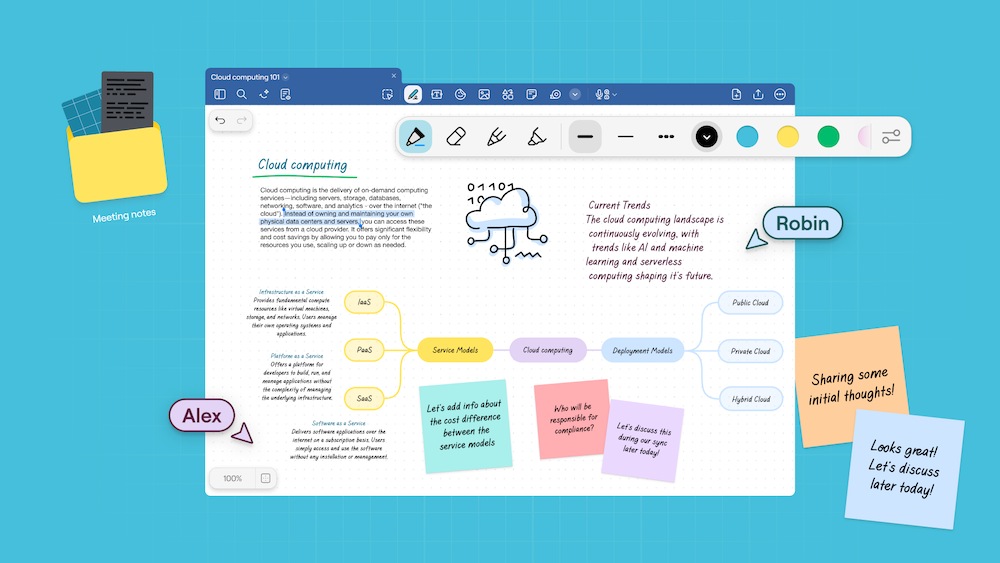
Whiteboards and Text Documents arrived in the September 2025 product launch. The company dropped the version-number progression rather than calling the release Goodnotes 7. A notebook, an open canvas and a structured document now supplied three different starting points. Someone planning a lesson or a project no longer had to squeeze every kind of thought into a page-shaped container.
An architect walks into a notes app
Goodnotes’ customers include students, journalers, teachers and professionals. The category becomes more interesting when somebody uses the software for a job it does not appear to have been named for. In an August 2026 customer story, architect Steve Giannetti described using Goodnotes to draw houses.
His process starts with imported grid paper. He draws plans freehand, selects and shifts elements, and uses an external image generator, Google’s Gemini, to visualize a sketch. He then brings the resulting image back alongside the drawing for a client conversation. Goodnotes supplies the drawing surface and the place where the work stays together.
Giannetti’s explanation is disarmingly plain: “The thing that makes it great is it’s so simple.” Readers can copy the sequence - sketch, visualize, annotate - without mistaking an illustrative rendering for a construction specification. The useful ingredient is the practitioner’s judgment about what the drawing means.
For students, the equivalent benefit is continuity. A lecture slide can become an annotated page; a recording can sit with the notes taken during it. Goodnotes’ 2026 updates added control over how handwriting appears during audio playback. The point is to return to the moment that needs attention, with more context than a lone sentence provides.
The teacher needs to see the working
Education creates a different problem from personal note-taking. A teacher needs to see what a roomful of students is doing. Goodnotes Classroom, launched in 2024, introduced a Class Navigator for viewing and annotating students’ pages in real time, plus tools for grouping similar answers and marking by question.
That changes the unit of attention. Instead of opening one child’s entire assignment, a teacher can compare the class’s responses to a particular problem. The teacher can change the AI’s answer groupings and adjust grades. Ying Wa College and Caritas Wu Cheng-Chung College supplied named educators’ accounts in the launch material.
In March 2026, Goodnotes announced that Classroom would move into the main app as Goodnotes Education, free for K-12 schools. It gave users an August 31 migration deadline. The stated reason was simplicity: students and teachers could occupy the same application as their school, university and personal work evolved.
Free software does not remove the practical requirements of a digital classroom. Devices, teacher preparation and access still shape whether the arrangement works. A live view of students’ pages is useful only when those students can actually participate. That is a deployment question, not a feature a school can tick off after a demo.
The pen now has company
Goodnotes’ AI expansion included buying expertise. In January 2024 it acquired Dropthebit, the Korean company behind Traw, which organized meeting, lecture and video material into summaries. The acquisition brought a team experienced in audio and video into a business historically associated with ink.
The design challenge is how much assistance to show. In its November 2025 account, Goodnotes said research revealed a recurring pattern: people seek information, make sense of it and share what they have learned. It designed floating, sidebar and window interfaces to fit different amounts of interaction.
Users also wanted to know what the AI had done. Previewing changes before insertion, showing steps and distinguishing AI contributions became part of the design. These choices make an assistant easier to supervise. A summary that looks finished can still need correction; the interface should leave room for that work.
By the April-June 2026 update, Goodnotes was also reporting a Claude connector and expanded Smart Ink editing on Windows, Android and web. The latter lets handwriting reflow as its width changes. This is a more distinctive proposition than another chat box: treating handwriting as material that can be rearranged without first asking its author to type it all again.
Digital paper, recurring bills
The current business combines a free tier, subscriptions, organizational plans and stationery sales. Listed US-dollar prices checked on September 8, 2026 put Essential at $11.99 a year and Pro at $35.99. Teams costs $120 per seat annually; Enterprise uses custom pricing. AI Pass adds $9.99 a month.
AI Pass is separate: $9.99/month. Regional pricing varies.
The detail to inspect is synchronization. Essential provides access across platforms, but Pro includes Goodnotes Cloud library sync between Apple and non-Apple devices. Apple-only Special Edition offers a one-time purchase where available, with different limits. Choosing a plan starts with the devices and workflows a person actually has.
Stationery adds a more cheerful kind of commerce. Goodnotes invested $1.9 million in WeBudding in 2023. In January 2025, a collection developed with WeBudding brought Hello Kitty, Cinnamoroll and My Melody planners and stickers into its marketplace. A digital notebook can be a working document and a small act of self-expression. Those customers may care as much about the cover as the summary button.
More features, the same old test
Goodnotes does not own handwriting or AI. Notability also offers handwritten notes, transcription and AI study tools. Microsoft OneNote combines digital ink, typed notes, collaboration and its Microsoft 365 connections. Goodnotes’ position rests on the combination: a familiar writing surface, adaptable documents and an established stationery culture.
Its own expansion supplies a useful boundary. Goodnotes Lite launched for mainland China in June 2026 with local infrastructure and payment options. At launch it had separate accounts and data, with no migration or synchronization between Lite and the global app. One brand did not mean one interchangeable service.
Inside the company, public careers material emphasizes ownership, user feedback and learning, supported by flexible work and development budgets. The dot-grid story makes those claims easier to assess than a values poster does. Somebody had to keep adjusting a small thing until it stopped bothering people.
The next version of that test is larger: whether a notebook can hold AI, meetings, lessons and diagrams without making a quick thought feel like administrative work. Goodnotes earned its place by helping people put the pen down and begin. Every addition now has to earn its space on that page.
Keep a page open
Goodnotes website · Plans · The GoodBlog · Newsroom
LinkedIn · X · Instagram · Facebook · GitHub · TikTok
▶ Watch: Meet the new Goodnotes ↗▶ Watch: Building Whiteboard ↗