A Golf Swing, Broken Into 4,000 Data Points
The company turned a country-club basement experiment into 250-plus training centers and a database of 14 million golf swings. Its bet: that the fastest way to fix your slice is to measure it.
Golf is the rare hobby where sincere effort makes almost no difference. You can hit a thousand balls, take advice from three friends, watch every YouTube tip, and still stand on the first tee with the same slice you had a decade ago. GOLFTEC's entire business rests on a plainer explanation: you cannot fix what you have never actually measured. So it measures - about 4,000 data points on every swing a student takes.
Headquartered in Englewood, Colorado, GOLFTEC is the world's largest golf-instruction and club-fitting company. Not by a slim margin. It runs more than 250 training centers across eight countries, employs over 1,000 certified personal coaches, and teaches roughly two million lessons a year. The pitch to a nervous beginner and a frustrated single-digit handicapper is identical: sit in a bay, swing a club, and let the technology tell you what your body is really doing.
01 / OriginsThe basement that became a franchise
The company started in 1995 with a borrowed idea. Joe Assell, a Mississippi State graduate of the PGA's golf-management program, was interning at Cherry Hills Country Club in Denver under head professional Clayton Cole. In the clubhouse basement, Cole had rigged up an early computer-based system for teaching the swing. He did not have time to turn it into a business, so he offered Assell the chance to try. Assell, Cole, and Mike Clinton launched the venture - first under the name Driving Obsession, rebranded to GOLFTEC in 1997.
The premise has not changed in thirty years, even as the hardware has. Traditional lessons run on the instructor's eye: a pro watches your swing, forms a hunch, and offers a cue like "stay down through it." GOLFTEC's founders bet that golfers would improve faster if the hunch were replaced with a number, and if that number could be shown back to them on a screen, compared against players who do it well.
02 / The MachineOptiMotion, and a swing with no sensors
The centerpiece today is OptiMotion, released in 2021 and now used in every GOLFTEC lesson. It is a 3D motion-capture system, but with an important twist: it is markerless. There are no dots taped to your joints, no sensor vest, no wearables of any kind. Two high-speed HD cameras and a layer of AI watch you swing and reconstruct your body in three dimensions - mapping hip sway, shoulder tilt, spine angle, hip and shoulder turn, and the path your hands travel.
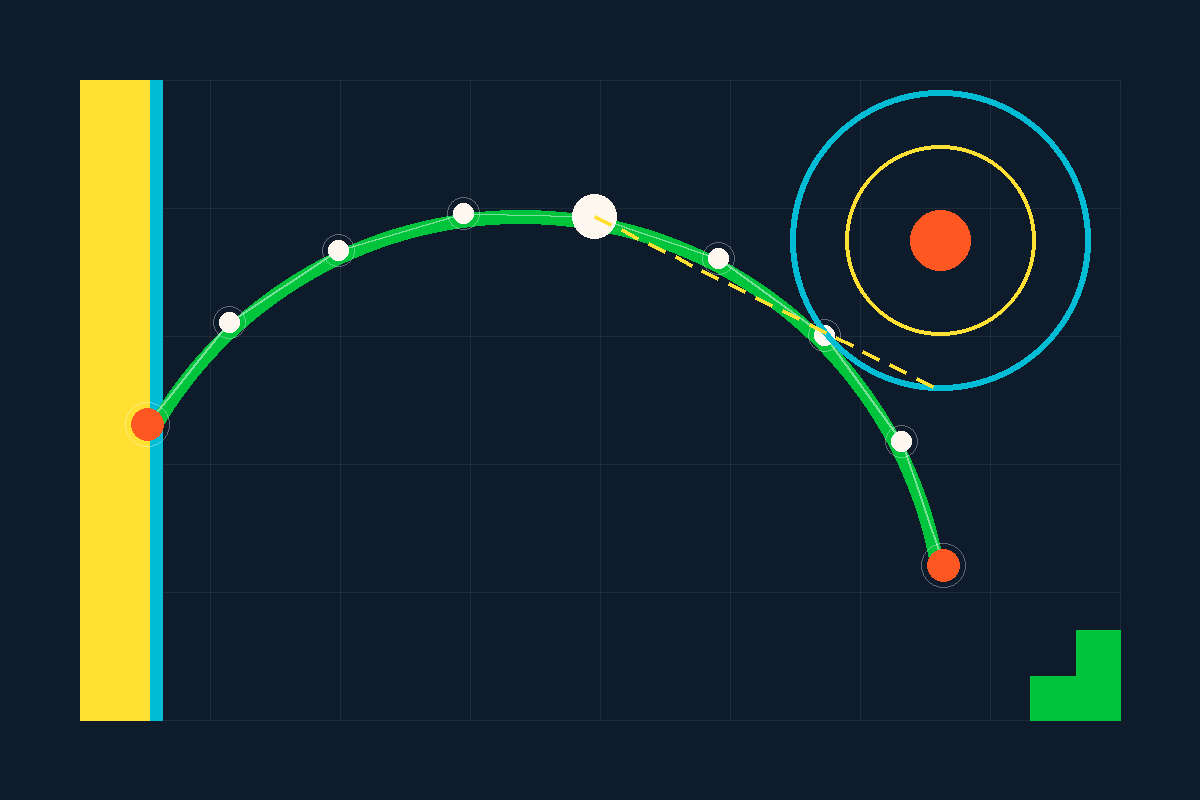
Each swing produces more than 4,000 data points, overlaid directly onto video so a coach can point at the exact frame where things go wrong. The measurements are then compared to a database of PGA Tour averages, which turns a vague feeling ("I came over the top") into a specific, visible gap. It is the same class of technology that television networks now use on air: GOLFTEC's OptiMotion has fed CBS broadcast swing analysis at Signature events, the PGA Championship, and the Masters. The unusual part is that an amateur gets the same tool in an ordinary paid lesson.
That study, called SwingTRU and unveiled in 2016, is the intellectual backbone of the method. By analyzing tens of millions of swings and millions of lessons, GOLFTEC argued that a handful of positions - not the dozens of things golfers fuss over - correlate most strongly with actually shooting lower scores. The company reports that the large majority of its students improve, dropping on average around seven strokes. Those are the company's own figures, drawn from its own data, and worth reading as an internal result rather than an independent audit. But the underlying logic is hard to argue with: coach the few things that move the needle, ignore the rest.
03 / What You BuyFrom a $99 evaluation to a fitted set
A typical relationship starts with a Game Evaluation, priced around $99, which blends coaching, measurement, and real shot scenarios into a baseline. From there, golfers buy lessons individually or in 3, 6, and 12-month packages, taught one-on-one in a bay or out on the course. GOLFTEC also fits clubs - starting around $95 - using launch monitors and shaft optimization across Callaway, Mizuno, PING, TaylorMade, and Titleist, and it sells the equipment it fits. Members can rent practice bays; a companion app stores swing replays, stats, and on-course GPS tools.
Illustrative view of the customer path, not to financial scale.
Behind the storefront is a mix of company-owned and franchised centers, which is how a coaching business scales to hundreds of locations without stretching a single payroll across the planet. The revenue is diversified - lesson packages, evaluations, fittings, memberships, and retail - and, since 2022, hardware. That year GOLFTEC acquired SkyTrak, the consumer launch monitor and home-simulator brand, its first meaningful acquisition in 27 years. The move was quietly strategic: the largest golf-instruction company bought its way into the measurement hardware that feeds its own coaching, and formed a parent entity, GOLFTEC Enterprises. Chris Koske, promoted to Chief Marketing Officer in January 2025 after a career at Callaway, Odyssey, and SuperStroke, now markets both brands.
04 / The RoomWho actually shows up
The customer is broader than the stereotype of the country-club regular. GOLFTEC's centers are built for the golfer who is a little embarrassed - the beginner who has never had a lesson, the mid-handicapper who has plateaued, the parent signing up a junior. The indoor bay is part of the appeal: there is no gallery, no wind, no lost ball, just a screen, a coach, and a number that does not care about your ego. For someone who has quietly avoided instruction for years, that privacy is the product as much as the technology is.
At the other end sit committed players chasing a single digit, plus corporate and charity event clients using the bays for group outings. GOLFTEC says it has helped improve more than 1.8 million golfers, and the range within that number - first-timers to near-scratch - is the point. The method scales down and up because it does not depend on the coach's personality. Two people can walk into two different centers on two continents and get the same diagnostic language: here is your hip sway, here is the Tour average, here is the gap.
05 / The FieldWhere it sits, and who it is not
GOLFTEC does not really compete with a rival chain of the same shape, because none exists at its scale. Its true competition is fragmented: the independent PGA teaching professional at the local range, regional academies, and the growing shelf of measurement companies - Trackman, Foresight Sports, Full Swing, Uneekor - that sell the launch monitors and simulators an ambitious golfer might buy instead of booking a lesson. GOLFTEC's answer to all of them is the same one it started with: package the technology with a trained human coach, and back both with a swing database no competitor can easily replicate.
That database is the real moat. Fourteen million swings, benchmarked and structured over three decades, is not something a new entrant can raise money and buy. It is the accumulated exhaust of running the business itself. Japan's Golf Digest Online recognized the value early, taking a majority interest in 2018 and funding the expansion that followed - into New York City in 2024, and across Canada, China, Japan, Singapore, Hong Kong, South Africa, and Dubai.
The recognition has followed the numbers. GOLFTEC has appeared on the Inc. 5000 list for 14 consecutive years. Co-founder Joe Assell was named PGA Executive of the Year in 2022 and inducted into the Colorado Golf Hall of Fame. Dozens of its coaches land on Golf Digest's state-by-state best-teacher lists. In 2025, the company marked its 30th anniversary by parking OptiMotion swing bays outside the gates of the PGA Championship, letting fans get the same read on their swing that the pros inside were getting on theirs. Thirty years on from a country-club basement, that is a fair summary of the whole enterprise: take the measurement the professionals use, and hand it to everyone else.