Small-business software has a domestic problem. Everyone lives in the same house, but nobody speaks at dinner. The customer database sulks in one room. The marketing platform makes noise in another. Email, accounting and analytics pass on the stairs without making eye contact. Giovanni Farese has spent the better part of his career trying to get them around one table.
His current attempt is Webidoo's proposed AI operating layer, an umbrella meant to connect the tools, data and actions that a smaller company already has. The phrase sounds architectural because the problem is architectural. Farese argues that the average small business runs about 20 tools that do not communicate well. His response is pointed: Webidoo is not trying to become tool number 21.
That distinction contains nearly the whole story. Farese did not begin as a machine-learning researcher or a teenage programmer. He studied international law at the University of Sannio, then moved through regional sales, sales direction, teleselling, call-center operations and executive management. By the time he co-founded Webidoo in 2017 with Daniel Rota and Egidio Murru, he had spent roughly a decade watching companies translate ambition into workflow. Translation is usually where the glamour goes to die. It is also where businesses discover whether technology works.
An operator before a founder
Farese's early career reads less like a founder mythology than a tour of the machinery. He held roles at KLIK and Campaniacom, led operations and telephone-sales functions at 3g, became chief operating officer at axélero, and later served as general manager at MeglioQuesto. He also joined the board of Innova.Digital and completed a management program at SDA Bocconi in 2017.
The mixture matters. Sales shows where promises begin. Operations reveals where they break. Law trains attention on structure, obligation and the unpleasant usefulness of precise language. Farese eventually brought these strands to a market with a persistent disadvantage: small and medium-sized businesses were being offered sophisticated digital tools without the time, staff or integration needed to make them useful.
Webidoo's first mission could fit on a shop sign: simplify access to technology. The company started by helping smaller firms with websites, ecommerce, online advertising and digital presence. In Farese's own account, he and his co-founders wanted to support small businesses through digital transformation after years spent inside national and international ICT companies. The ambition was broad, but the customer was specific.
Simplify access to technology.Giovanni Farese on Webidoo's mission
This was not simply a distribution problem. A tool can be affordable and still be inaccessible. Someone has to configure it, connect it, understand its reports and decide what to do next. Webidoo gradually moved from providing digital services toward building products that absorb more of that work.
One customer problem, three delivery models
The shop where the future had price tags
In 2021, Webidoo opened a technology experience store in Milan's Portanuova district. It was a revealing detour. Farese could be found among drones, smart devices and consumer gadgets, presenting a place where people could touch technologies that often arrived wrapped in abstraction. He called the idea “Onlife,” a bridge between online and offline experience.
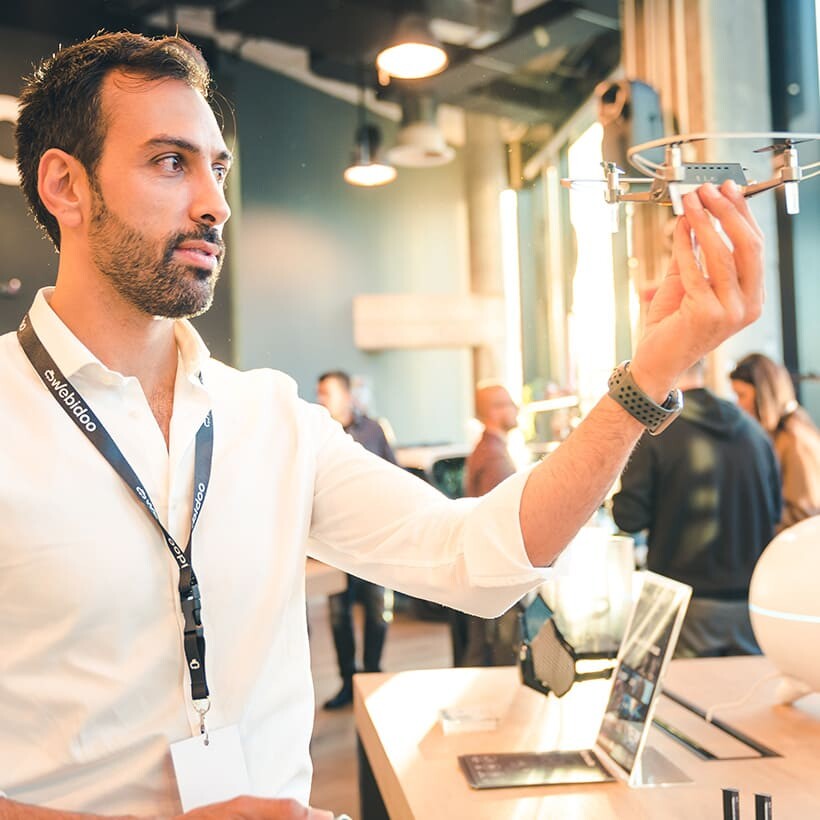
The store displayed the same instinct as the later software. Farese was interested in the last mile between novelty and use. A drone under glass is a curiosity. A drone held, tested and explained starts to become a decision. Webidoo's team scouted products across Europe, Asia and the United States, then helped brands present them to the Italian market.
The retail experiment did not become the center of Webidoo's identity, but it clarifies Farese's taste. He likes technology with fingerprints on it. His public comments on AI return repeatedly to tasks, time and measurable gains. Abstract intelligence is less interesting than an email answered, a report synthesized or a follow-up completed.
From dashboards to delegated work
Webidoo's product sequence mirrors the quickening pace of business AI. Jooice gathered digital-marketing activities into one hub. Welpy, launched in 2023, became a conversational marketing assistant aimed at content and skill-building. Groow arrived in 2025 with AI agents designed to take on repetitive work across a small company.
The company describes Groow as human-centered. Farese's version of that idea is practical rather than sentimental: people should recover time for strategy, innovation and relationships while software handles routine analysis, drafting, classification and administration. Internal research published by Webidoo reported estimated productivity improvements above 40 percent for small businesses integrating AI, with digital marketing above 43 percent and professional services above 42 percent.
The numbers are company research, not a universal law. They are more useful as a map of where Farese thinks value appears first. Marketing contains repeatable, text-heavy tasks: keyword analysis, content drafts, email replies, ticket classification and automated follow-up. Professional services contain document review, summaries and administration. AI enters through the chores, then earns permission to approach the judgment.
We're not building tool number 21. We're building the layer that finally makes them all work together.Giovanni Farese, May 2026
Chicago in the middle
Webidoo's American move adds another layer to Farese's story. The company established US operations with Chicago as a headquarters. The choice avoided the standard founder pilgrimage to a coast. Farese has explained it through customers and logistics: Chicago has a substantial community of small and medium-sized businesses, access to talent and institutions, and a time zone that lets a team reach both US coasts without becoming nocturnal.
It also suits a company born in Milan but learning to design globally. Farese now describes his work across American, European and Middle Eastern teams, each with different expectations and styles of communication. His conclusion is that global thinking must begin before expansion, when leaders design products and teams, rather than after the first international office opens.
He has cultivated the local side as deliberately as the geographic one. At one Chicago gathering, he and Webidoo hosted entrepreneurs for a home-cooked dinner without slides or a stage. The format was modest and strategically sound. Software travels quickly; trust still prefers a table.
A few years ago, Farese and colleague Federico Salvitti were walking through Times Square when they stopped near the Nasdaq tower. They took a picture and entertained the possibility that Webidoo might one day appear there. In 2026 they took another picture during a Webidoo event at Nasdaq celebrating the company's US expansion.
Farese uses the paired images to separate vision from execution. The first photograph held an idea. The second held the accumulated result of decisions made with incomplete information. Between them came a funding round in 2021, acquisitions, new products, overseas offices and the ordinary disappointments that rarely make it into a founder's camera roll.
His public writing can be brisk and exhortative: begin before perfect readiness, make mistakes, adjust, keep moving. Yet he also calls himself naturally impatient and admits that important outcomes took long stretches when progress seemed invisible. The tension is useful. Speed governs the next action. Patience governs the mission.
A larger round, the same customer
In May 2026, Webidoo announced a $25 million investment led by IXC3, a fund managed by Azimut Libera Impresa. Existing investors included 8a+ and TIM Ventures. The money was assigned to product and research, expansion in the United States and an acquisition strategy. The company presented its destination as an AI operating layer for small businesses.
Funding can encourage a company to discover new appetites. Farese's sharper challenge is to preserve the old one. Webidoo was founded to reduce the distance between a small business and useful technology. Nine years later, the tools are more capable, the vocabulary more fashionable and the capital larger. The small-business owner still arrives on Monday with too many tabs open.
Farese's career suggests that the next AI contest will not be settled only by model quality. It will be settled inside processes: which data can move, which action can be trusted, which task saves enough time to be noticed. He has moved from law to operations, from services to products, and from Milan to Chicago without wandering far from that ground.
There is a pleasing modesty in his ambitious pitch. “Superpowers” is the word he likes for what small businesses should gain. The mechanism underneath is less comic-book and more plumbing: connect the systems, remove the friction, let information reach action. Pipes rarely make the cover. When they work, everyone in the house notices.