An electric motorcycle is a splendid way to attract attention. A municipal work truck has to earn its keep. Between those two vehicles lies much of George Gebhart’s working life: a succession of batteries, motors, workshops and decisions about how to turn an interesting machine into something another person can depend on.
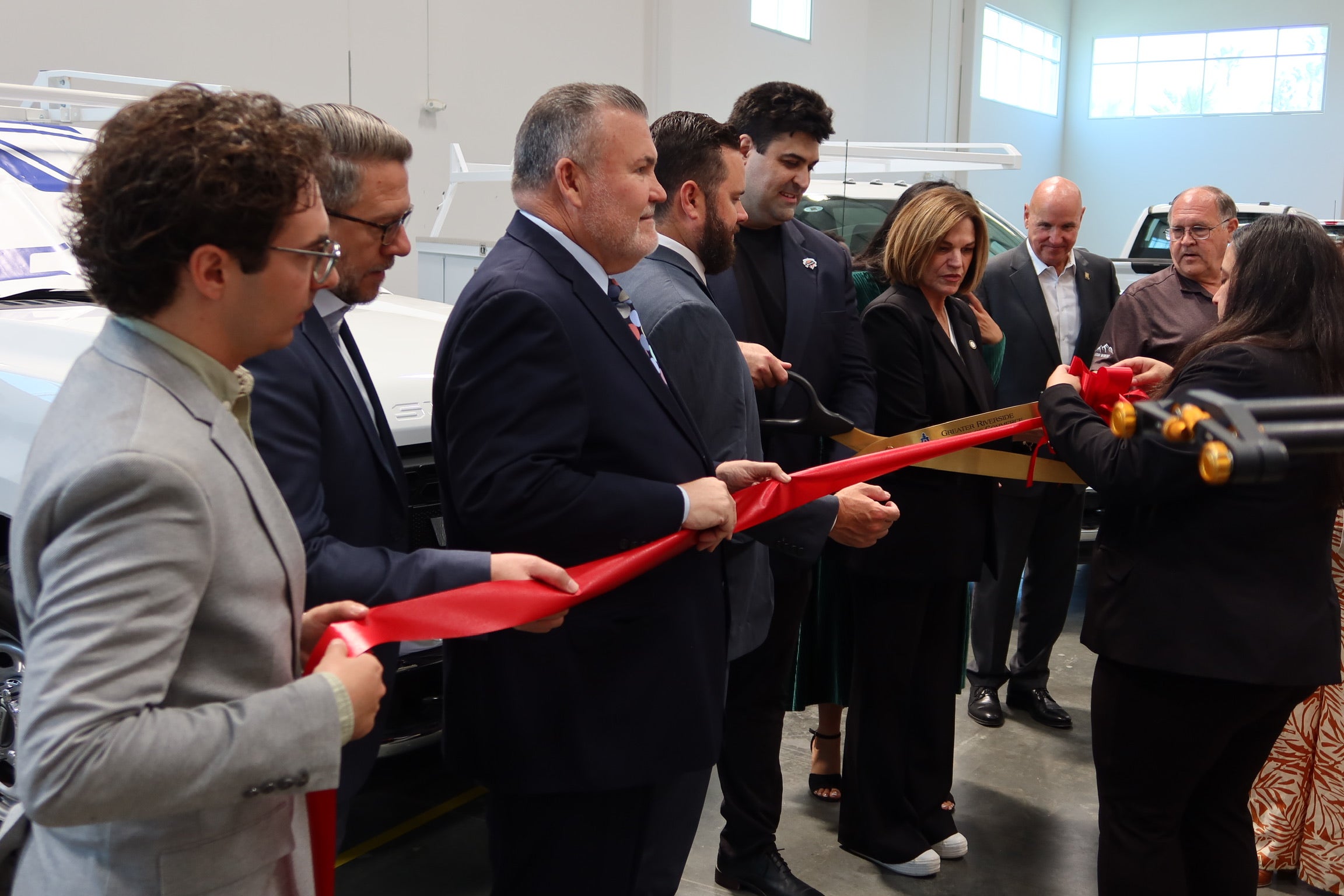
In June 2026, the City of Riverside became the first customer to take delivery of production Voltu3 trucks as Voltu Motor celebrated its California manufacturing headquarters. Gebhart, the company’s founder and CEO, had reached a particular kind of arrival. The customer was also the city hosting his factory. His technology would be going to work close to home.
The occasion supplied the customary ribbon and oversized scissors. The more interesting object was the truck behind them. Its job was to carry the company’s engineering out of a presentation and into a fleet. For Gebhart, whose early electric-vehicle work began in Argentina, it was another change of vehicle around a remarkably durable interest: controlling how electrical energy becomes useful motion.
A second beginning, in the backyard
In 2010, Gebhart assembled a team to build an electric motorcycle. Within months, the group had dissolved. That small failure belongs near the beginning of his story because it makes what followed easier to understand. The project did not proceed in a straight line merely because its founder had spotted a promising technology.
In 2011 he approached his brother Iván, a lawyer, who joined him. They began in the backyard of Gebhart’s home in Paraná, later establishing a workshop and building prototypes. The division of expertise was useful: an engineer could develop the machine, but a business needed other kinds of judgment too. The brother became a cofounder and early investor.
Gebhart was a bioengineering graduate of the National University of Entre Ríos. His work in robotics helped direct his attention toward electric propulsion. The transferable question was practical: how do the battery, electronics and motor cooperate? Once you are occupied with that question, the outline of the vehicle around them becomes a little less sacred.
By 2016, the brothers’ motorcycle had a name, Voltu V1, and their business was Reisender Electronic Technology. The machine combined electric propulsion with familiar motorcycle materials and forms. Steel, leather and a tubular frame gave the new technology something recognizably mechanical to wear. The future, apparently, could keep a decent jacket.
- 01 / PARANÁA backyard and a motorcycleEarly development with brother Iván, from 2011.
- 02 / POSADASManufacturing the componentsFactory inauguration in November 2018.
- 03 / RIVERSIDEA customer gets the keysFirst production delivery announced in June 2026.
The motorcycle was an introduction
Gebhart made an important distinction early. The motorcycle introduced the company; the underlying technology could serve other vehicles. In 2016 he described ambitions to supply batteries and propulsion for cars and other forms of transport. The visible product was two wheels. The less visible business was a collection of systems that could travel.
That helps explain why the later work truck belongs in the same story. A motorcycle and a utility pickup offer rather different pleasures. Underneath, both need energy storage, controlled power delivery and a way to recharge. Gebhart’s career has followed those components across applications, rather than remaining loyal to one silhouette.
There was a public-facing side to the engineering, too. He appeared among the speakers at TEDxRosario’s 2016 edition. In 2018, he and industrial designer Juan Maronese were scheduled to speak together at Universidad Gastón Dachary in Posadas. Building the technology involved explaining it, and explaining it brought him into rooms beyond the workshop.
A factory requires a different vocabulary
The Posadas plant was inaugurated in November 2018. The announced production lines covered motorcycles, energy-storage modules and energy management and motors for electric vehicles. At the opening, Gebhart also showed a small energy-storage product intended to provide electricity when the grid was unavailable. Motion was only one use for the system.
His discussion of Posadas was revealingly unromantic. He talked about the port, shipping costs, local technical schools and the workforce. The first employees would receive training, then help train the next group. It is a less glamorous account of entrepreneurship than an inventor sketching an idea on a napkin, and considerably closer to the work of opening a factory.
The questions were expanding. Who could assemble the product? How would it leave the building? Which skills existed nearby? Those questions would return in California. A motor can be designed on a workbench; producing it repeatedly makes the surrounding town part of the engineering problem.
Put the invention where the work is
The Voltu3 gives Gebhart’s current strategy a familiar shape. It is built on a Ford F-350 chassis, with Voltu’s battery and electrical systems. The choice puts the company’s technology inside a recognizable work vehicle. It also makes the proposition easy to picture: keep the utility of the pickup, change the machinery doing the pushing.
Voltu advertises a towing capacity of 17,000 pounds and payload above 4,000 pounds. These are company specifications, but they show the audience Gebhart is addressing. The prospective buyer has equipment to move and a workday to finish. A truck’s appeal becomes a matter of whether the necessary load arrives at the necessary place.
Charging is part of that proposition. Voltu’s advertised onboard system uses the propulsion inverter and motor windings for charging, rather than requiring a separate conversion system to do all the work outside the vehicle. Its battery modules use immersion cooling. Gebhart’s attention remains on the parts and their integration, even as the product has grown considerably larger.
Advertised towing capacity
Advertised payload capacity
Voltu3 manufacturer specifications. Capacity figures describe different measures and are not additive.
The customer gets a vote
By November 2024, Riverside and Voltu had announced an agreement bringing the company’s headquarters and manufacturing operation to the city. Riverside would receive 20 early vehicles for its utilities, streets and parks departments. That gave the venture something more concrete than a welcoming ceremony: an identified customer with identified jobs.
There was a broader ambition behind the location. The initial announcement described a manufacturing and research facility, a substantial production ramp and hundreds of prospective jobs. Gebhart linked the move to an interest in changing energy generation and consumption. In practice, those ambitions started with the rather specific business of supplying municipal trucks.
When Voltu held a demonstration for prospective buyers in March 2026, Riverside Public Utilities general manager David Garcia described having been skeptical about whether the truck could meet his team’s needs. A test drive helped persuade him. That is a useful scene in Gebhart’s story because it gives the person purchasing the technology a mind of his own.
Founders tend to receive plenty of opportunities to explain why their invention matters. A fleet manager can answer by asking for the keys. The demonstration brought those two kinds of knowledge together: the builder’s knowledge of what the system should do and the customer’s knowledge of what the work requires.
The engineer keeps the CEO’s chores
Gebhart presents himself as both a technologist and the person responsible for making the business function. Discussing the American expansion in 2025, he described selecting executives himself and keeping fundraising among his own responsibilities. His engineering background has not removed the need to persuade investors and organize the next stage of the business.
“I take care of funding myself as a CEO.”
GEORGE GEBHART / EXPERIENCED VOICES, 2025
His route into the United States also involved help. Plug and Play introduced him to investors, corporations and the startup environment. UC Riverside helped connect Voltu with regional resources and partners. Those relationships make the move look less like a lone founder crossing a border and more like the patient construction of a working network.
That fits the earlier pattern. His brother supplied expertise he did not have. Local schools mattered when staffing Posadas. University and government relationships mattered in Riverside. The machines may be proprietary; the process of getting them made has repeatedly involved other people opening doors, supplying skills and asking questions.
A truck with somewhere else to send its energy
Gebhart’s ambitions extend beyond propulsion. In August 2025, he submitted a research concept to the California Energy Commission proposing high-power vehicle-to-grid and vehicle-to-everything functionality. The proposed development would turn electric vehicles into mobile energy resources, supplying power to the grid, other vehicles or infrastructure.
The concept included work on connectors, software, communications and certification. Those details matter because the proposal described development to be done, rather than a completed installation. Even the aspiration has the shape of an integration problem: make several pieces cooperate well enough that an organization can use them.
It also echoes the small backup-energy product he discussed in Argentina. A battery can move a vehicle, or keep stored electricity available for another purpose. Across the years, Gebhart has kept returning to both possibilities. The truck gives that older interest wheels and a place in a working fleet.
After the scissors
The June 2026 opening marked production and first customer delivery. The accompanying plans still looked ahead: approximately 14,000 trucks and 400 direct jobs over four years. Those figures describe the intended scale. The delivery describes an event that happened. Both belong in the account, with their different meanings intact.
Gebhart’s story now rests on the distance between them. He has taken a project that restarted in a backyard, passed through a motorcycle and an Argentine factory, and put its technology into a California customer’s hands. The next chapter will be written in production schedules, repeat orders and vehicles returning for another shift.
A ribbon takes a moment to cut. An ordinary workday lasts much longer. Gebhart has spent years getting his machines invited to one.
Keep following the road
- Voltu Motor - vehicles and technology
- George Gebhart on LinkedIn
- Listen: Experienced Voices with Jeanne Gray
- Listen: Enterprise Radio with Eric Dye
- Watch: Riverside and Voltu’s 2024 announcement
- Read: Riverside factory opening
- Read: the 2016 motorcycle interview
- Explore: Gebhart’s published inventions
- Read: the proposed V2G/V2X project