Before the Apple II appeared in shops, Geoffrey Rutledge built a computer in medical school. It is a small biographical detail with the neatness of a parable. Medicine was then a kingdom of paper. The fax machine, he later recalled, counted as an advance. Yet here was a future physician assembling a machine whose descendants would eventually sit between nearly every doctor and patient in America.
Rutledge did not begin with the ambition to become a technologist. As an undergraduate, he worked in molecular biology and discovered that the part of science he cared about most was the human part. He wanted to connect with people. Medicine gave him that intimacy. Computing gave him leverage. His career became a long, occasionally awkward courtship between the two.
The courtship matters because healthcare has never lacked information. It has lacked the agreeable habit of placing the right information, and sometimes the right person, where a patient can actually reach it. Rutledge has spent four decades worrying at that distance: first as a physician and researcher, then through consumer websites and mobile tools, and now as co-founder and chief medical officer of HealthTap.
“Fundamentally, I am a physician.”Geoffrey Rutledge, Raise the Line interview
A bedside manner for the machine age
After medical school at McGill University, Rutledge trained in internal medicine at UC San Diego. He became board-certified in both internal medicine and emergency medicine, then earned a PhD in medical computer science at Stanford. Those credentials suggest someone who enjoys having more than one difficult problem open at once. He also researched with NIH support and taught on the medical faculties at Harvard, Stanford, and UC San Diego.
The formative tension was already clear. Clinical practice is local and immediate. A physician can help the person in the room. Software can travel, duplicate itself, and remain awake at indecent hours. Rutledge saw a way to make the second serve the first. At Healtheon, which became part of WebMD, he created an early consumer health website and personal health record. The internet was beginning to answer questions patients had once saved for an appointment, assuming they managed to get one.
Giving people information online also introduced a fresh nuisance: information online. A shelf of medical books had authority built into its weight. A browser window offered no such guarantee. The difficult problem was trust. Rutledge's later work would return repeatedly to verification, peer review, and the stubborn importance of a licensed clinician.
Creates a consumer health website and personal health record at Healtheon/WebMD.
Leads medical information work at San Mateo Medical Center while practicing emergency medicine.
Serves as chief medical officer and product executive at Epocrates.
Co-founds HealthTap and takes the chief medical officer role.
Presents an evaluation of a supervised generative-AI assistant at an AAAI symposium.
At San Mateo Medical Center, he took on the less glamorous machinery of hospital work. Rutledge implemented an information system that coordinated documentation, care, and reporting. He wrote that it removed $250,000 in annual transcription costs. This was not a robot-doctor fantasy. It was the humbler and more useful proposition that a well-placed system could return attention to clinicians.
The informatics establishment eventually gave that work an official seal. In 2014, Rutledge was elected a Fellow of the American College of Medical Informatics, whose fellows are recognized for sustained contributions to the field. His historic biography there described a HealthTap network of 60,000 practicing doctors. The number belongs to a particular moment in the platform's growth, but the mechanism matters more: persuading physicians to donate small pieces of expertise, then arranging those pieces so the public could use them. Medicine had always contained a knowledge network. HealthTap tried to make the network visible.
The future arrives on a weak connection
Rutledge moved through Wellsphere, an online health community, and then Epocrates, where he served as chief medical officer and executive vice president of product development. Epocrates had made the phone useful at the point of care. When he co-founded HealthTap in 2010, the phone itself was becoming the clinic's possible front door.
There was one slight problem: the door did not yet open smoothly. High-resolution mobile video was not ready when the company began. HealthTap anticipated that the codecs and networks would improve, then launched live video consultations in 2012. The platform worked. Public habit lagged behind. People knew a doctor's visit as a place: a waiting room, an examination table, a familiar stack of magazines surrendering slowly to time.
HealthTap's original model tackled trust before it tackled appointments. People asked medical questions. Doctors answered. Other doctors could agree or offer another response, creating a positive-only form of peer review. In 2012, Rutledge told Fast Company that the design let the network identify good answers without making public criticism the main event. It was a social network built around professional reputation, with the dislike button politely escorted from the premises.
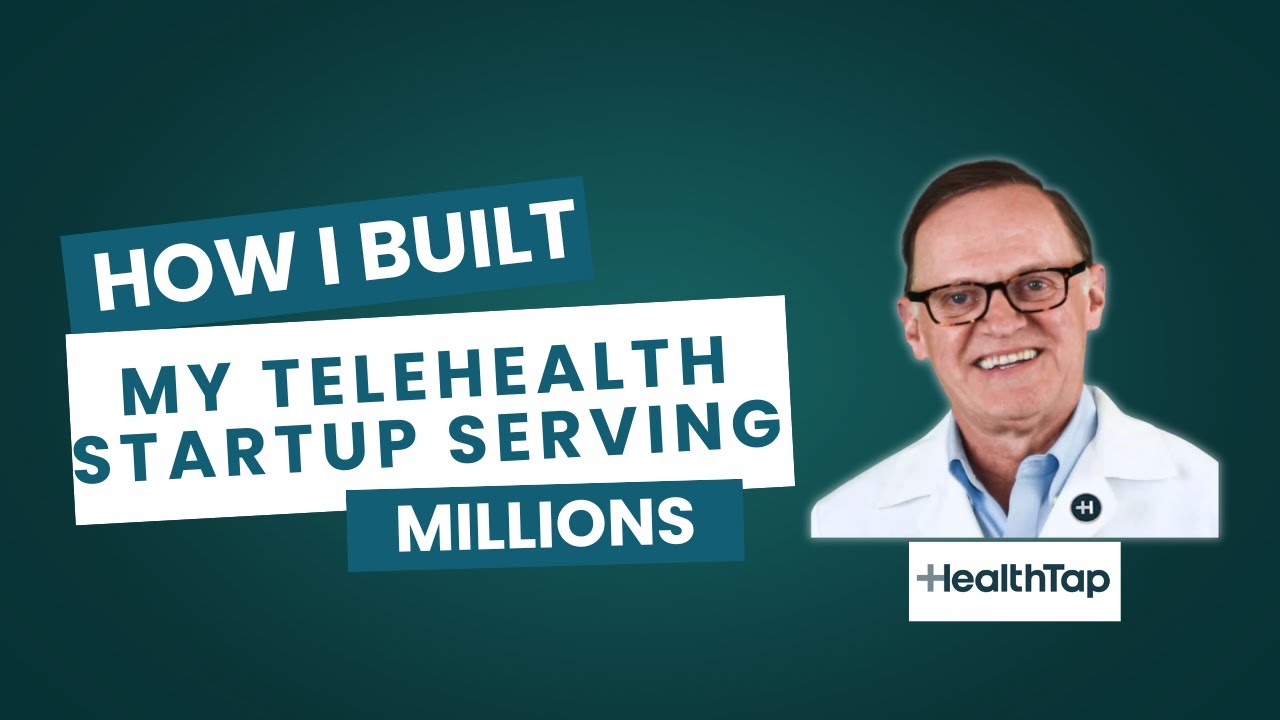
The eventual virtual clinic made a larger claim. A video visit need not be emergency plumbing for a minor complaint. It could support continuity: choose a primary-care doctor, return to that doctor, and keep a conversation alive between visits. Rutledge's preferred future is not an infinite carousel of strangers in white coats. It is a familiar physician made easier to reach.
Then came the pandemic. Patients and clinicians who had treated telehealth as a curious side entrance were pushed through it at once. The result was neither orderly nor elegant, but it demolished the cultural objection. People discovered that attention could survive a screen. In a 2025 interview, Rutledge said HealthTap's primary-care visits averaged 4.95 out of five stars, with more than 98 percent receiving four or five stars. Those are company-reported figures, but they reveal the scale of his own surprise. He had hoped for four and a half.
“The fundamentals of virtual care are identical before and after the pandemic.”Geoffrey Rutledge, AJMC interview
The machine takes the history. The doctor keeps the judgment.
A veteran of one digital-health revolution is now living through another. HealthTap's Dr. A.I. conducts a pre-visit interview and prepares a draft clinical note. The workflow is deliberately narrow. It does not prescribe a treatment. The physician does not see its differential diagnosis before making the clinical decision. The software organizes the opening act; the doctor remains responsible for the ending.
In a 2024 paper presented at an AAAI Spring Symposium, Rutledge and co-author Alexander Sivura reported results across 124 primary diagnoses. The eventual physician diagnosis appeared first in the system's differential 62.1 percent of the time, in the top three 80.6 percent of the time, and in the top ten 87.9 percent of the time. Rutledge has said the draft history can save roughly ten minutes in a visit.
Dr. A.I. evaluation · physician's eventual diagnosis found in differential
The study measured inclusion in a generated differential, not autonomous diagnosis or treatment. The physician remained the decision-maker.
The ten minutes are the point. Rutledge's version of automation is not interested in winning a bedside popularity contest. It handles the repetitive interview and documentation so a physician can spend more of the appointment thinking, listening, and explaining. The oldest ambition in his career survives inside the newest technology: use the machine to make room for the person.
His recent public writing is notably less starry-eyed than the usual AI sermon. He argues for a defined workflow, validation against clinical ground truth, published evidence, and continuous monitoring after deployment. The language is closer to a treatment protocol than a product launch. He has warned that a safety problem may arrive quietly, as changing override rates or gradual performance drift, rather than as one spectacular error.
Still trying to close the distance
Rutledge's career can be mistaken for a sequence of technologies: websites, personal records, mobile apps, video, language models. Look again and the sequence becomes one argument conducted across changing media. A patient has a question. Somewhere, a doctor has useful knowledge. The task is to connect them without losing trust along the way.
That argument has made him an executive and founder, but he continues to present himself first as a physician. It also explains why his aspiration is so specific. He wants every person in America to have a primary-care doctor who knows them and can be reached for advice. The ambition is national; the emotional unit is one relationship.
In August 2026, Rutledge spoke at the InnovatorMD World Congress on AI in primary care. The subject sounds several lifetimes removed from a handmade computer and a state-of-the-art fax machine. It is not. The tools became faster and the screens became thinner. The central question barely moved.
Technology is very good at arriving. Healthcare is slower, because healthcare has to deserve admission. Rutledge has spent his working life standing at that door, part doctor, part programmer, asking the machine for its references.