Geoff Ballotti remembers the plates. At the Pancake Man in Hyannis, Massachusetts, eggs and maple syrup could harden into a substance with ambitions beyond breakfast. The hot water would run out. The dishwasher still had to get the dishes clean. In 1976, this was his introduction to hospitality: a restaurant whose most memorable product, from his side of the kitchen, was work.
He also remembers being thanked. Two waitresses at the restaurant made a point of thanking him when he brought the spoons or coffee creamers they needed. Years later, recounting his beginnings, he could still summon those small acknowledgments. A business that sells a night's rest had first caught his attention through the people who noticed somebody doing an unglamorous job.
Today Ballotti is president and chief executive officer of Wyndham Hotels & Resorts. His working world includes hotel brands, franchise contracts, reservation systems and owners spread across countries. The distance from that kitchen is considerable. What makes his story interesting is how often he returns to the starting point, and how many detours he took before reaching the executive suite.
A promotion measured in buckets
At Boston's Le Méridien, where he worked on the hotel's pre-opening team, Ballotti was again washing dishes. He wanted to become a busboy. It was a perfectly intelligible ambition from where he stood: the busboys arrived with buckets, deposited their contents and went back out. They occupied the next rung of a very visible ladder.
Eventually he became a busboy, then a waiter. Bernard Lambert, a manager at the hotel who later led the Le Méridien brand, became a mentor. Ballotti could see a future in Lambert's example. A hotel career acquired a human face before it acquired a job description.
There is something pleasantly specific about that first goal. Accounts of corporate success tend to give teenagers astonishing foresight. Ballotti's remembered ambition comes with dirty crockery. He wanted the next job he could see. The larger possibilities became imaginable through meeting someone who had already made a life in the business.
The French major takes a bank job
Hotels did not immediately win. Ballotti studied French at Colby College and considered teaching it. The economics were discouraging: he later recalled substantial debt and a prospective starting salary that made the plan difficult. His father suggested banking. Ballotti joined the Bank of New England and spent five years there, including work as a construction lender on hotel loans.
This was an unexpectedly useful vantage point. A hotel looks different when it arrives as a financing proposal. The rooms have to support a building, an operating business and the borrowing behind both. Ballotti had already seen the labor that kept a property functioning; lending exposed him to the calculations that allowed one to exist.
Harvard Business School followed. Afterward, he sought a corporate role at ITT Sheraton and entered its development group. The French degree also found its use as his work took him into Europe. A discarded teaching plan had left him with a practical skill. Careers sometimes have a better filing system than the people living them.
- 1976Dishwasher
Pancake Man, Hyannis - 2003North America president
Starwood - 2008President and CEO
Group RCI - 2014President and CEO
Wyndham Hotel Group - 2018President and CEO
Wyndham Hotels & Resorts
Venice, then a much larger map
Ballotti's European assignments included Milan, Brussels and Rome. He spent eight years overseas, and speaks French and Italian. As managing director of Ciga in Italy, his responsibilities included a company operating hotels such as Venice's Gritti Palace and Hotel Danieli. It was a considerable change of scenery from a Cape Cod pancake restaurant.
The work widened in stages. Starwood appointed him executive vice president for North American hotel operations in 2002. He became president of its North America division in 2003. By the time he moved to Wyndham in 2008, his North American responsibilities had encompassed 450 hotels and 65,000 associates across owned, managed and franchised properties.
His new job was president and CEO of Group RCI, Wyndham Worldwide's vacation exchange and rental business. Stephen Holmes, then Wyndham Worldwide's chairman and CEO, pointed to Ballotti's financial knowledge, international operations experience and familiarity with travel distribution. The appointment rewarded a combination of skills accumulated in different rooms of the same industry.
What the search results left out
In a 2018 conference presentation, Ballotti described searching Google Images for leadership. Up came the usual collection: handshakes, boardroom tables, people delivering presentations. He found the imagery wanting.
“The one image that does not come up is the image of empathy.”Geoff Ballotti, AAHOA convention, 2018
He spoke about Christel DeHaan, the former owner of RCI who founded Christel House International, and about the obligation to give back. Ballotti himself served on the charity's board. His choice of example expanded leadership beyond the person at the front of a meeting. It made room for attention to the people affected by a decision.
That emphasis also appears in how colleagues describe him. When he was named the 2023 Arne Sorenson Social Impact Leadership Award honoree, AHLA's Chip Rogers singled out his empathy and accessibility. Awards can flatten a person's habits into ceremonial language. In this case, the language points back to those waitresses and their remembered thanks: being noticed mattered to him early.
Helping someone get the keys
Under Ballotti's leadership, Wyndham launched Women Own the Room and BOLD by Wyndham, programs designed to help women and Black entrepreneurs enter hotel ownership. Their practical concerns include access to support, mentorship and financing. The question extends beyond who works in a hotel to who can own one.
By January 2025, Wyndham reported that the two programs together had generated more than 100 deals, with nearly 40 hotels open. Those are distinct measures. A signed agreement marks a commitment; an open hotel is a business receiving guests. Keeping both in view gives the effort a more useful shape than a general promise of opportunity.
Ballotti's own ascent began inside hotel operations. These programs concern another threshold, with its own financial requirements and professional networks. The connection is a recurring interest in helping people move into positions they can picture but may struggle to reach. Wyndham's teams and participating owners do the work of turning that interest into individual projects.
The everyday traveler has a business model
Ballotti became Wyndham Hotel Group's president and CEO in 2014. In 2018, Wyndham Hotels & Resorts became a separate publicly traded company, with Ballotti leading it. Its economy and midscale brands put him in charge of a business closely tied to ordinary journeys: a road trip, an overnight stop, a job away from home.
Franchising adds another audience to the conversation. Most of the people running the hotels are independent owners. The brand company supplies systems, distribution, marketing and loyalty benefits; owners have to make a particular property work in a particular place. A recognizable sign is a beginning. The relationship depends on what stands behind it.
Technology is part of that bargain. Wyndham Connect introduced tools including guest messaging, mobile check-in and check-out, upselling and mobile tipping. In January 2025, Wyndham said approximately 2,000 North American hotels were regularly engaging with it. For Ballotti, the ambition of a large network has to become useful at the scale of a front desk.
A room for people who stay a while
ECHO Suites offers a concrete example of the strategy. Its first hotel opened in Spartanburg, South Carolina, in July 2024. The extended-stay brand was designed for guests who need accommodation for longer stretches, including construction and trade workers traveling to projects.
At that opening, its development pipeline approached 270 hotels and exceeded 33,000 rooms across the United States and Canada. A pipeline describes future projects, with all the work still required to deliver them. Spartanburg supplied something more immediate: a location where guests could actually check in.
The idea suits Ballotti's focus on accessible travel. Hospitality includes people whose trip begins with a work assignment and whose main requirement is a comfortable place to settle temporarily. Extended stay gives that customer a particular place in the portfolio. It also asks developers to think about demand that can last longer than a weekend.
Optimism, with numbers attached
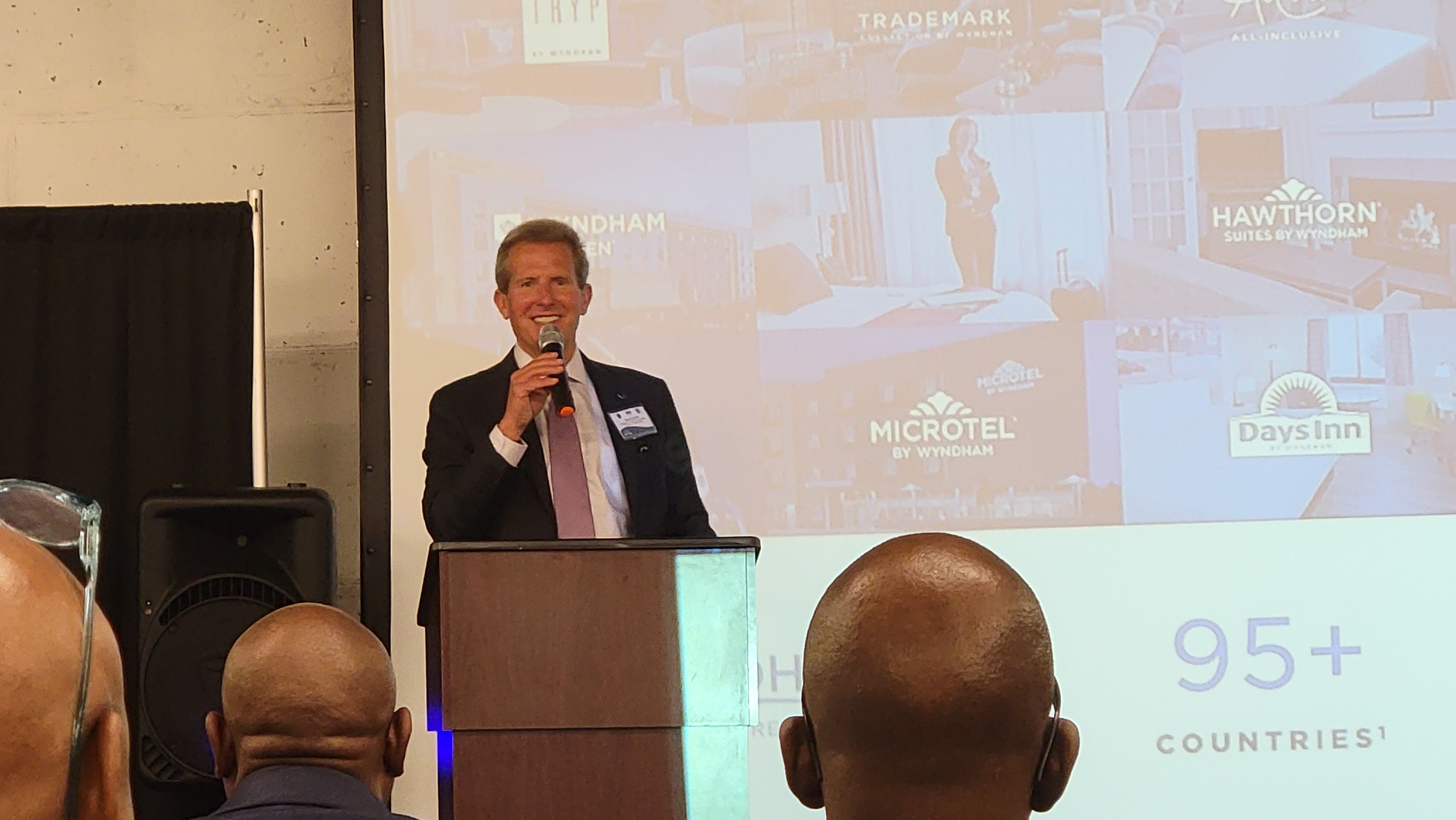
At the AAHOA convention in Philadelphia in April 2026, Ballotti discussed improving demand and the importance of advocacy by small business owners. He brought colleagues from development, marketing, operations and technology. The appearance put several parts of Wyndham's promise to franchisees in the same place.
His advocacy has a longer history. Elected national chair of the U.S. Travel Association in 2017, he argued for travel as a source of economic opportunity and cultural exchange. His responsibilities have repeatedly taken him beyond his own company's boundaries, into the shared concerns of owners, travelers and the wider lodging business.
By October 21, 2026, Wyndham reported third-quarter global revenue per available room growth of 2% in constant currency and U.S. growth of 6%. International performance remained uneven, including a decline in China. Ballotti's optimism had supporting figures, along with differences a global executive still had to manage.
Wyndham's reported network at October 21, 2026. Company scale, not personally owned properties.
There is no need to give the dishwasher advance knowledge of any of this. The young Ballotti wanted a better job within sight of his own. Banking, business school, Europe and a succession of operating roles widened that view. The point of returning to the kitchen is to remember how much of a hotel depends on work that guests rarely see. Ballotti still remembers who said thank you.
Continue the conversation
Read · watch · connect