Most software careers are narrated from the screen outward. Gary Goldstein’s makes more sense from the filing cabinet inward. His working life has tracked a stubborn layer of business that customers rarely see and employees notice only when it fails: the forms, approvals, eligibility records, status changes and repeated bits of information that have to travel between people and systems.
Goldstein has been trying to make that layer behave since before software-as-a-service became a phrase. In 1997, after building an insurance business, he founded BISNet. It moved benefits communication, enrollment and administration online for employers and insurance companies. He later recalled a client list that included eBay, E-Trade, Sony PlayStation, Dreyer’s and Blue Shield of California. He dates sales of the business to 2005 and 2008. Years later, he returned to the same terrain through Insynctive.
The return is the interesting part. A founder who sells a company gets permission to become a different person. Goldstein instead found a larger version of the original problem. The paper had become software, but the work was still fragmented. Payroll lived here, employee records there, specialist products somewhere else, and every organization had its own forms and exceptions. The mess had acquired APIs without acquiring coherence.
Origin storyAn entrepreneur, discovered after the fact
Goldstein was born in St. Louis and moved around the country with his family while his father served in the military. The family eventually reached the Bay Area, where he attended Campolindo High School and then the University of California, Berkeley. He studied mathematics from 1975 to 1980. Entrepreneurship was not yet packaged on campus as a curriculum, a club and a pitch competition. He has said he did not know he was an entrepreneur until working life revealed it.
The clues were close to home. He has described a grandfather, mother and brother who all built businesses. After Berkeley, he entered insurance and started a firm of his own. This was less a cinematic leap than an apprenticeship in consequences. Insurance taught him where information gets stuck, how administrative mistakes compound and why the same details wind up on one form after another.
BISNet turned that operational knowledge into a product. The company sat between employers, workers and carriers, bringing communication, enrollment, administration and transactions online. The category sounds inevitable now. In 1997 it required convincing organizations that a sensitive, paper-heavy process could be entrusted to a networked system. Goldstein grew the business through the dot-com rise and fall, then sold it. The company’s technology continued beyond his ownership.
“It’s not a straight line to success.”Gary Goldstein
The line has become his compact theory of company-building. Goldstein has connected its origin to conversations with his son, but its authority comes from the career around it. He has been a founder, chief executive, operating leader, business coach, adviser and investor. Public profiles connect him with JuiceHounds, VizKinect, XplorIt, ArmaTerra Georeinforcing, Maslow Six Entertainment and AcroTech Systems. Not every stop belongs to one tidy ascent. Together they look like fieldwork in how different organizations get unstuck.
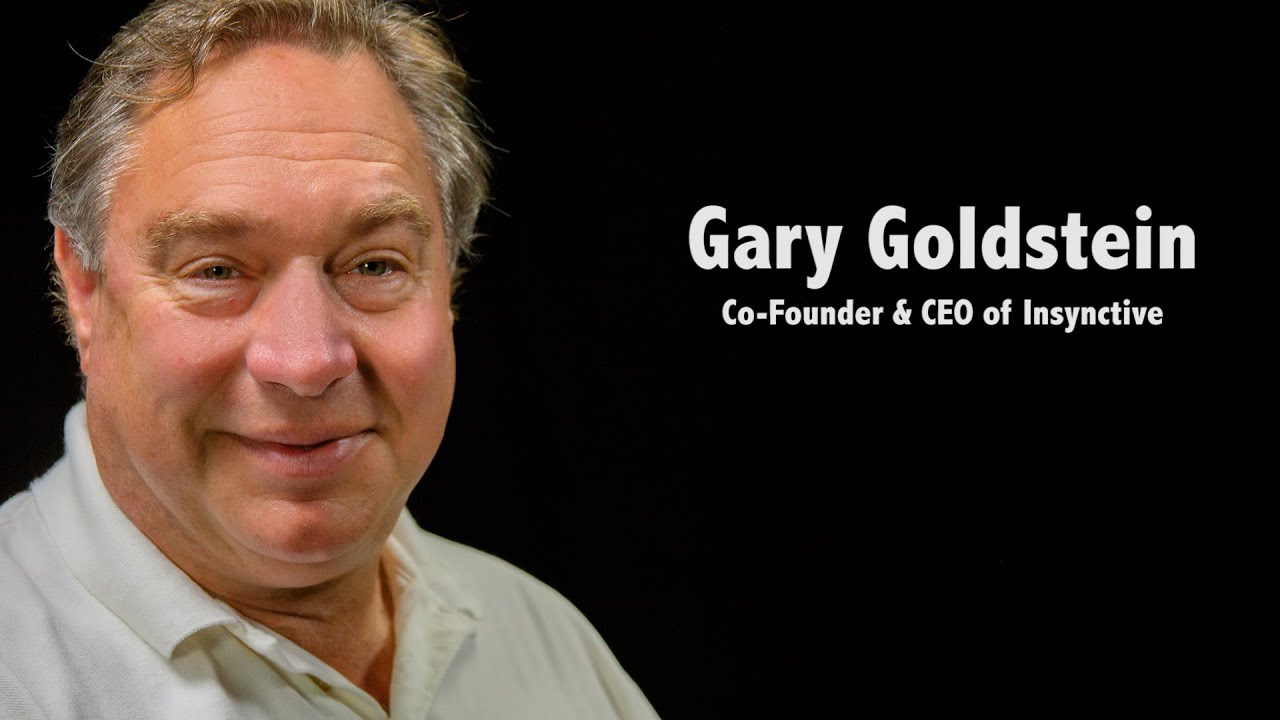
The second buildSoftware for the space between systems
Insynctive was founded in 2016. Goldstein met the original founder, recognized pieces of a broader platform and helped change the model. The company would not merely digitize a single employer’s forms. It would offer service providers and employers a configurable layer for onboarding, employee records, benefits administration, document management and outside products.
That distinction explains the company better than a list of features. Insynctive is designed for organizations that already own a stack. They may have payroll they will not replace, a specialist tool they like and a set of internal documents nobody else uses. A clean-sheet rebuild would create its own disruption. Goldstein’s answer is connective: synchronize databases, pre-populate forms, route documents, configure approvals and move information in both directions.
There is an unfashionable humility in building around the systems a customer already has. Startup language favors replacement: obsolete tools swept away by a unified future. Operating reality is more archaeological. A company’s stack records years of contracts, habits and compromises. The useful product often arrives as a bridge, not a bulldozer.
Goldstein’s long exposure to the work gives him a founder’s advantage that cannot be downloaded from a market report. He knows that the form is not merely a form. It may carry an employer-specific rule, require a signature, trigger a notification, update a record and pass information to another vendor. The apparent nuisance is a workflow. Once the workflow is visible, it can become a product.
The 2017 connection with ADP Workforce Now gives the strategy a concrete shape. Insynctive joined ADP Marketplace with an integrated product rather than asking clients to abandon a familiar payroll environment. The partnership made the platform legible as a layer: one place to manage a process while information continues to move through an established system. That model now appears across Insynctive’s description of its work, from database-to-database synchronization to document routing and electronic signatures. It also clarifies what Goldstein carried forward from BISNet. The opportunity was never simply to put a paper form on a screen. It was to preserve context as information crossed organizational boundaries. A field entered once by mail, fax or manual upload could become a reliable transaction. The interface mattered, but the handoff was the business.
Operating systemMilestones, dissent and the right kind of control
Goldstein talks about leadership with the same practical bent. A company needs measurable milestones, he argues, because progress must be observable. When the numbers or deadlines say the plan is off course, the leader’s job is not to defend the old route. It is to gather the people who see different parts of the system: customers, distributors, employees and advisers.
That method contains a useful tension. The founder supplies persistence, but other people supply correction. A former BISNet colleague described Goldstein publicly as a tremendously enthusiastic leader who backed employees working on process improvements. Another longtime colleague credited his perseverance, optimism and ability to draw better work from a team. These are testimonials, not audited performance measures, but they match the operating philosophy Goldstein gives in his own interviews.
Control is also the product principle behind Insynctive. Goldstein has argued that HR teams should be able to configure their own workflows without assembling a large technical team for every change. This is not the consumer-software fantasy of one button. It is a more grounded promise: the people who understand the process should be able to shape it.
By 2025, he was discussing the modernization of HR operations at a Silicon Valley Forum fireside chat, drawing on nearly four decades in the field. Current Insynctive materials stretch beyond the company’s early HR framing into document automation, database synchronization, e-signatures and configurable workflows for enterprise and government customers. The company remains small. The ambition is infrastructural.
Look for information that people retype, approvals nobody can see and systems that exchange data by spreadsheet. Each handoff is evidence of a product boundary waiting to be redrawn.
A life outside the stackThe Berkeley loop
Goldstein’s public biography is not all middleware. He lists family, friends, golf, entrepreneurship, innovation and volunteering among his interests. His Berkeley connection continued long after graduation. He helped establish the Cal Gamma chapter of Phi Kappa Psi as a student and later served as president of its house corporation, a volunteer role he has held since 2013 according to his public profile.
He speaks readily about the people around him: entrepreneurial relatives, a longtime mentor, investors, fraternity brothers, his wife and son. The pattern is consistent with his view of leadership. The individual supplies energy, but the path is social. Progress depends on people willing to support the mission and people willing to say when the plan needs work.
A 2023 podcast conversation returned to that balance. Goldstein discussed the hard moments of entrepreneurship, prioritizing family during long working hours and wanting customers to be satisfied. He also spoke about Insynctive giving back to the community. Those ambitions are modestly phrased, which suits a founder who has spent his life attending to things that are important precisely because they do not look dramatic.
The temptation in writing about enterprise software is to make abstraction sound visionary. Goldstein’s story points the other way. Start with a worker entering the same name again. Follow the data through the form, the approval and the outside system. Notice where it stops. Then remove one needless step. Repeat for a few decades, and the paperwork nobody sees becomes a career.