The curious thing about GameFounders is that the investment cheque was small enough to fit inside a much bigger question. In 2012, a young team could receive up to €15,000 by joining its Tallinn accelerator. In exchange, GameFounders took 9 percent of the company. Three months later, the team was supposed to understand something its prototype could not explain: how to become a business.
- The work: commercial mentoring and early investment for game studios.
- The wider bet: bring expertise into regions building a games industry.
- The distinction: 67 invested studios across 26 countries; 100+ studios supported across programs, according to GameFounders.
The prototype is only the beginning
A game gives its makers immediate evidence. A character moves. A puzzle works. A player smiles. The business surrounding that game supplies much less obliging feedback. Who will distribute it? How will people discover it? What should a publishing agreement contain? These are the questions GameFounders puts at the centre of its work. A good afternoon of playtesting cannot answer all of them.
Launched in Estonia by Kadri Ugand, now listed as Kadri Härma, Paul Bragiel, Lauri Antalainen and Sven Illing, the company chose a narrow subject with a broad supporting cast. Game studios were the focus; mentors, investors, universities and public agencies supplied the connections. Its place in the market sits between early-stage games investing and the less tidy business of helping a region develop an industry.
The distinction matters to its users. Founders want help commercialising a game. Regional partners want more capable local companies. Students want practical experience. Those ambitions overlap, but they are not interchangeable. An accelerator can introduce a studio to a publisher while also introducing a university student to the possibility of working in games.
A cheque with a timetable
The original offer was concrete: relocate for three months, receive seed capital and work through a program of mentoring, seminars and introductions. The money was tied to equity, rather than being a no-strings grant. Early terms allowed €5,000 per relocating founder, up to €15,000 per team. That bought some breathing room. The calendar determined what happened inside it.
GameFounders’ historical presentation describes Friday pitch days, fortnightly board meetings and playtests with different groups twice a month. Seminars ranged from game design to publishing deals. The arrangement made it harder to disappear into production and emerge weeks later with a splendid feature nobody had asked for. Outside feedback had a standing appointment.
That is a useful part of the program to copy. A small studio can set a regular date to explain its business, put its work in front of unfamiliar players and check progress against decisions made earlier. It need not rent an accelerator office to do so. It does need people willing to ask inconvenient questions.
Two bills, two beneficiaries
The early financing structure separated the cost of running the accelerator from the capital invested in studios. Government support covered operations; private investment supplied the studio fund. Public money paid for an environment where knowledge could circulate. Private investors received stakes in companies. The same program could therefore pursue regional benefits and financial returns without pretending they were the same ledger.
Consider the alternative: a general startup accelerator can teach fundraising, but a game studio also needs people familiar with players, monetisation and publishing. A specialist investor supplies capital and contacts, but does not necessarily organise university sessions or local meetups. GameFounders brings those activities together. Its expertise is in the commercial questions and the network around them.
Malaysia adds a second door
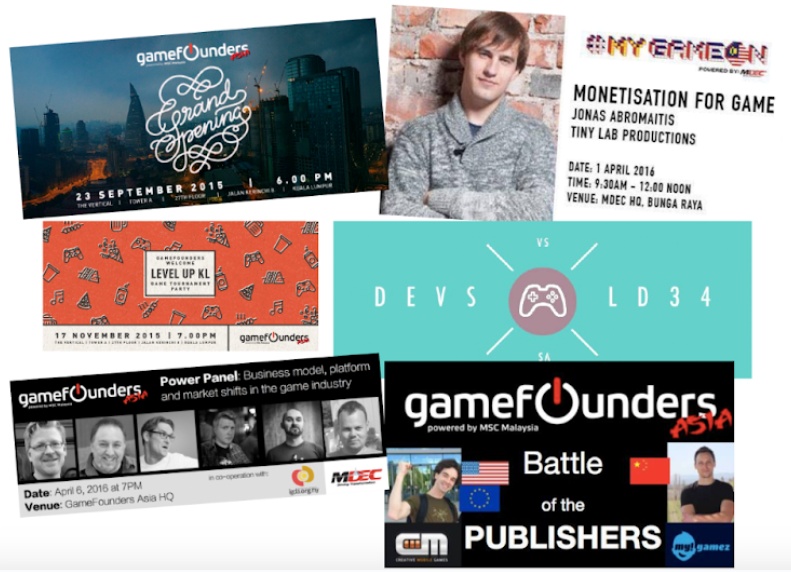
The Kuala Lumpur chapter began in 2015 with Malaysia’s Multimedia Development Corporation, known then as MDeC. For international teams, it expanded the network into Asia. For the local industry, it brought visiting knowledge closer to home. GameFounders records four Malaysian accelerator cycles during 2015-2017, involving 39 teams, alongside 40 LITE teams.
LITE is an instructive detail. Local studios could prepare for the full accelerator with limited access to training, mentoring, pitching and strategy sessions. A single entrance requirement would have treated every team as equally ready. The parallel route acknowledged that readiness itself can be developed.
Education also became part of the design. The university partner program started in 2015 with five Malaysian universities. Students could attend streamed training, hear visiting mentors and join playtest days. Internships placed local talent with participating studios or GameFounders itself. The accelerator’s working knowledge had several exits into the surrounding community.

Riyadh starts before the studio
In August 2022, Saudi Arabia’s communications and technology ministry launched a GameFounders initiative targeting 100 Saudi participants. Its six-month training stage covered development, design, art and marketing. The company records 100 incubator participants and 21 accelerator teams across its 2022-2023 Riyadh program period.
Here, the starting point included skills and team formation. That changes the job. Before a founder can improve a studio’s commercial strategy, there must be people capable of forming the studio. GameFounders’ incubator and accelerator address different points in that journey. Counting participants and counting companies tells different parts of the story.
Copy the calendar, then check the neighbourhood
Geography was never incidental. In a 2015 interview, Härma explained why an established games centre such as Helsinki offered less room for this particular model.
“There are mentors in every corner. We can’t add value.”Kadri Ugand, speaking to GamesBeat in 2015
The point was access. Where founders already have experienced neighbours, importing a mentoring network may solve little. Product fit matters too: the early investment model favoured scalable businesses, particularly mobile free-to-play, with expertise in acquisition and monetisation. A niche premium game may need a different set of advisers.
For a studio considering GameFounders, the useful question is specific: which commercial decision would this program help us make? For a regional partner, it is who will keep the knowledge after the cohort leaves. The company’s history suggests a practical answer: give feedback a timetable, give local talent a route in, and make introductions that remain useful when the visitors go home.