The most revealing line on Frost's website is not about an interest rate. It is the promise that when a customer opens a chat, a person answers, not a bot. In 2026 that sounds almost eccentric. Banks have spent years turning branches into apps, tellers into menus and service calls into obstacle courses. Frost has invested in the same digital machinery, but it draws the line in a different place: technology should carry the relationship, not impersonate it.
That distinction explains a surprising amount about the San Antonio company. Frost is large enough to sit among the 50 biggest banks in the United States, yet narrow enough to operate around a single state identity. Its parent, Cullen/Frost Bankers, had $53.9 billion in assets at June 30, 2026. The bank has more than 200 financial centers, roughly 1,760 ATMs and more than 6,000 employees. Its products stretch from a first checking account to municipal bond underwriting. Still, its public language sounds less like a financial supermarket than a good local hardware store: square deals, sound assets, someone who knows why you came in.
A statewide bank with a neighborhood brain
Frost serves two broad constituencies. For individuals, it offers the familiar bank shelf: checking and savings accounts, certificates of deposit, cards, mortgages, personal loans, investment accounts and financial planning. For businesses, the shelf gets deeper: working-capital loans, commercial real-estate finance, merchant services, treasury management, international trade support, insurance, employee benefits, retirement plans, public finance and fixed-income capital markets.
This breadth matters because the customer problem changes with scale. A household wants to move money safely, avoid needless fees, finance a home and find help when something looks wrong. A small business wants cash to arrive on time and payroll to leave on time. A middle-market company may need account reconciliation, fraud controls, a revolving credit line, bond advice and help hedging risk. A wealthy family may need trusts, estate administration, custody and a plan that survives more than one generation. Frost can keep those needs under one roof.
The business model is conventional banking, executed across more relationships. Frost earns net interest income by funding loans and securities largely with customer deposits. It adds fees from trust and investment management, insurance commissions, deposit services, cards, brokerage and capital-markets work. That mix helps a customer grow from a checking account into a business loan or a wealth mandate without outgrowing the institution.
The constraint is the strategy
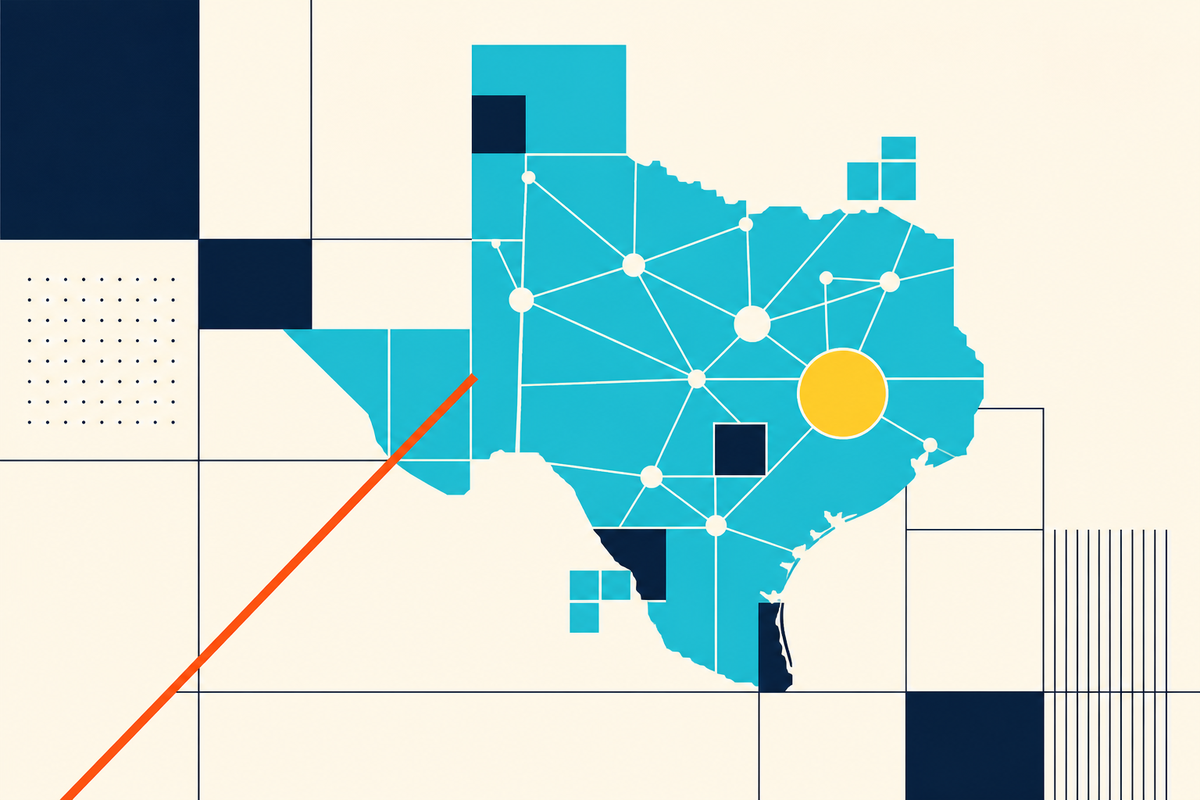
National banks compete with universality. Digital banks compete with low overhead and a smooth interface. Community banks compete with familiarity. Frost's position borrows from all three but belongs fully to none: large-bank capabilities, competent technology and local-bank attention, constrained to Texas. The geographic limit concentrates brand spending, executive attention and underwriting knowledge in markets the company can study closely.
It also creates a clean expansion map. Frost launched a major organic growth program in 2018, more than doubled its Houston presence, then moved to triple its Dallas-area financial centers and double its Austin network. Ten new locations opened in Austin, Dallas and San Antonio during 2025. Plans called for another 12 to 15 in 2026. Where rivals see expensive real estate, Frost sees customer acquisition, local deposits and a physical advertisement with bankers inside.
“Everyone is significant, and at Frost, we treat them that way.”Frost's stated service belief
The branches are not nostalgia projects. The mobile app carries deposits, transfers, bills, alerts and account management, while digital wealth tools let clients see assets, debts and progress in one view. Frost's useful idea is to stop treating channels as enemies. A routine task should disappear into software. An anxious or complex task should surface a capable person. The branch, phone line and app become different doors into the same relationship.
The large-bank promise
Product breadth, capital, digital tools, ATM reach and specialists for complex commercial or wealth needs.
The Frost adjustment
Texas market focus, expanding local access, live human help and a culture built around long relationships.
A culture manual small enough to remember
Frost's internal constitution is called the Blue Book. It joins a mission statement with three values: integrity, caring and excellence. The mission is unusually concrete for corporate prose: grow and prosper by building long-term relationships through good service, high ethical standards and safe, sound assets. It gives employees a commercial ambition, a method and a risk boundary in one sentence.
That last phrase carries historical weight. Frost traces its origin to 1868, when Thomas Claiborne Frost operated a mercantile business in San Antonio and extended credit around frontier commerce. The institution survived the Depression. During the Texas banking crisis of the 1980s, when energy and real estate collapsed, Frost was the only one of the state's 10 largest banking companies to make it through without federal assistance or an out-of-state takeover. In 2008 it declined TARP funds. Prudence here is not decorative. It is institutional memory.
Culture is difficult to audit, but some outputs are visible. Employees logged more than 27,000 community-service hours in 2025. The company emphasizes internal development, benefits and work-life balance in recruiting. Its community work covers financial literacy, nonprofits, arts, education and economic development. The long relationship with the San Antonio Spurs, dating to 1973, grew into a jersey partnership and then naming rights for the Frost Bank Center. The arena sign reads like sponsorship; locally, it also reads like family history.
The numbers behind the manners
Good service does not excuse weak economics, and Frost's 2025 filing shows a bank growing through a demanding rate environment. Average loans rose 7.3 percent to $21.2 billion. Average deposits rose 3 percent to $42.2 billion. Net income reached $648.6 million. Period-end assets increased from $50.8 billion in 2023 to $52.5 billion in 2024 and $53.0 billion in 2025. Capital ratios remained above regulatory minimums.
Period-end assets / $ billions
Scale beyond the balance sheet is just as important. Frost reported more than $66 billion in trust, brokerage and advisory assets in 2026. Those assets do not sit on the bank's balance sheet in the same way as loans, but they show how far the franchise extends into fee-based advice and fiduciary work. Frost is not merely a place to park a paycheck. It is competing for the financial life around that paycheck.
The customer-service moat
A feature can be copied by the next product sprint. A service habit is slower to reproduce because it depends on hiring, training, staffing levels, incentives and daily judgment. Frost has ranked highest in Texas in J.D. Power's retail banking satisfaction study for 17 consecutive years through 2026. That does not prove every interaction is perfect. It does suggest the service claim survives contact with a large body of customers.
The same pattern appears in business banking. In 2025 Frost was the only Texas-based bank nationally recognized by Coalition Greenwich for overall satisfaction, ease of doing business and customer service in both small-business and middle-market segments. Those customers care about software, but they also care about a banker understanding a cash cycle before a deadline. Frost's expertise is the combination: commercial credit, treasury mechanics and local context delivered through an accountable relationship.
Competitors can undercut a fee, match an alert or open a nearby location. The harder task is making thousands of employees behave consistently enough that customers notice. That is why the Blue Book matters more than its modest size suggests. It turns the brand from an advertising instruction into an operating one.
There is a practical lesson here for any service business. Customers rarely experience a strategy document; they experience a handoff, a delay, an alert and the person who owns the next decision. Frost has made those small moments its public product. The approach is not mysterious, but it is expensive to sustain and easy to dilute. Consistency is the innovation.
Where Frost fits now
Frost occupies the upper end of regional banking: too broad to be a traditional community bank, deliberately less sprawling than a national giant. Its alternatives include Chase, Bank of America and Wells Fargo; Texas and regional institutions such as Comerica, Prosperity, Amegy, Cadence, PNC and Bank of Texas; local credit unions; and digital-first banks that can reach Texans without a lobby.
Its risk is the reverse side of its advantage. Concentration makes Texas knowledge valuable, but it also ties growth and credit quality closely to one state's economy. Branch expansion requires capital and patience. Live service requires people. The model has more operating weight than a digital-only bank, so it must turn that weight into deposits, loyalty and larger relationships rather than mere warmth.
So far, Frost is making a disciplined case that regional banking can remain regional without becoming quaint. It can automate the forgettable parts, keep humans close to the consequential ones and grow by going deeper into a place it already understands. The bank's oldest idea was credit extended between people who knew what the goods were worth. The interface has changed. The wager on recognition has not.