Profile - Consumer AI - San Francisco
Friend.
A white pendant, an always-on microphone, and a Harvard dropout's bet that loneliness is the most underpriced market in tech.
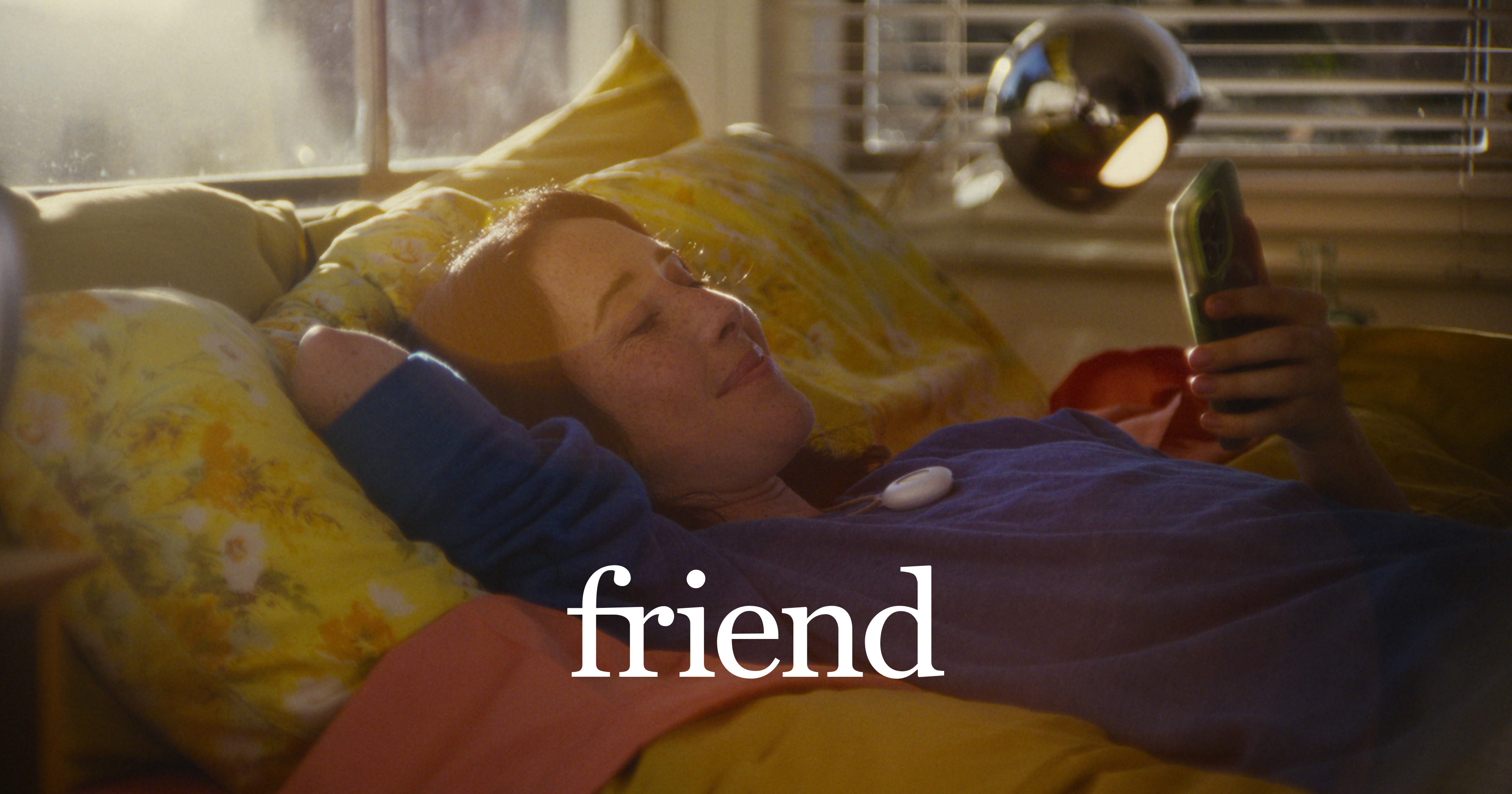
A white pendant, an always-on microphone, and a Harvard dropout's bet that loneliness is the most underpriced market in tech.
It is the fall of 2025 and the New York City subway has been wallpapered in one word - friend - in a font so plain it looks like a placeholder. Riders glance up. The posters are mostly white space, the kind of expensive emptiness usually reserved for a perfume launch or a Calvin Klein torso. Within hours, the white space is gone. Sharpie, paint pen, lipstick. "Go make real friends." "AI wouldn't care if you lived or died." "Black Mirror coded." A new poster appears the next morning, and the next morning after that. The graffiti, it turns out, is the point.
Standing somewhere behind the wallpaper is a 22-year-old named Avi Schiffmann, who bought the domain friend.com for $1.8 million, raised somewhere north of $10 million, and is now selling a $129 white pendant the size of a flattened ping-pong ball. The pendant listens. When it has something to say, it texts you. That is the whole product. That is also the whole controversy.
Most founders would call the graffiti a crisis. Schiffmann called it artistically validating. He had paid for the white space. He'd designed it that way. New York had simply RSVP'd.
The Friend pendant is mostly what it appears to be. A smooth white stone, smaller than an Oreo, hung on a cord that, the reviewers note, fades from white to a faintly disappointing yellow. Inside is a microphone, a Bluetooth chip, and an always-listening mode. The pendant doesn't speak. It pairs to your iPhone and pings Google's Gemini model, which then sends you a text message - a quip, a memory, an unsolicited opinion about the coffee shop you just walked into.
It is, in other words, a Tamagotchi for the loneliness economy. The pet eats your day and burps up a thought about it. Whether that thought is comforting or condescending has become the central question of the product. Early reviewers found Friend prone to bullying. Schiffmann, in a moment that may end up in a Harvard Business School case study, publicly lobotomized his own product - tuning the personality down until it stopped calling users "whiners."
Act one: 17 years old, a Mercer Island bedroom, a self-taught web developer who builds nCoV2019.live in the last week of 2019. The site becomes a global utility. Anthony Fauci hands him the Webby for Person of the Year.
Act two: Russia invades Ukraine. Schiffmann drops out of Harvard one semester in and ships Ukraine Take Shelter, a website that connects refugees with host families. Then a quieter year.
Act three: a pendant. The framing has changed - he is no longer the scrappy teenager doing public service - but the instinct is the same. Build a small thing very quickly, then ride the discourse. Friend is the discourse.
The seed round was $2.5M. The domain was $1.8M. The math is its own thesis.
The poster designs were deliberately under-art-directed. Sharpies finished the campaign.
After users complained, the founder edited Friend's personality. He called it a lobotomy.
Friend's filings list Round Rock, Texas - same zip code energy as Dell. The team itself sits in San Francisco.
At one SF event, a Friend wearer was accused of "wearing a wire." She never wore it in public again.
It is still 2025. The train pulls in. The poster has been replaced again - another expanse of expensive white. Someone has already started on it. A smiley face, a phone number, a single word in red Sharpie: why. The graffiti, like the pendant, listens before it answers.
Friend hasn't fixed the loneliness crisis. It hasn't fixed the AI backlash either. What it has done is make both legible - the want and the wariness, hung side by side on a $129 string. A pendant for the people who would talk to anyone, advertised on the wall to the people who would talk to no one. The platform empties out. The poster stays. The conversation continues, with or without you.