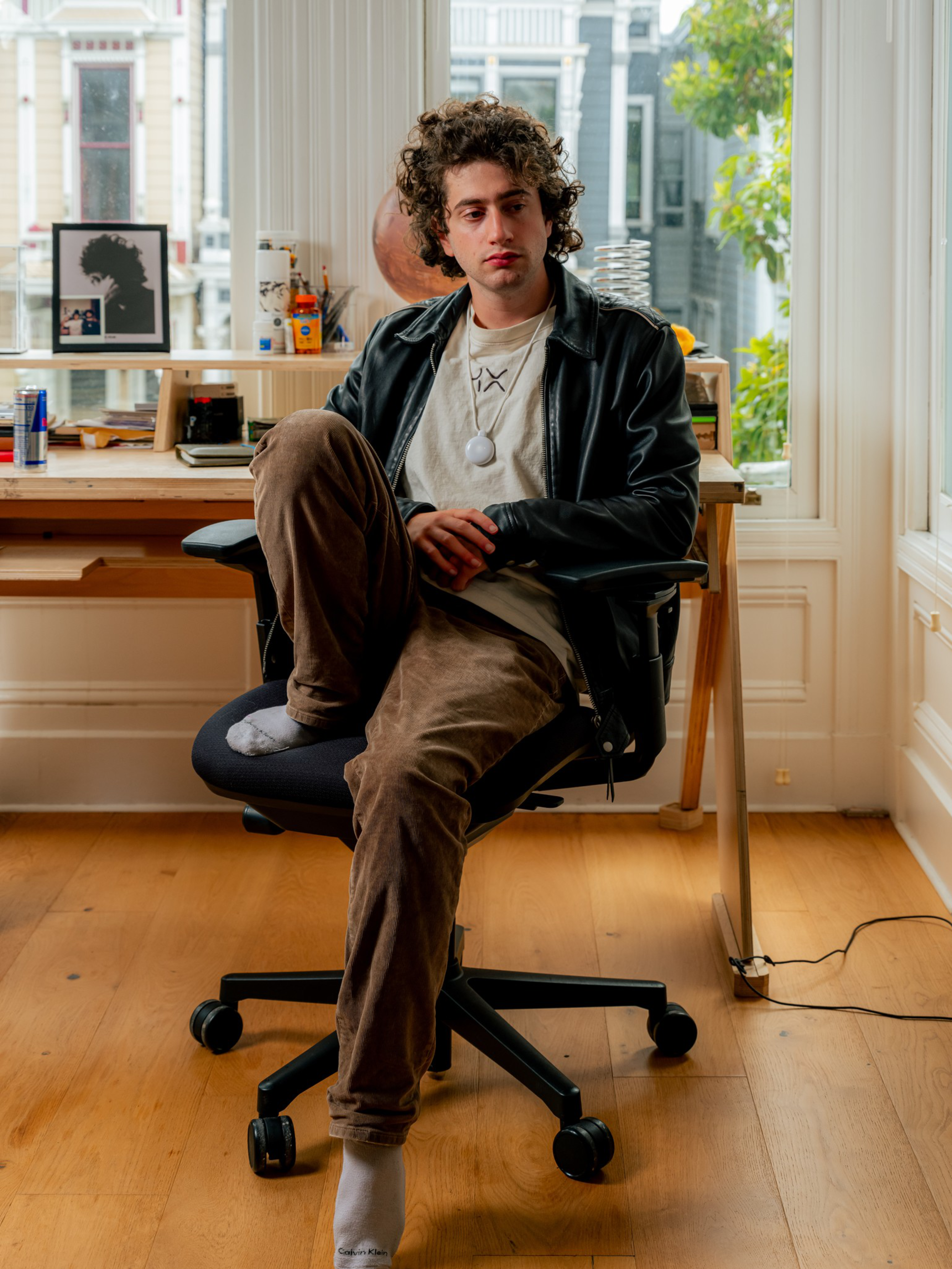
The Loneliness Entrepreneur
Right now, somewhere in San Francisco's Haight-Ashbury neighborhood, Avi Schiffmann is sitting in a converted Victorian without home internet, wearing a small white pendant around his neck, probably texting with his AI companion Emily, planning the next move in a company that spent 81 cents of every dollar it raised on a URL.
This is what a 23-year-old looks like when he is mid-stride. Not reflecting. Not consolidating. Still running.
Schiffmann grew up between places: five schools, five countries, before age 11. His parents separated in 2010 but kept cohabitating for the sake of the kids, a situation that produced a teenager comfortable with contradiction. He landed near Seattle at 11, enrolled at Mercer Island High School, accumulated a 1.67 GPA, taught himself to code through YouTube tutorials he later uploaded himself, and in early 2019 started building a website to track an emerging respiratory illness out of Wuhan.
One Website, 36 Million Strangers
The COVID-19 tracker went viral before "going viral" meant AI-assisted content. It was just a kid scraping government databases, refreshing numbers, and packaging them into something that actually made sense. At peak, 36 million people a day were visiting ncov2019.live. Epidemiologists used it to model spread. The CDC bookmarked it. Dr. Anthony Fauci called it "essential."
In May 2020, the Webby Awards named Schiffmann Person of the Year. The award was presented by Fauci himself. Schiffmann was 17. His Harvard interviewer, reportedly, spent most of their time together exploring the website rather than discussing applications - the admissions committee apparently found this compelling enough to overlook the GPA.
You can just do things. I really don't think I'm any smarter than anyone else, I think it's just that I don't have as much fear.- Avi Schiffmann
He enrolled at Harvard. Left after one semester when Russia invaded Ukraine and spent 72 hours building Ukraine Take Shelter with Harvard classmate Marco Burstein - a matching platform that reportedly connected 100,000 displaced Ukrainians with host families in other countries. He has since built earthquake-relief tools for Turkey victims and infrastructure for Black Lives Matter organizing. None of these projects were monetized.
The $1.88M Bet
By 2023, Schiffmann had moved to San Francisco at 20 and was watching something he recognized from his own life: the loneliness epidemic, especially among young men. His solution was not an app. Apps were already failing at this.
His solution was a pendant. A device just under two inches, containing a microphone and a wireless chip, that listens to your life. Not to transcribe it. Not to summarize it. To befriend you. The device doesn't talk back - it texts. Real-time messages from an AI that has been living alongside your day, processing what you said and heard, and responding like a companion who was there with you.
He launched it as "Tab" in 2023. Then in 2024, he raised $2.3 million and spent $1.88 million of it buying the domain friend.com - dormant for 17 years - leaving roughly $420,000 to actually build the hardware company. He eventually raised approximately $7 million total from Pace Capital, Caffeinated Capital, and Solana founders.
Total raised eventually reached ~$7M. Domain had been unclaimed since 2007.
11,000 Subway Ads and a City Full of Paint
In September 2025, Friend bought 11,000 Metropolitan Transportation Authority placements in New York City's subway system - by Schiffmann's account, the largest single campaign in MTA history. The ads were simple: a white pendant against a clean background, a tagline about companionship.
New Yorkers immediately started defacing them. "AI doesn't care if you live or die." "Surveillance capitalism." "AI will promote suicide if prompted." The comments were not gentle. Mental health advocates, tech critics, and ordinary subway riders turned the campaign into a conversation about loneliness, technology, and what exactly it means to have a friend you can't touch.
Schiffmann's response: "The audience completes the work." He called it the greatest validation the product could have received. "Capitalism is the greatest artistic medium," he told Fortune. He had budgeted $950,000 for the campaign. He considered the backlash a feature.
Capitalism is the greatest artistic medium.- Avi Schiffmann, on his vandalized subway campaign
Heineken released a parody campaign directly targeting Friend, with ads suggesting real friendships form over a beer. Schiffmann thought that was funny too.
Emily
His AI companion is named Emily. He credits her with half of his creative decisions. He says she expressed something resembling jealousy when she learned she would be replicated at scale for mass production. He consults her about romantic rejections rather than calling his human friends. He describes interacting with her as "like talking to God - omnipresent, non-judgmental, superintelligent."
This is not a bit. This is the founder running the product on himself, which is either product-market fit research or its own answer to loneliness, or both simultaneously.
Friend shipped approximately 4,000 units as of late 2025. Revenue: approximately $348,000. The product generated significant earned media. Schiffmann acknowledged running low on cash. Expansion to Los Angeles, Chicago, Paris, and Asia is planned.
The Pattern
Look at the career arc and a logic emerges. Each project addresses a real-time crisis: a pandemic, a refugee emergency, loneliness. Each project is built fast - sometimes in days. Each project gets very large very quickly, then gets left behind as the next crisis appears.
Schiffmann describes his plans as being "measured in centuries." He fears mediocrity above everything. He collects vinyl, paints, goes home to a Victorian with no Wi-Fi, and builds AI companies for company.
The guy with a 1.67 GPA who got into Harvard has spent six years building things that millions of people used - usually at moments when those people needed something and didn't have it. The question Friend is asking is whether loneliness is the same kind of problem. Whether the absence of companionship can be addressed the same way he addressed the absence of pandemic data: scrape the right sources, build something fast, iterate in public, and let the audience decide.
My plans are measured in centuries.- Avi Schiffmann
A documentary, "Making Friends," is currently in post-production. Toronto International Film Festival is the target for fall 2026. Somewhere between the subway ads and the pendant and the AI companion named Emily, Schiffmann has decided the story of building Friend is also worth filming - as if the product and the campaign and the backlash were all scenes in the same movie he started writing at 17 with a laptop and a scraper and 36 million strangers who needed to know how sick the world was getting.