A hundred-year business plan comes with an obvious personnel problem. The founder is unlikely to attend the closing meeting. Fred Lampropoulos understood that when he made a century the horizon for Merit, the company he helped start in 1987. He wanted an organization that would carry on after him. By the time he handed over the chief executive’s job in October 2025, he had spent 38 years seeing how much work could fit inside the opening portion of that promise.
There were factories and patents, overseas operations and a campus in South Jordan, Utah. There were also guitars, a campaign for governor, and tomatoes. Lampropoulos’s business life makes more sense with those last items left in. They reveal someone who enjoyed an audience, noticed what employees did outside their immediate jobs, and kept finding reasons to invest in a place.
His attachment to Utah began under circumstances that offered very little assurance of permanence.
A week in Pioneer Park
Born in Boston into a Greek immigrant family, Lampropoulos arrived in the Salt Lake City area in 1964. His family had come from Rock Springs, Wyoming, and initially lived out of a car at Pioneer Park. They stayed there for a week. Members of the Greek community helped them get established. The future employer’s introduction to the city depended on other people making room.
It is tempting to make every later decision grow neatly from that week. Lives are seldom so obliging. What can be said is that the episode remained part of his public story long after he had an office, a company and civic awards. His arrival in Utah was something he continued to discuss, rather than a chapter quietly removed from the executive biography.
He went to Granite High School, played football and became the first person in his family to finish high school. He attended Westminster College and the University of Utah, but his formal studies did not lead straight into a professional qualification. Money ran short. The Army became the next route forward.
The route took him well beyond Utah. He served as a commissioned officer in the United States Army Special Forces, with his officer service recorded from 1969 to 1978. He later credited the military with teaching him how to organize and lead. His business vocabulary would retain the emphasis on preparation, commitment and the consequences of deciding how long to stay with a task.
From Merit’s founding in 1987 to Lampropoulos’s departure as CEO in 2025.
Learning the work, then owning it
His civilian career did not proceed along a tidy conveyor belt. He worked in insurance, stockbroking and commercial property before finding his way into company management. In his account of those years, stockbroking presented a social obstacle as well as a professional one: he lacked the connections that made the job easier for some of his competitors.
Then came Utah Medical, a struggling Lehi company. Lampropoulos took on a business he had to learn while running it. He described teaching himself, and he helped return the company to profitability. Merit’s later corporate biography records his service as Utah Medical’s chair and president from 1983 to 1987. The experience gave him something more useful than a polished origin myth: years spent working inside an existing enterprise.
In 1987, he started again with an ownership stake in the undertaking itself. Merit’s founding team consisted of Lampropoulos, Kent W. Stanger, Darla Gill and William Padilla. Keeping the other three names in the picture matters. A founder can become the public face so thoroughly that the group at the beginning disappears from view.
The early operation concentrated on molding plastics. Growth later came through both internal development and acquisitions. Those are different kinds of work: creating something within a company, then learning how to bring somebody else’s business into it. Across decades, Merit would have to do both. The executive’s job grew along with the enterprise, from getting an operation started to maintaining relationships across facilities and countries.
“It really takes a cast of thousands.”
Fred Lampropoulos, 2019
By 2015, Merit had passed $500 million in annual sales. Lampropoulos was still talking about the business as unfinished work. A company could have decades behind it and remain, in his view, early in its life. That perspective helps explain why the campus and the people on it occupied so much of his attention.
A factory with room for tomatoes
The employee garden began with a scene he could see from his office. Workers were crossing the street to a neighboring farm, where the farmer had invited them to pick tomatoes and peppers. Their enthusiasm caught his attention. There was demand for something the company had not planned to provide, expressed in the simple act of people walking over to get it.
In 2016, Merit opened its own employee garden. The initial scheme gave employees beds they could adopt. The program developed further, including a U-Pick option in which ten minutes of gardening earned a basket of produce. A factory campus had acquired a small, seasonal economy of its own.
The numbers from 2021 give the arrangement texture. U-Pick recorded 562 visits, involving 260 employees from 73 departments. Participants took home 5,400 pounds of produce. Garden sales also raised $15,000 for the company’s Candy Cane Program, which supports employees in need during the holidays. These are modest units beside a public company’s revenue, and that is part of their usefulness. They describe something a person can carry.
A garden also offers a practical test of an employer’s intentions. Someone has to allocate land, employ people who know what they are doing, and keep the program running after the opening photographs. The harvest will not wait for a more convenient quarter. There is something gently comic about a century-long business ambition finding an everyday expression in a basket of vegetables.
Lampropoulos’s interest in the campus extended to learning and family life. He spoke about employee education, English-language classes and a development center for employees’ children. The underlying question was concrete: how could a place of work become somewhere people had good reasons to remain?
A guitar, a ballot, a classroom
There was plenty of room for personality in this institutional project. A 2012 visit to Merit found Lampropoulos greeting employees with banter and stories. His office contained guitars as well as artwork and awards, and he sometimes played lunchtime concerts. He was still recognizably the person who had played music as a teenager, with a larger building around him.
He also knew the usefulness of a joke at his own expense. When he announced his run for Utah governor in 2004, a campaign billboard rendered his surname as “Lampersistent.” A long Greek name had become a piece of advertising copy. It was a fair joke for someone who would spend decades repeating his plans to audiences with varying degrees of patience.
The campaign did not put him in the governor’s office. He was eliminated at the Republican convention that May. The loss belongs in his story alongside the awards: he could build a company, commit money and energy to an election, and still fail to persuade enough of the people whose votes counted.
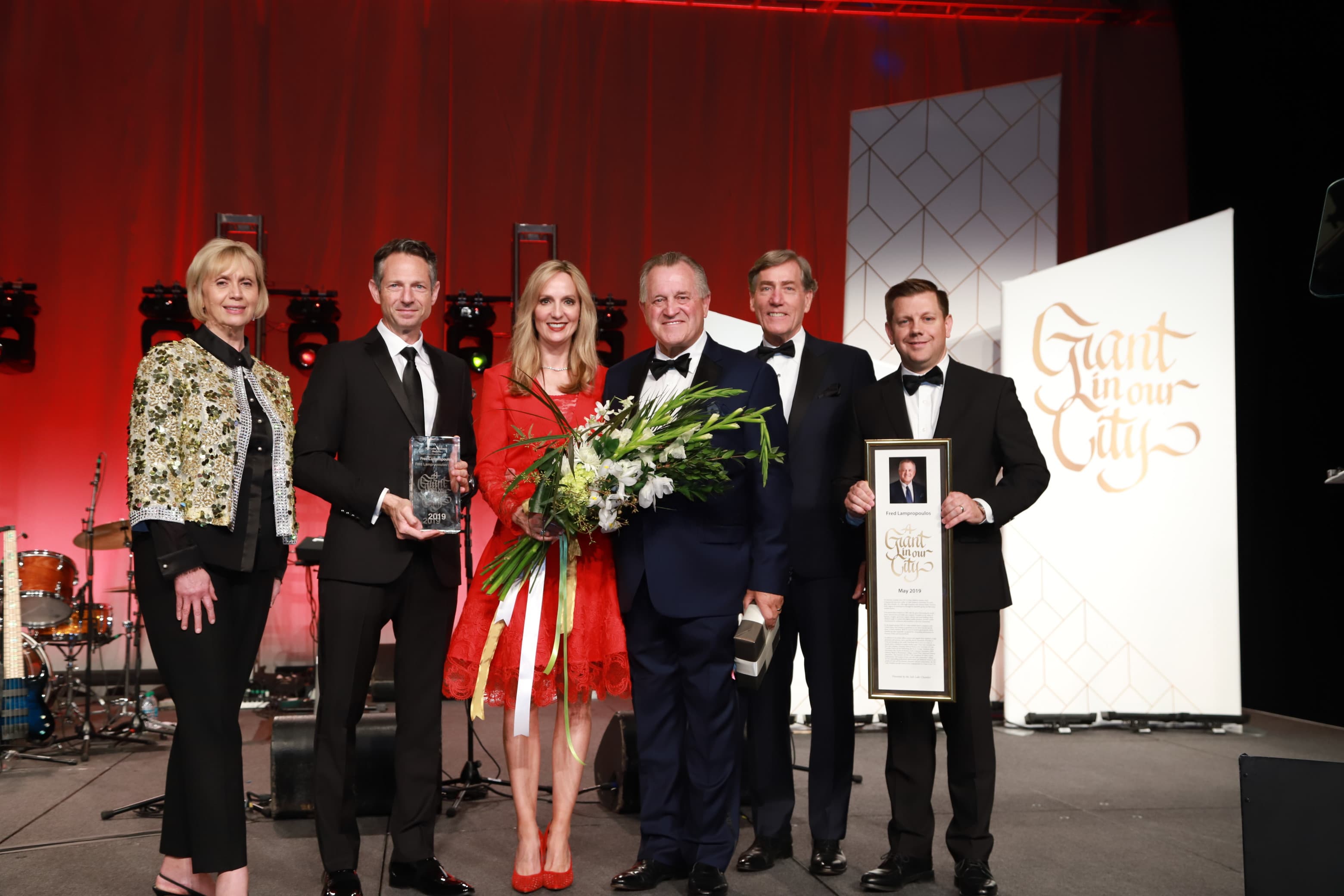
In 2019, he received the Salt Lake Chamber’s Giant in Our City award and MountainWest Capital Network’s Entrepreneur of the Year honor. He played guitar at the Chamber celebration. An evening dedicated to the executive made space for the musician, a sensible precaution when the guest of honor has brought both careers along.
That same year, NUI Galway appointed him an honorary adjunct professor of engineering, with a role mentoring staff and students. Merit’s European headquarters were in Galway, where the company then employed about 1,000 people. The university relationship gave the international business a local connection beyond its factory gates. For someone whose own college studies had ended early, being invited into another generation’s education made a particular kind of circle.
The founder hands over the clock
The hundred-year plan depended on a distinction Lampropoulos made in public: creating lasting value required sustained investment in an organization’s knowledge and people. In discussing acquisitions, he emphasized retaining facilities and expertise. The useful things inside a business included what its employees knew how to do, and those things could be lost if the people left.
Eventually, the founder’s own departure put continuity on the calendar. Martha G. Aronson became Merit’s President and CEO on October 3, 2025. Lampropoulos moved into the Executive Chair position, with that employment ending on January 3, 2026. He resigned as director and board chair effective January 4. F. Ann Millner became chair the following day.
A three-month consulting agreement covered the next part of the transition. These dates give the long story a necessary precision. The founder who had spent decades explaining Merit was no longer its chief executive or its board chair. Other people now occupied those seats.
His final public quarterly call, in July 2025, had offered a more personal farewell. He thanked the investment community for what it had taught him, including the criticism that had brought necessary matters to his attention. After so many years of questions, he acknowledged that the questions had helped.
In May 2026, the Salt Lake Chamber gave him a North Star Award. The civic recognition continued after the executive tenure had ended. Merit, meanwhile, had entered the portion of his ambition that required successors. A hundred years was always going to need more than one person’s working life. The next meeting could go ahead without him.