The first thing Mike Schrobo distrusted was not a bot. It was the tidy story inside an advertising dashboard. For more than two decades, he managed performance campaigns, including multimillion-dollar budgets, and watched fake leads, repeat clicks and suspicious bursts of activity slide past the standard safeguards. The numbers said the campaigns were moving. The sales results sometimes said otherwise.
That irritation became Fraud Blocker, the Los Angeles software company Schrobo founded in 2019 with fellow performance marketer Brandon Tome. Their premise was almost impolite: an ad platform sells the traffic, counts the traffic and judges whether the traffic was legitimate. Advertisers might want a second opinion.
Fraud Blocker supplies it as a subscription. A customer connects Google or Meta ad accounts, installs a tracking tag on a website and lets the software watch incoming visits. It looks for repeated clicks, headless browsers, mismatched locations, VPNs and Tor nodes, questionable IP history, visits that end almost instantly, and devices cycling through an implausible number of addresses. Each visitor contributes to a fraud score. Rules determine what gets blocked, and exclusions can be pushed back to connected campaigns.
01 / The productA bouncer with a spreadsheet
The blocker metaphor sounds final. The actual product is more like a nightclub bouncer who keeps notes. An IP address matters, but it is only one clue. Device fingerprinting can connect activity that moves between addresses. Geolocation can expose a visitor apparently teleporting between countries. Timing and cursor motion provide behavioral hints. A public blacklist adds context. No single item proves fraud, so customers can tune thresholds to suit their own tolerance for risk.
That last point separates a useful security control from an overeager door policy. A VPN user can be a customer. A fast visit can be a mistake rather than a scam. A household or office can produce many clicks from one network. Fraud Blocker packages many imperfect signals, gives the marketer a view of the decision, and lets the account decide how aggressively to act.
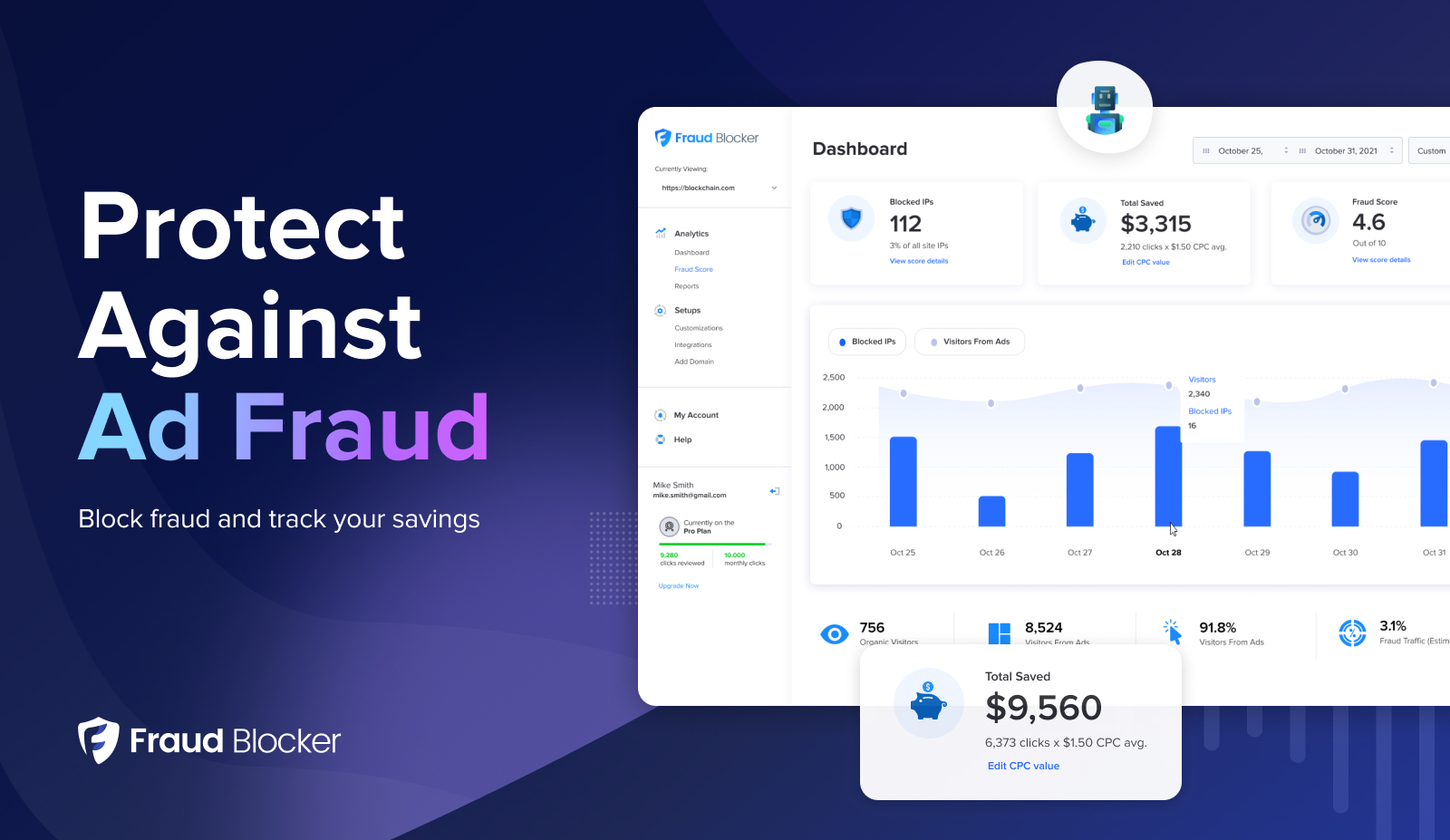
The dashboard reports invalid clicks, estimated savings and traffic by fraud type. Agencies can separate client accounts, invite team members, apply white labeling and send data into their own dashboards. The 2026 API exposes reports, domain management and email verification; a Zapier connection can route results to Sheets or Slack, while Snowflake datasets serve teams that want rawer material. A WordPress plugin reduces installation to entering a Domain ID.
Schrobo’s answer is funny because it is so small. Over one visit, software can imitate a person. Over 30 days, the human mess - inconsistent mouse speed, pauses, crooked paths, changes of mind - becomes harder to reproduce. Fraud Blocker says it now studies mouse velocity and conversion paths alongside device and network signals. The contest is not human versus machine in the abstract. It is one pattern trying not to look like a pattern.
02 / The buyerWho pays for doubt?
The natural customer is anyone for whom a bad click has a noticeable price: a local service business buying expensive search terms, an ecommerce brand scaling campaigns, a lead-generation company, or an agency responsible for dozens of client budgets. Fraud Blocker says it serves more than 4,500 client accounts across 20,000 domains and analyzes 60 million IP addresses a month. Those are company-reported figures, useful as a view of claimed scale rather than an audited census.
The business model is ordinary SaaS, which is a compliment. Monthly plans are tied mainly to ad-click volume and domains. As of August 2026, Standard costs $79 a month for 5,000 clicks and one site. Pro begins at $99; Enterprise begins at $489. Quarterly and annual payment reduce those rates. There is a seven-day trial, no required long-term contract and no overage bill - protection pauses when the click allowance runs out unless the customer upgrades or waits for the next billing cycle.
The useful ROI test is not “Did the dashboard find fraud?” Of course fraud software will find something suspicious. The better question is whether blocked traffic improves qualified leads, sales, acquisition cost or return on ad spend after the subscription and staff time. One public customer testimonial says Fraud Blocker saved $200 during a week with $4,000 in Google Ads spend. That is specific and promising, but it is still one customer account, not a universal ratio.
03 / The wedgeThe click was only the first invoice
A fake click charges three times. First comes the media cost. Then a fake form submission enters the CRM and consumes a sales rep’s afternoon. Finally, if the ad network treats that form fill as a conversion, automated bidding learns to seek more traffic that resembles it. The fraud has become a lesson taught to the algorithm.
This explains Fraud Blocker’s expansion beyond IP exclusion. Email Spam Protection checks addresses as they enter lead forms and can block visitors who submit invalid ones. Dedicated email analytics arrived in June 2026. AI-powered reporting, still described as beta, lets users ask questions of visitor logs and generate charts rather than scroll through rows. The product is moving from “stop that address” toward “explain the quality of this audience.”
The market is crowded. ClickCease, CHEQ Essentials, Lunio, PPC Protect and TrafficGuard chase much the same budget. Larger security or verification vendors such as HUMAN Security, DataDome and DoubleVerify overlap at the edges. The free alternative is to trust native invalid-traffic controls, monitor analytics manually and ask an ad network for refunds. Fraud Blocker differentiates on transparent click-based pricing, direct controls, agency features and a product that a small marketing team can install without becoming a security operations center.
Its deeper distinction is organizational. Ad fraud often lands between departments. Marketing owns the budget; security understands bot infrastructure; finance sees the waste after both. Schrobo talks about malware-driven “ghost click farms” - distributed networks using residential IPs, browser extensions or mobile software rather than a picturesque wall of phones. That language moves the problem out of campaign optimization and into cybersecurity, where persistent access to a device can carry risks beyond one ad click.

04 / The lessonWhat a reader can steal
The founders’ change of mind is the cleanest part of the company story. They did not begin with a new machine-learning technique in search of a problem. They began with a cost they could see but could not explain, then concluded the existing referee had conflicted incentives. The first failure was the standard safety net: platform controls did not catch enough of the fake leads, automated activity and aggressive repeat clicking they observed. The response was an independent measurement layer.
Borrow the experiment, not the anxiety
- Choose one campaign with enough spend and a measurable sales outcome.
- Record qualified leads, revenue, acquisition cost and the platform’s invalid-click rate.
- Run an independent detector through a representative period, not a dramatic weekend.
- Review false positives and tune rules before enabling aggressive automation.
- Keep the tool only if business outcomes improve after its full cost.
There is a broader product playbook here. Find a line item customers already suspect. Create an independent audit trail. Turn the findings into an action, not another dashboard. Price below the likely waste. Then expose the data so sophisticated customers can carry it into their own systems. Fraud Blocker’s newer APIs, datasets and no-code integrations follow that progression almost literally.
That uncertainty matters. Agentic browsers may research products for humans, trigger retargeting pixels and return later with a buyer attached. They are neither conventional customers nor necessarily malicious bots. Block them all and an advertiser could discard useful demand. Count them all as people and the attribution model becomes fiction. Fraud Blocker has proposed treating agents as a separate traffic class and, eventually, requiring verifiable credentials. For now, that is an industry problem without a settled technical or economic answer.
When the playbook breaks
The subscription is harder to justify when ad spend is tiny, campaigns run briefly, most traffic comes from unsupported networks, or the business cannot connect clicks to qualified leads and sales. Direct automated protection currently centers on Google and Meta. Other networks may require exporting IP lists and importing them manually. And because legitimate people use VPNs, shared networks and unusual browsing patterns, aggressive settings can reject good traffic. Detection is a decision aid, not a divine judgment.
05 / The betCan a small team keep up?
LinkedIn places Fraud Blocker at two to ten employees; supplied company data says nine. Smallness can be an advantage when customers want quick setup, visible pricing and contact with someone who understands paid media. It can also be a liability in an arms race where fraud networks mutate, ad-platform policies change and support spikes after a marketplace promotion. AppSumo reviews include enthusiastic accounts of easy setup and savings, alongside complaints about connections, reporting and delayed support. The fair conclusion is not a star average. It is that buyers should use the trial and verify results against their own ledger.
The company’s 2026 release pace suggests it knows blocking alone is not a durable moat. Email verification, AI reporting, APIs, Snowflake access and WordPress installation turn one narrow tool into a traffic-quality layer. If that layer helps marketers distinguish humans, malicious automation and useful agents, it earns a place in the stack. If it merely produces a larger number labeled “saved,” the old dashboard problem returns wearing a different logo.
Fraud Blocker’s best idea is therefore its least theatrical: watch the fundamentals. Clicks and conversions can be imitated. Revenue is more stubborn. The marketer should compare suspicious patterns with sales, tune the rules, and keep asking whether the busy chart corresponds to a busy business. The ghosts do not need to disappear completely. They only need to stop getting the advertising budget.