Chad’s backyard workshop in North Texas has a demanding tenant: his livelihood. Vehicle builds, video production and conference calls all need electricity. Storms interrupt the local supply. His answer, documented in a FranklinWH customer story, was an aGate controller and two aPower 2 batteries, holding 30 kilowatt-hours between them. The installation also had to satisfy the homeowners association. Energy independence, apparently, must look respectable from the street.
- FranklinWH coordinates batteries, solar, grid power and optional backup sources.
- Its aPower 2 stores 15 kWh and delivers 10 kW continuously.
- Existing solar owners can add AC-coupled storage; aPower S also connects directly to solar.
- Backup duration and financial returns depend on the house, its tariff and the installation.
A workshop cannot wait for the weather
“I can’t afford any down days,” Chad says. The first weak link in his account was the electricity supply that supported his work. He wanted his property to generate, store and manage energy locally. Prometheus Power Solutions put the batteries behind the garage and routed the wiring discreetly. The result was a power system designed around work, weather and neighborhood rules. That combination says more about the market than a photograph of a handsome white cabinet ever could.
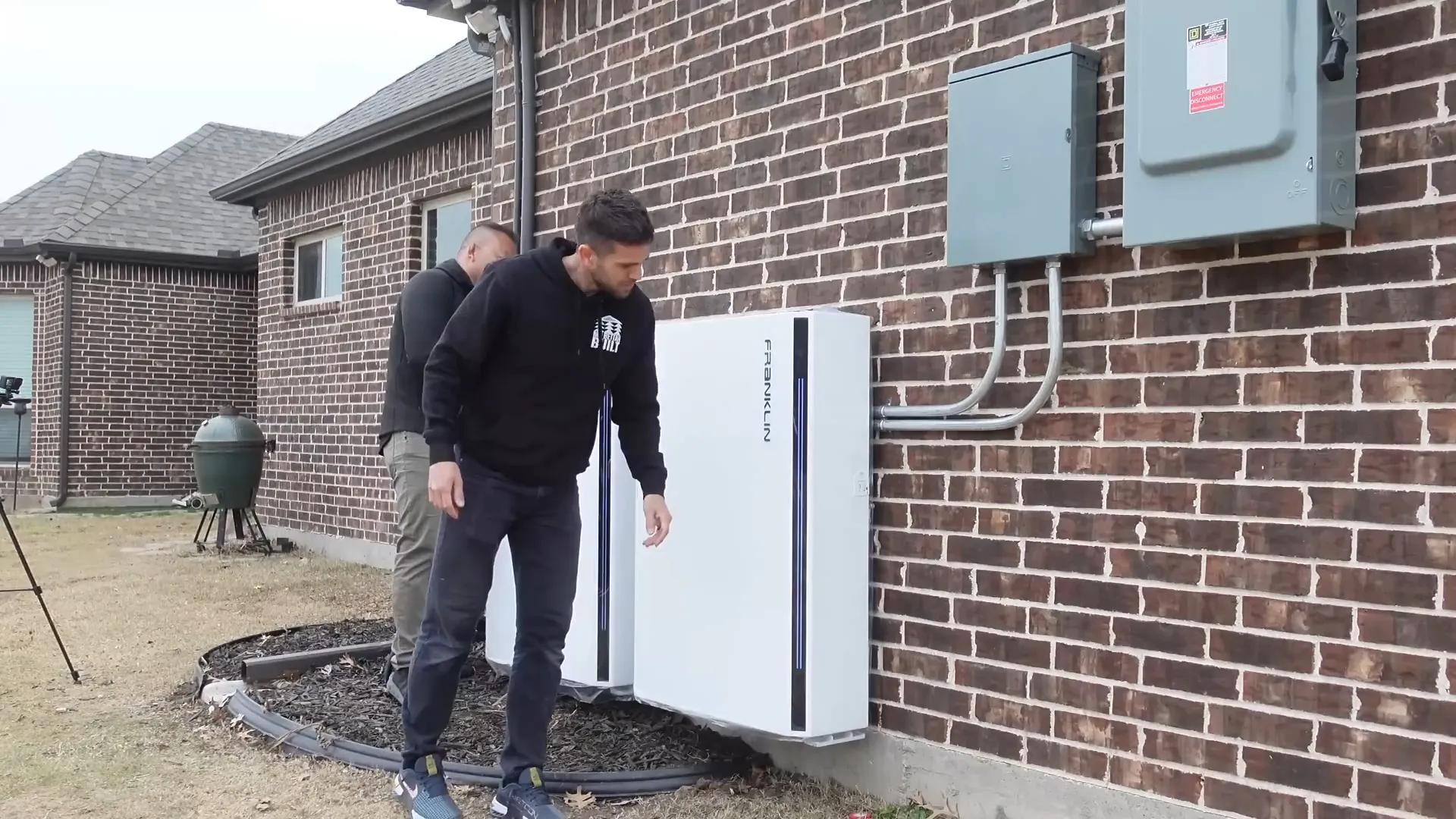
The cabinet with the less glamorous job
FranklinWH manufactures residential energy storage and management systems. Its organizing idea is that a house has several electricity sources, each useful under different conditions. Rooftop solar produces when sunlight permits. The grid supplies power at prices the homeowner rarely controls. A battery stores electricity for later. A generator can extend backup when the weather refuses to cooperate.
The aGate coordinates these sources and household loads. Optional Smart Circuits let owners schedule or disconnect selected appliances. That matters because a pool pump and a refrigerator have different claims on the remaining reserve. The app offers self-consumption, time-of-use and emergency backup modes. Its optional Storm Hedge feature uses National Weather Service alerts to prepare the battery for a possible outage.
*Optional module and compatible installation required. Simplified system diagram.
The distinction between capacity and power is crucial. The aPower 2’s 15 kWh describes stored energy; its 10 kW continuous rating describes delivery speed. A large reserve with inadequate output cannot run every demanding appliance together. High output with a modest reserve may run them beautifully, briefly. “Whole-home” describes an intended configuration, not permission to ignore arithmetic.
Illustration: 15 kWh ÷ constant load. Ignores reserve, losses, changing demand and recharging; not a runtime promise.
Keep the roof. Change the wiring logic.
FranklinWH’s useful competitive position begins with compatibility. The AC-coupled aPower 2 connects on the alternating-current side of the system, making it an option for adding storage to existing solar equipment. Owners comparing it with Tesla Powerwall, Enphase IQ Battery or sonnen should ask how much equipment their particular project requires them to replace.
The aPower S, launched in 2025, adds an integrated solar inverter and direct solar connection. It gives FranklinWH another route into new installations, where the customer is choosing solar and storage together. The choice between the two products follows the roof and electrical design. A newer model name alone is a poor purchasing strategy.

The electrician is part of the product
Co-founder Gary Lam’s route to home storage began with a college solar course and Solar Decathlon projects. He later worked as an R&D engineer at Petra Solar, where home batteries caught his attention. FranklinWH was founded in 2019 and introduced Franklin Home Power to the US market at Intersolar in January 2022.
By August 2023, the company said it had onboarded more than 1,000 installation companies. Its $25 million Series B, led by Particle Future, was earmarked for research, supply chains, operations and its sales network. The business sells physical systems through an installation channel. An electrician’s ability to design, commission and service the equipment is consequently part of what the homeowner buys.
Manufacturing is another part. FranklinWH says its Santa Clara facility moved from pilot runs to scaled battery production in 2025, handling battery packs and complete aPower assembly. Its stated culture emphasizes research and exchange between disciplines. In this industry, collaboration has a practical test: whether hardware, software and installation behave as one system at someone’s house.
Your battery gets a second job
In September 2026, FranklinWH reported that Hawaii Energy Connection had installed 1,800 aPower units in more than 1,000 homes. That is one partner’s regional footprint, but it illustrates how storage grows through local expertise. Meanwhile, integrations with Virtual Peaker and EnergyHub let eligible utilities coordinate household batteries during periods of high demand.
The company reported participation in more than 28 US utility-led virtual power plant programs when Ke Bi became global CEO in August 2026. Here, energy independence acquires an interesting qualification: a battery can reduce a household’s dependence on the grid while helping the grid serve everyone else.
“In our evaluation, FranklinWH stood out for both technical performance and customer experience.”Shoshannah Lenski · Ann Arbor Sustainable Energy Utility
Ann Arbor’s city-led pilot points toward another customer: public institutions seeking wider access to solar and storage. FranklinWH’s announcement describes approximately 150 participating homes initially, with expansion to 1,000 expected in 2027. Texture’s software is intended to aggregate the systems. Those are deployment plans, not completed installations.
Start with the bill, then the breakers
EnergySage’s May 2026 review puts a typical installed aPower 2 system at $17,655 before incentives. A local quote may differ substantially. Competing systems, electrical work and additional batteries change the comparison. Savings depend on when electricity is expensive, how solar exports are paid and which programs the owner can actually join.
The useful lesson to copy is a sequence: identify indispensable loads, measure demand, choose backup duration, then price the design. If electricity prices barely vary and solar exports already earn favorable payments, daily savings may offer little justification. If outages last for days without a replenishing source, stored energy eventually runs out. FranklinWH makes the household’s options more manageable. The household must still decide what deserves the power.