The helicopter was a reward for doing well in an exam. Frank Wang had wanted one for years. Growing up in Hangzhou, he read about model aircraft and imagined a flying companion, something that could follow him and bring back pictures. At sixteen, he finally got his remote-controlled helicopter. He crashed it. Replacement parts took months to arrive. Gravity had made its opening argument, and it was annoyingly persuasive.
A model helicopter asks quite a lot of its owner. It must be assembled, understood and coaxed into the air. Keeping it there is another matter. Wang’s disappointment contained a useful question: why should something so appealing require such an apprenticeship? The machine demanded that a person become a better pilot. His career would revolve around making the machine carry more of the burden.
Born in 1980, Wang belongs to a generation that watched Chinese manufacturing become part of almost every household. His own interest was intensely particular. A red helicopter in the children’s comic Grandpa Think-Hard stayed with him. He wanted a little aircraft of his own, with the freedom to see from somewhere other than the ground. “I just wanted to fly so badly,” he recalled in 2015.
A professor leaves the door open
Wang entered the Hong Kong University of Science and Technology in 2003. There, the childhood fascination acquired the vocabulary and tools of electronic engineering. He completed his bachelor’s degree in 2006 and an MPhil in electronic and computer engineering in 2011. The overlapping dates matter: DJI began in 2006, while its founder’s formal education was still under way. The company and the research grew together.
Robotics professor Li Zexiang became his graduate supervisor and an early supporter of the business. That relationship gives the familiar dorm-room founding story some necessary company. A student can bring obsession; a university can provide equipment, instruction and people who recognize a project before it resembles a business. Wang’s ambitions had somewhere to land, and someone willing to take them seriously.
In 2014, Wang credited Hong Kong’s research environment with helping turn his enthusiasm into a sustainable commercial project. The following year, DJI established a research and development team at Hong Kong Science Park. He pointed to the universities, international talent and proximity to Shenzhen. His working geography joined two places with different contributions: research in Hong Kong, and the practical business of making things across the border.
“I would not have achieved what I achieve today if I had not come to Hong Kong.”
Frank Wang · 2015
The difficult business of doing nothing
The title of Wang’s 2011 master’s thesis sounds modest: Control systems for autonomous helicopters. Its abstract describes a thoroughly uncooperative object. A helicopter is unstable. It needs rapid control signals; its behavior changes with its design; its movements interact. The controller must also remain small and light. Every solution, in other words, has to be carried into the air by the problem.
Hovering looks like an absence of activity. In engineering terms, it requires continual work. Wang’s research addressed the control systems that let a small aircraft manage that work. For the eventual customer, this mattered in a wonderfully ordinary way: the machine could become less demanding. Someone interested in taking a photograph might spend more time thinking about the photograph.
Two kinds of steadiness. One usable picture.
There was a second problem below the aircraft. A flying camera inherits the aircraft’s movements, which is inconvenient when the point is a watchable image. DJI developed stabilized camera supports, or gimbals, as well as flight controllers. The distinction is easy to miss from the ground. A drone that stays aloft and a camera that stays composed are separate accomplishments.
These technologies also created uses beyond recreation. In 2017, DJI received a Technology and Engineering Emmy for its airborne video platforms. Its drones had appeared on productions including Better Call Saul and Game of Thrones. A childhood wish for pictures from the air had become equipment for other people’s stories. Wang did not need to appear on screen for the work to be visible.
The box that changed the customer
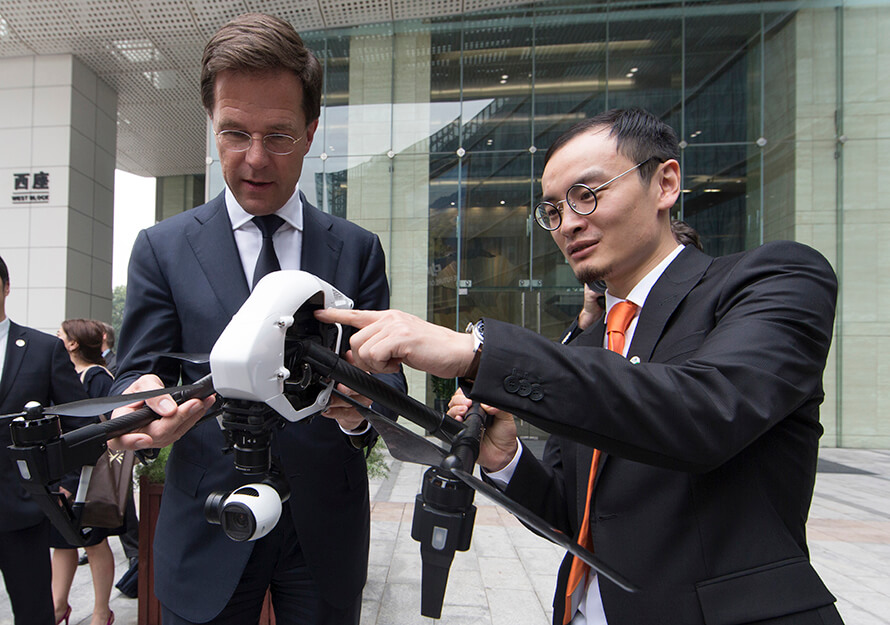
On January 7, 2013, DJI announced the Phantom at $679. Its white body contained a GPS-based autopilot, and the package included a remote controller and a mount for a GoPro camera. The original Phantom did not have an integrated camera. That small historical detail is useful: the familiar flying camera arrived through successive decisions, rather than springing fully formed from a founder’s imagination.
Earlier multirotor aircraft often required building and soldering. The Phantom brought the assembly and control system into a ready-to-fly product. That altered the invitation. A prospective buyer could be interested in aerial images without first being interested in assembling an aircraft. Reducing the preparation expanded the kinds of people who might see a reason to buy.
A ready-to-fly aircraft, remote control and GoPro mount. Camera sold separately.
In his early account of DJI’s ambitions, Wang described a much smaller aim: supporting a team of ten or twenty people. The eventual scale makes that recollection amusing, but it also keeps the origin in proportion. A business can begin with a saleable answer to a narrow problem. The size of the opportunity need not be obvious to the person holding the screwdriver.
By July 2015, DJI had customers in more than 100 countries and employed about 3,000 people worldwide. Its equipment was being used in film, farming, construction and other industries. Each application asked something different of the same basic proposition: put a controllable machine somewhere a person or conventional camera would find difficult to reach.
Precision has a social cost
Wang’s standards have never been confined to the aircraft. In a 2014 interview, he described being so intent on winning a university robotics competition that teammates found him difficult to work with. He recognized that his approach caused problems. Reading about Steve Jobs then offered encouragement to the part of him that preferred demanding results to being agreeable.
It is a revealing account because Wang supplied both sides himself. He understood the discomfort and still believed forcefulness could help build a company. Technical conviction can be productive; working beside it can be exhausting. The same person can be right about a machine and difficult about a meeting. His story gives no reason to pretend those qualities cancel each other out.
There is a useful counterweight in his connections. Li remained part of the story long after graduate school. In 2019, Wang and Li received the IEEE Robotics and Automation Award together for their work on civilian drones and aerial imaging. Recognition arrived with two names on it. The student’s determination had benefited from a professor’s judgment, and the engineering community acknowledged the partnership.
Give the engineers an arena
Wang also wanted engineering to acquire some of sport’s spectacle. During a 2015 visit by IEEE leadership, he discussed RoboMaster, DJI’s student robotics competition. His ambition was that its winners might become stars, with an audience comparable to basketball’s. It is an unusually theatrical wish for a founder who generally prefers the workshop to the spotlight.
RoboMaster gives university teams a practical assignment: build robots, program them and compete. A circuit diagram must eventually survive contact with another team’s circuit diagram. DJI’s account of the event lingers on the work around the arena: dismantled chassis, wiring and students absorbed in code. It is easy to see why a former student inventor would find that scene familiar.
Here the childhood story opens outward. Wang had wanted access to a flying machine. The competition offers other young engineers access to a stage for their own machines. The audience sees the match; the participants have already spent their time learning what breaks. A robot tournament allows the messy business of engineering to keep some of its entertainment value.
A larger machine to understand
In September 2022, DJI opened Sky City, its Shenzhen headquarters, designed with Foster + Partners. The two towers include spaces for testing drones indoors. Wang said the headquarters had taken six years to build. A company born around small aircraft now occupied buildings designed partly around their movement. Even the office had acquired an airspace problem.
On January 10, 2026, HKUST honored Wang among the first recipients of its Distinguished Engineering Alumni Award. Then, in an April interview, he revisited the harder parts of running DJI. He spoke about reflection, his public image and the distance between making products and managing people. The account included a homely detail: four cats lived in his office.
The teenager’s problem had been an aircraft he could not control. Twenty years into DJI, Wang was describing another demanding system, populated by people with judgments of their own. Read beside his earlier accounts, the change is striking. There is more room for self-examination. The engineer who wanted machines to become easier for people was taking another look at how he worked with people himself.
The helicopter from Hangzhou offers a fitting place to leave him. It broke, and the waiting was long. What followed required teachers, collaborators, manufacturing and repeated attempts to make flight less temperamental. Plenty of childhood presents end up in a cupboard. This one left its owner with a question he kept working on, long after the replacement parts arrived.
Keep exploring
The work, the conversations and the engineering.