Frank Lautenberg went into business selling insurance. Then a customer sold him something more interesting: a payroll company. Henry Taub had a small operation in Paterson, New Jersey, and Lautenberg could see a market for it. “I sold Henry some insurance, and he sold me on his company,” he recalled. It is a pleasingly economical account of a career change. Each salesman appears to have closed.
The company would become Automatic Data Processing, known as ADP. Lautenberg became its early salesman, a partner, and eventually chairman and chief executive. In 1982, at 58, he won election to the United States Senate. The first career had occupied roughly thirty years. The second would occupy much of the next thirty, with a retirement in the middle that did not take.
Payroll rarely supplies the opening scene of an adventure. Its essential drama is that nothing dramatic should happen. People work. Their wages arrive. The business keeps its records straight. Lautenberg found opportunity in this quiet obligation, long before his name appeared on ballots or on a New Jersey railway station.
Thirteen schools, one way out
He was born in Paterson on January 23, 1924, the son of Jewish immigrants. His father, Sam, worked in the silk mills and tried other ways of making a living, including selling coal and farming. The family moved repeatedly. Frank attended thirteen schools in twelve years. A childhood like that gives the ordinary phrase “settling in” rather a lot to do.
Education became the route out. After graduating from Nutley High School in 1941, Lautenberg entered the Army during World War II. He served in the Signal Corps in Europe. When he returned, the GI Bill made Columbia possible. He graduated in 1949 with a degree in economics.
Decades later, he credited that education with widening the range of futures he could imagine. The significance was larger than a collection of subjects mastered. College opened a horizon. That is a useful distinction in a life often reduced to two job titles and a fortune: before Lautenberg could sell anyone on a new arrangement, he had been given access to one himself.
Prudential provided his early sales work. Payroll provided the opening that held his attention. He began bringing customers to the Taubs' young firm before joining it full time in 1952. He had found something worth explaining to people, and people willing to pay for the explanation's practical result.
Automatic, with considerable human effort
Henry Taub had started Automatic Payrolls in 1949. Its name was optimistic. The early work relied on mechanical bookkeeping equipment rather than the computers later associated with ADP. “Automatic” described the relief experienced by a customer handing over a task. Someone at the other end still had to do it.
The partnership had complementary strengths. Henry brought accounting, Joe Taub organization, and Lautenberg marketing. The arrangement matters because the familiar story of a technology company often concentrates on the machine. Here, a person had to persuade employers to entrust a recurring obligation to an outside business. That was Lautenberg's part.
He described customers as concerned with the company's “ability to deliver the promised service.” The observation sounds modest. It is also a demanding sales standard. A payroll customer has a recurring opportunity to discover whether the promise was worth believing. There is no shortage of Fridays.
“I sold Henry some insurance, and he sold me on his company.”
Frank Lautenberg, recalling the start of his ADP career
By 1957, the firm was introducing punched-card processing. In 1961, renamed Automatic Data Processing, it went public and leased its first computer, an IBM 1401. The business existed before the equipment that would accelerate it. The customers and the task were already there.
It is possible to see the computer as the turning point and miss the preparation. A faster way to process information becomes commercially useful when someone has organized a service people want. Lautenberg's place in ADP's early trio gives the selling its due. Accounting, operations, and persuasion each had a job.
Automatic Payrolls
the young firm
leases an IBM 1401
the second CEO
A bigger business, then a different brief
ADP expanded beyond payroll into other forms of business recordkeeping. Brokerage processing became a major business in 1962; services for automobile dealers followed as a major unit in 1972. The territory was changing, but the underlying proposition remained recognizable: undertake the information work another business needs done.
Lautenberg became ADP's second chief executive in 1975. The company then had 35,000 clients and revenues of $155 million. In 1982, when Josh Weston became its third CEO, the corresponding figures were 100,000 clients and $670 million. Those dates describe a company growing substantially during Lautenberg's leadership, with a business built by more than one person.
Two historical snapshots, seven years apart. Bars share a zero baseline.
His interests had already spread beyond the company. He served as a commissioner of the Port Authority of New York and New Jersey from 1978 to 1982. He also supported Democratic candidates financially. Public service was becoming a possible next occupation rather than an item left to other people.
A chief executive's next chapter can be pleasantly predictable: a few boards, a few speeches, a little more freedom with the calendar. Lautenberg chose an election. That meant putting an established business career before an electorate which was under no obligation to be impressed.
The salesman meets the ballot
In 1982, his Republican opponent was Millicent Fenwick, an established congresswoman. Lautenberg won. He entered the Senate in December, after a career spent making the case for a service. He would now have to make the case for himself, repeatedly, and for legislation in a chamber where a persuasive presentation is only part of the work.
He won reelection against Pete Dawkins in 1988 and Chuck Haytaian in 1994. His campaigns could be combative. The neat business biography, in which success supplies a serene passage into civic duty, does not quite accommodate New Jersey elections. Lautenberg had stepped into a profession that asks its practitioners to keep proving they belong.
He could answer vulnerability with a joke. When announcing his retirement, he said, “Mr. Vulnerable always wins.” The line had four words and a useful amount of swagger. A record of winning had given him something to point to, although even he could not turn the electorate into a standing order.
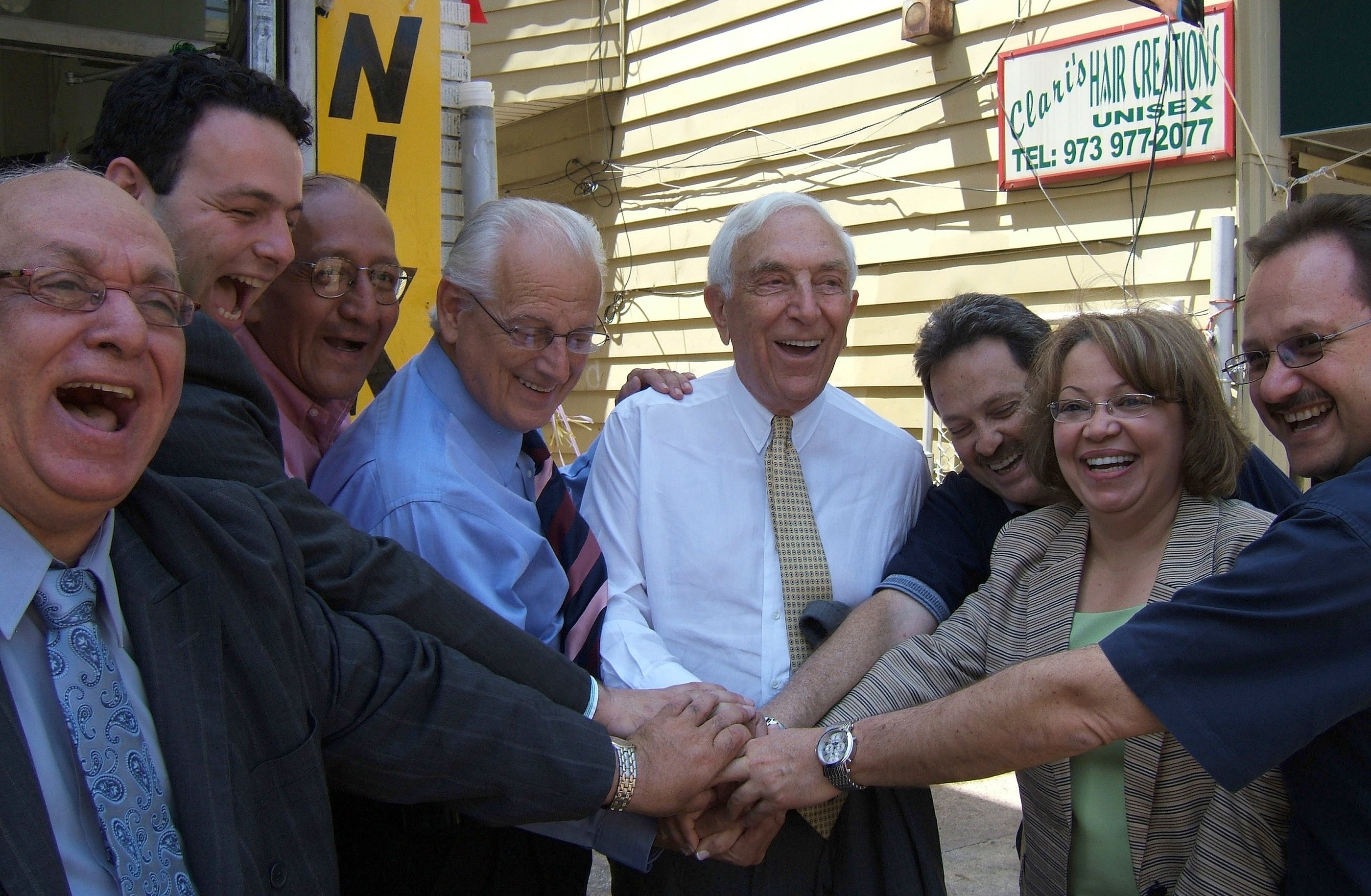
His legislative work included two quite different measures bearing the Lautenberg name. The 1989 refugee amendment changed the treatment of designated groups seeking admission to the United States, including Jews from the Soviet Union. His own family's immigrant history gave that work an evident personal context.
In 1996, another Lautenberg Amendment extended federal firearm restrictions to people convicted of qualifying misdemeanor crimes of domestic violence. The two measures addressed different problems through the same instrument: a change in the rules by which institutions make decisions about people.
A name commuters have somewhere to go past
For many New Jersey travelers, Lautenberg's name belongs to a transfer station. Secaucus Junction was dedicated as the Frank R. Lautenberg Rail Station in 2003. He had helped secure the federal money to build it. The station connected railway lines that had needed a way to meet.
At the opening, NJ TRANSIT described the new facility as linking ten of its eleven rail lines. Passengers could make journeys across a network that had previously required less convenient connections. For a politician's memorial, a place designed to help people leave is an appealing choice.
He supported Amtrak and New Jersey public transportation through his Senate career. These were concrete commitments, expressed in budgets and projects. A commuter may never think about the legislative work behind a transfer. That is precisely how useful infrastructure usually announces its success: the connection becomes ordinary.
There is a family resemblance between this work and payroll. Both concern arrangements people need in order to get through the day. Neither benefits from requiring the customer to admire the machinery. The comparison is a way of reading Lautenberg's two careers, rather than a claim that he planned them as a single business strategy.
Retirement fails to hold the account
Lautenberg left the Senate in January 2001. In 2002, Robert Torricelli withdrew from his reelection campaign, and New Jersey Democrats turned to the retired senator. Lautenberg ran against Doug Forrester, won, and returned in January 2003. He won his fifth term in 2008.
Returning involved an institutional indignity: his earlier seniority did not simply come back with him. He was an experienced senator returning as a freshman. He later identified the loss of seniority as a regret. Someone who had run a large company could appreciate how much an organization makes of where your name sits on the list.
He remained in office until his death on June 3, 2013. His accumulated service amounted to twenty-eight years, five months, and eight days. That made him New Jersey's longest-serving senator. There had been two sustained careers, and two periods in the Senate, rather than a brief public-service epilogue to a business life.
1982 · 1988 · 1994 · 2002 · 2008
In May 2024, he received the Presidential Medal of Freedom posthumously. The recognition followed his induction into the New Jersey Hall of Fame in 2015. The honors add dates to the story, while the business and the railway station provide less ceremonial ways to encounter it.
One final piece of bookkeeping continued surprisingly late. In October 2026, Lautenberg for Senate filed termination paperwork with the Federal Election Commission, more than thirteen years after his death. Reports described roughly $87,000 in remaining money distributed, with most going to the Lautenberg Foundation. Even the closing of a political career has accounts to settle.
His Senate colleague Jack Reed remembered Lautenberg's fond expression: “Only in America.” It fits the scale of the journey, from a frequently moving Paterson household to Columbia, ADP, and Washington. It also leaves room for the people and institutions along the way. Someone built the firm. Someone sold the service. Someone funded the education. Someone cast the vote.
The railway station is a particularly apt place to leave him. People arrive with work to do and somewhere else to be. The arrangement helps them get there. A payroll salesman from Paterson would have understood the appeal.
Follow the paper trail
- Archived Senate website · Historic Twitter account · Facebook · YouTube videos
- ADP’s illustrated company history, 1999 annual report · ADP company profile
- Lautenberg’s 2005 oral history interview · His papers at Rutgers
- The opening of Secaucus Junction · Hall of Fame tribute and video
- The 2024 Medal of Freedom announcement · The October 2026 campaign account filing