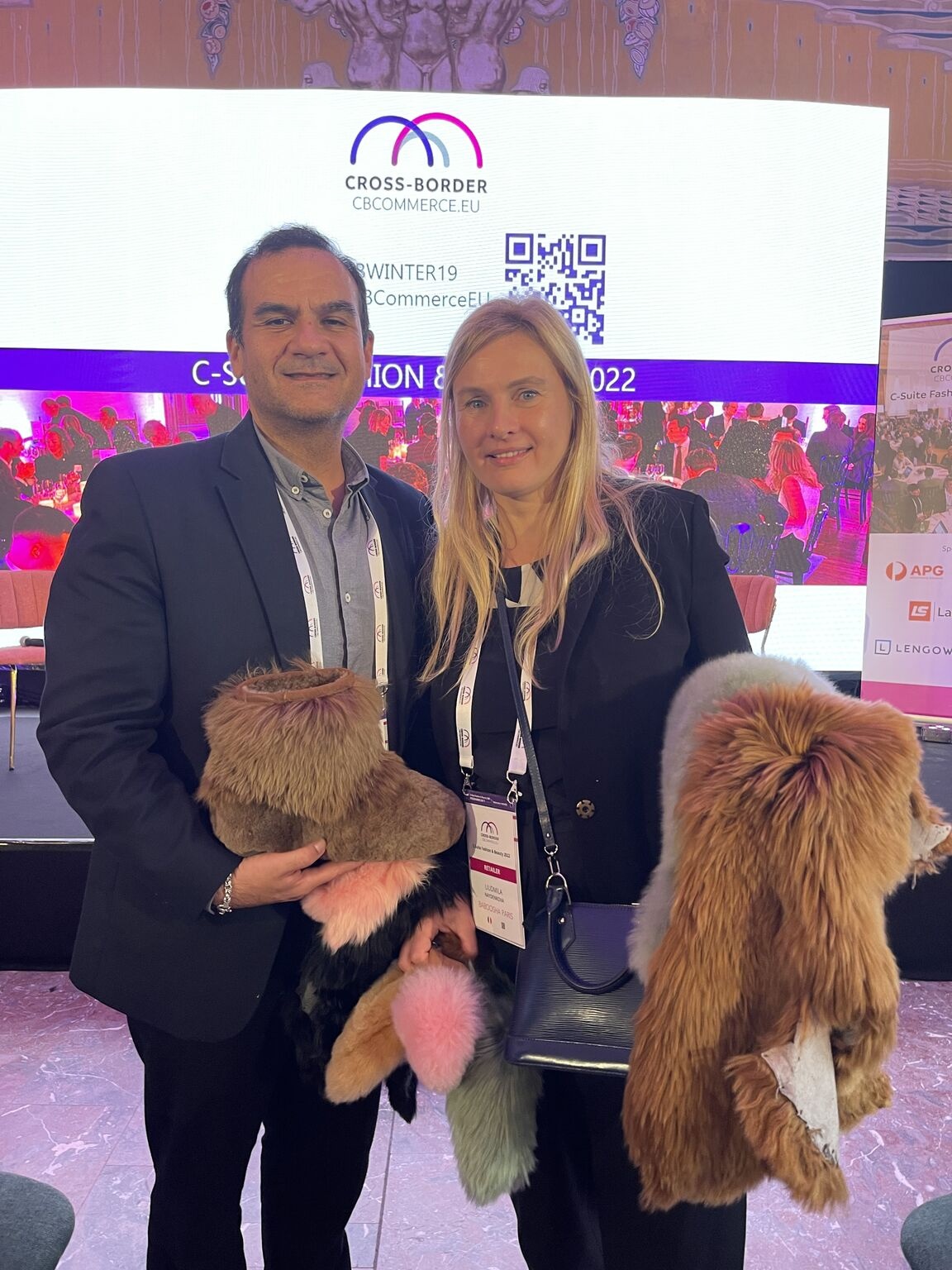
At a fashion and beauty event in Brussels in 2022, Frank Amoros posed beside creative director Liudmila Naydenkova with an armful of furry footwear. The photograph has the cheerful incongruity of business attire meeting something that belongs near a sofa. There is a jacket, a conference backdrop, a name badge. There are also slippers that refuse to be discreet. For a career spent around brands, it is a useful image: sooner or later, the business proposition has to become something you can hold.
Amoros was there as CEO of Baboosha, a Paris-linked consumer brand. Today, his work includes advising Mod Op’s CEO and leading Amoros Group. Between those settings lies a recurring professional problem. A company has an idea, a capability or an opening. Turning it into something another person will choose requires several kinds of work to meet.
That is the interesting part of his career. The job titles change the scale of the question. A pair of slippers asks it in one form. An agency seeking growth asks it in another. The practical decisions remain stubbornly specific: who is the customer, what are we offering, and who can help us deliver?
A product interrupts the pitch
Baboosha gives that question a tangible beginning. Amoros brought a prototype to Miami while developing the business. His collaborator Heather LeFevre remembered oversized white slippers, handmade in Peru. Amoros had been born there and raised in the United States; his subsequent working life had taken him to Paris.
The product connected those places, but geography alone could not make the brand. A prototype invites a different conversation from a finished advertisement. You can turn it over. You can question the shape. You can imagine the person buying it, then ask whether the object in front of you deserves that expectation.
There is an appealing discipline in working with something so ordinary. Footwear cannot survive entirely as a clever sentence. It has to occupy space in somebody’s home. The customer gets the last word, and the customer may be wearing pajamas.
For an agency professional, a consumer business changes the point of view. Advice becomes a decision with a consequence. A discussion about positioning has to account for the object being sold. The photograph, the purchase and the thing that arrives have to belong to the same promise. That connection makes Baboosha a revealing chapter in Amoros’s working life.
Let somebody else try the idea
In 2019, Baboosha entered another kind of room: The Woodshed, Alex Bogusky’s show about creative work. Amoros appeared with LeFevre and Leo Lourdais. Bogusky and guest host Courtney Loveman took on the brand’s challenge, proposing ideas to be tested in the marketplace.
The format is an interesting choice for a founder. A business can acquire its own private vocabulary surprisingly quickly. People close to it know the history of every decision. People encountering it for the first time know none of that history. They have a shorter question: why should this matter to me?
Putting the brand before outside creative thinkers gives that question some room. The exercise makes the founder’s idea available for reinterpretation. It also makes the creative process visible, including the point where a promising thought has to face an audience.
That is a useful connection to Amoros’s agency background. The work involves other people’s judgment. A founder may arrive with conviction; a collaborator arrives with another angle. The productive part is what they can do with the difference. Even a decidedly furry product benefits from a little friction.
Paris had another assignment
In April 2018, Kraft Branding appointed Amoros chief growth officer, based in Paris. Sandra Malone joined as managing director for Europe, based in London. Kraft was expanding its European presence, with a branding assignment for Belgian technology company Barco among its recent business wins.
By then, Amoros had more than twenty years of account-management experience. His agency background included Young & Rubicam, Wunderman, Publicis, Crispin Porter + Bogusky, Fullsix, Starcom and Creata. His brand work included AT&T, Diageo, Volkswagen, Viacom/CBS, Coca-Cola, Anheuser-Busch InBev and McDonald’s.
A list of organizations gives a career its outline. The appointment explains what Kraft wanted from that experience: agency growth and the ability to bring a network to bear on client work. Growth in this setting requires both an opening and a team capable of making use of it.
The division between Paris and London also gives the title a practical setting. International ambition eventually becomes a conversation between people in particular markets. An introduction has to lead somewhere. A proposition has to make sense to the person hearing it. The map is helpful; the relationship does the work.
Chief growth officer, Paris
The Woodshed appearance
Fashion & beauty roundtable
The listener in the account team
There is a less photogenic part of marketing that matters just as much: understanding the client’s business well enough to be useful. Former colleague Orlando R. Nieves recalled Amoros’s work on the BellSouth account at Bromley in Miami, including DSL product messaging. The detail matters. Internet-service messaging presents a concrete commercial question, with a product and an audience to understand.
Nieves described him as an attentive listener. Another colleague, Gui Ambros, emphasized his willingness to research, ask questions and obtain a team’s agreement before moving work forward. These recollections place the emphasis on preparation and participation.
Listening has an oddly modest reputation in a profession that produces so much language. Yet it changes what can be said with confidence. It gives an account team a way to understand the problem before organizing an answer.
The same habit becomes useful when responsibilities cross departments. A commercial question may need a creative answer, an operational change or a different sequence of decisions. Someone has to hear enough of the situation to connect those possibilities. An attentive listener can save a room from an eloquent answer to the wrong question.
The people behind the software
At Mod Op, Amoros’s public commentary has turned toward AI and the capabilities organizations need to use it. His emphasis is on people, processes and governance. He has highlighted discussions involving Tessa Burg and Michael Ditter that ask how technology becomes part of the way a business works.
“Technology ALONE doesn't win races, people with the right capabilities do.”
Frank Amoros
The line leaves room for a useful distinction between having access and being able to act. A tool can be available to everyone while useful judgment remains unevenly distributed. A team still needs to know which problem deserves attention, what a good result looks like and how responsibility will be shared.
Amoros has also welcomed Kenneth Phua’s description of leadership as an umbrella that gives people trust and space to execute. The metaphor is unusually domestic for a technology discussion. It points toward the conditions under which work becomes repeatable: people need room to learn and enough support to carry the work through.
His interest in customer relationships extends beyond the purchase itself. In discussing Stephen Trammell’s work at Nestlé Purina North America, he emphasized the value of helping customers across a broader journey. That concern brings the technology conversation back to a familiar marketing question. What experience does the customer actually receive?
He has praised Mod Op CEO Eric Bertrand’s focus on senior involvement, integrated creative and media work, and technology that supports people. Taken together, those interests suggest an advisor looking at how the pieces of a business fit. Buying the software is one decision. Organizing the work around it requires several more.
An advisory practice with a next step
Amoros Group brings those concerns into a practice serving CEOs and founders. Amoros leads its key advisory relationships, drawing on experience across the United States, Europe and Latin America. He works in English, Spanish and French. The firm maintains a focused senior core and adds collaborators when an engagement calls for specialist expertise.
Its published advisory areas connect growth and market positioning, AI and business transformation, and strategic opportunities affecting enterprise value. Those areas share a practical dependency. A company’s position affects whom it can reach. Its operating model affects what it can promise. Its relationships affect which opportunities it can pursue.
The firm describes a sequence of discovery, definition and activation. The last step asks for ownership, resources and a practical path forward. It is a sensible demand to place on a strategy. A recommendation becomes more useful when somebody knows what to do with it on Monday.
Seen across the career, that demand connects the account team, the Paris growth assignment, the consumer brand and the advisory practice. Each setting gives Amoros a different distance from the same problem. The work begins with a possibility. It acquires substance through decisions, collaborators and an experience that another person can recognize.
The Brussels photograph makes that substance unusually visible. Two people stand together with products in their hands. The footwear supplies the joke. The collaboration supplies the business. After all the language that surrounds strategy, there is something satisfying about an idea that can finally leave the meeting on somebody’s feet.