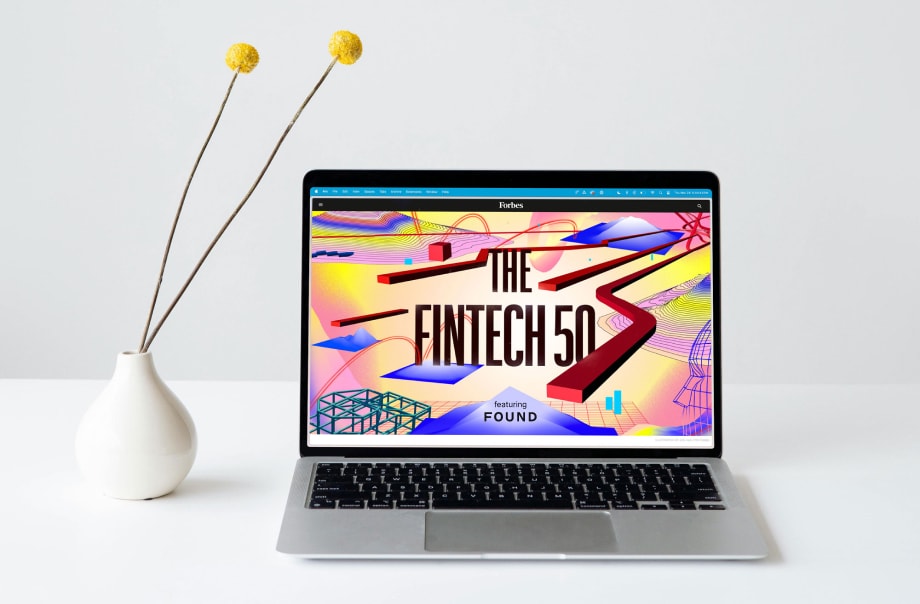
The freelancer who already paid her quarterlies, on time, without crying.
It is 11:42 p.m. on a Tuesday in Austin. A wedding photographer just deposited a $4,800 check from her phone. The app already knows roughly $1,180 of it isn't really hers - it's the IRS's. It moves the money into a tax bucket without asking. She closes the app and goes to bed.
That little choreography - deposit, categorize, estimate, set aside - is the entire reason Found exists. For most of the 64 million Americans who work for themselves, the moment a client pays them is also the moment a quiet panic begins. How much of this is mine? Is this rent money or tax money? Should I be saving a receipt right now? Found has spent six years trying to answer all three questions at once, in the background, while the photographer sleeps.
Self-employment is the fastest-growing tier of the U.S. workforce. The banking system mostly noticed in passing.
The numbers are louder than the marketing. Roughly 38% of the American workforce now does some form of self-employed work - photographers, plumbers, etherealist software consultants, dog walkers, etsy sellers, fractional CMOs. For decades, the banking sector treated this group as a rounding error: a personal checking account with a debit card and a vague feeling that you should "talk to an accountant in April."
That worked, sort of, until it didn't. Mixing personal and business spending turns bookkeeping into an annual archaeological dig. Quarterly tax payments get skipped because nobody can quite calculate them. Receipts go into a shoebox. Receipts go into a Google Doc. Receipts go nowhere. By the time a 1099 contractor's tax bill arrives, the money has been spent on more interesting things.
A bank account, an accountant, and a tax advisor walk into a bar. The self-employed have been buying drinks for all three.
Two Square veterans decided the only fix was to merge the three things into one.
Lauren Myrick spent eight years at Square - most recently running Square Payroll - which is to say she spent eight years staring at the tax and compliance plumbing under millions of small businesses. Connor Dunn was the engineering lead on that same payroll product. They had seen, up close, how often the friction wasn't a bank problem or a software problem. It was the seam between them.
Their bet, made in 2019: if banking and bookkeeping and taxes were all one product instead of three, the seams would disappear. The shoebox would become a database. The accountant would become a query. Quarterly tax payments would become a button. It is not a thrilling pitch at a dinner party. It is a thrilling pitch in front of Sequoia, who led the Series A and has led every round since.
A short, slightly nerdy history of Found
- 2019 Lauren Myrick and Connor Dunn leave Square; Found is incorporated in San Francisco.
- 2020 Seed round closes with Sequoia and Founders Fund; product enters early beta with freelancers.
- May 2021 $12.75M Series A, led by Sequoia. Public launch via TechCrunch. The pitch is finally legible.
- 2022 $60M Series B with Lightspeed leading. Paid tier Found Plus debuts.
- 2023 Found partners with Lead Bank to provide FDIC-insured accounts. Tax tools expand.
- Jul 2024 $50M Series C led by Sequoia, with Khosla Ventures joining the cap table. Valuation tops $400M.
- May 2025 Found crosses 500,000 self-employed business owners on the platform.
What the app actually does, in plain English.
Found starts with a business checking account. The deposits sit at Lead Bank, Member FDIC; Found itself is a financial technology company, not a bank. (This distinction matters to lawyers, regulators, and anyone who has been reading footnotes for a living.) On top of that account, Found stacks a debit card, ACH transfers, mobile deposit, and a free invoice generator with online payment links.
Then the interesting part. Every transaction is auto-categorized into business expense buckets. The app maintains a live profit-and-loss statement. It estimates federal self-employment tax in real time as money comes in, and it can sweep an estimated chunk into a tax savings bucket automatically. When quarterly tax deadlines come around, you pay the IRS from inside the app. W-9s and 1099s are tracked. Contractor payments are tracked.
The base tier is free. Found Plus is $35 a month (or $315 a year) and adds advanced bookkeeping and contractor management. Found Pro is $80 a month for users whose business has outgrown a single shoebox and is now reaching for a second.
Found is a fintech, not a bank. The banking lives at Lead Bank, Member FDIC. The magic, such as it is, lives in the app.
Half a million users, four blue-chip investors, one bank partner. So far, the math is working.
Crossing 500,000 self-employed business owners is the kind of number that makes vendors of "small business software" politely ask for a meeting. Sequoia led the Series A in 2021, the Series C in 2024, and stayed for everything in between. Lightspeed and Founders Fund are along for the ride. Khosla Ventures joined in 2024 - a name that does not, traditionally, write checks for niceness.
The Lead Bank partnership, announced in 2023, was a quietly important moment. It gave Found a regulated banking spine to push more sophisticated features into the app without having to chase its own charter. (Charters are slow. The self-employed are not.)
The product looks like a banking app. The valuation looks like a software company. The customer support inbox looks like a tax accountant. All three are correct.
"Give solo operators the financial infrastructure that big companies take for granted."
This is the mission, restated by Myrick in interviews about as many times as she has been asked. It is unglamorous on purpose. The promise is not that Found will make anyone rich. The promise is that Found will keep them from being surprised - by a tax bill, by a categorization error, by a quarter they forgot was a quarter.
It is worth pointing out what Found is not. It is not a credit-builder app. It is not a stock-trading product. It is not a buy-now-pay-later anything. It is determinedly boring in a category that has been determinedly exciting, mostly to its customers' detriment. Boring, in fintech, is increasingly the point.
The freelance economy is not a trend. It is the floor.
Every projection of the U.S. labor market for the next decade points the same direction: more self-employment, more independent contracting, more people who are simultaneously their own employer, employee, accountant, and HR department. A growing slice of the country needs financial tools built for that shape of life. The category Found chose in 2019 was a niche. By 2030 it will be a wing of the bank.
Which brings us back to Austin. It is now Wednesday morning. The photographer wakes up and checks her phone. The check has cleared. The tax bucket has grown. Found has produced a one-line summary of how the week is going, and nobody has had to open a spreadsheet. The shoebox, somewhere in a closet, is empty.
Find Found
Official channels, press, product demos, and the people who run the place. Open in a new tab and treat it like a press kit.