In 2017, Forest had the sort of problem founders are meant to avoid: almost no money left in the bank. Monthly recurring revenue was finally growing. Sandro Munda, its co-founder and chief executive, chose that moment to stop charging. The company moved to a freemium model and, in his own account, cancelled its MRR. It was an expensive way to ask a better question: who, exactly, needed this software?
- Forest began as a tool that made admin panels from existing business data.
- Its founders discovered that developers chose the tool, while operations teams became the buyers as companies grew.
- Today it sells governed back-office workflows for human teams, outside experts and AI agents, with the actions recorded.
The original product solved a familiar irritation. A startup builds a polished app for customers, then asks engineers to assemble a private screen where staff can find an account, correct a record or issue a refund. That screen rarely wins a product launch. It does, however, become the place where a business actually conducts itself. Forest Admin could generate much of it from a database, connect outside services and let teams add dashboards and custom actions. It made the neglected room useful.
The developer chose; the operator paid
Early Forest customers were often small startups. There, the developer could both select and buy the product. Munda wrote that Forest’s larger value appeared at companies with more complicated processes: the developer remained a decision-maker, but the operations leader became the buyer. That distinction justified the gamble. Forest needed developers to adopt it easily, then needed features that an operations team would pay for when a workflow became too important to live in a homemade panel.
The switch cost more than a tidy chart might suggest. Forest says it gave up recurring revenue and raised a €300,000 SAFE within a week to execute the plan. In the first half of 2017, the team worked on developer adoption; later it added premium plans for larger teams. It closed a seed round at year’s end. In 2019, Notion Capital and Runa Capital backed a $7 million Series A. At that point, the company reported about 2,000 customers. Those are historical figures, not a current customer count.

That early lesson still shapes the business. The tool started as a convenience for engineers. It became a place where support, payments, risk and compliance teams could act on customer data without asking an engineer to make every change. The more consequential the action, the more valuable the surrounding rules became: who may see the record, who may change it, whether someone else must approve, and what evidence remains afterward.
A banking operation lives behind the app
Swan offers a particularly clear example. The banking infrastructure company needed an internal tool before its own product launched. Its payment group uses Forest for KYC, payment operations and customer support. Swan chose to permit sensitive creation, modification and deletion through Forest actions, so those changes could be traced and routed through approvals. Its vice president of payments, Julien Mettoudi, said the user group grew from about 10 to around 100. In a bank, a button that changes a record is also a question about authority.
“Forest Admin helped us secure our sensitive actions, and there are quite a few when building and running banking services!”Swan case study
The problem recurs in different costumes. Fingo uses Forest for customer onboarding and KYC, giving internal teams and outside partners different views of the data. Moka used it when launching in France, with eight teams and 20 workflows described in Forest’s case study. Raylo’s support staff use it to manage subscriptions and customer requests. These are not identical businesses. They share a need for a practical operations surface over data and services that already exist.
The audit trail gets a new employee
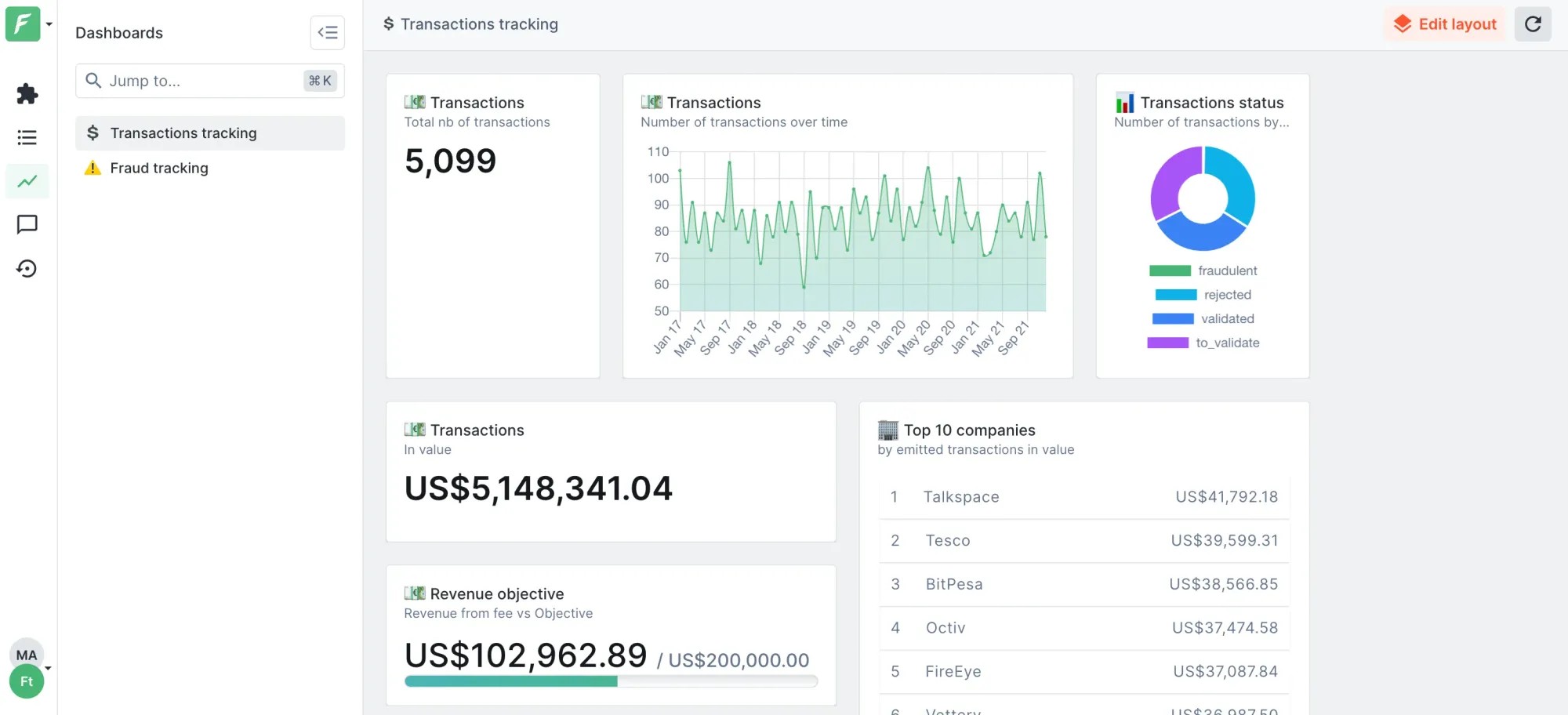
Forest now describes itself as operational infrastructure for regulated companies. That sounds broad until the pieces are named. A customer-hosted backend connects to business data. Forest supplies workspaces, actions, workflows, role-based permissions, approvals and audit logs. Its 2026 integration push brought in more than 25 fintech providers across banking infrastructure, identity checks, sanctions, transaction monitoring and fraud. Forest is the layer in which an analyst sees those signals and does something governed with them; it is not the bank ledger or the fraud detector itself.
AI changes the operator, not the need for rules. Forest’s MCP server lets compatible agents read permitted records and trigger actions or workflows. Its MCP client lets Forest workflows call outside tools. The distinction is plain: one direction brings outside capabilities into a case; the other lets an agent work on the case. Forest says both pass through its permission model and audit trail. Its September 2026 release added MCP-triggered workflows and a deterministic mode for decision steps, reflecting customer requests to keep some choices rule-bound.
The Onepilot collaboration makes the proposition unusually concrete. Forest describes an onboarding case that an AI agent cannot resolve, perhaps because ownership is complicated or a document is unusual. A Onepilot expert can take the escalation in the same workflow and under the same audit model. Its Marble collaboration draws another boundary: Marble can make a fraud or AML decision; Forest runs the operation around that decision. The seller of the workflow does not have to claim it can perform every specialist check.
The price of a permission slip
Forest sells subscriptions that rise with usage. Its public price sheet lists a free sandbox for two users and 500 monthly write events. Starter is listed at $499 per month, Professional at $2,199 and Enterprise from $5,999, with annual engagements. The plans include different user and event allowances; additional identities and events can cost more. A human employee, external user and AI agent each count as an identity. The rather dry billing unit reveals what the company believes it sells: controlled action at scale.
That has a boundary. A business with a simple internal table and little risk may find a home-built screen or general internal-tool builder sufficient. A company with many providers, sensitive changes and a duty to explain decisions has a different cost equation. Forest’s advantage depends on those operations being important enough to configure carefully. The system does not decide whether a rule is wise, and no audit log can rescue a badly designed process.
There is a lesson in Forest’s unlikely route here. The founders did not begin with a grand theory of AI governance. They watched who chose a useful tool, then who had to live with its consequences. They paid to learn the difference. The admin panel was where the answer first appeared: behind every ordinary button is a person, a permission and, in the best case, a record.