A fraud ring is a group project disguised as a collection of individuals. One account looks respectable. Its identity document passes. Its phone number works. The trouble appears only when someone notices that the same device has touched five accounts, the same movement pattern repeats across sessions, or a tidy new customer sits one edge away from a known mule. Bureau sells the ability to notice those edges before the money moves.
Founded in 2020 by Ranjan R Reddy, Bureau is enterprise software for deciding whether a digital person and their action can be trusted. It combines identity verification, device intelligence, behavioral biometrics, transaction data, alternative data, compliance screening, and a relationship graph. Banks, fintechs, insurers, gaming operators, marketplaces, ecommerce companies, and gig platforms plug those signals into configurable workflows. The output is meant to be an action - approve, monitor, ask for another check, send to review, or block - rather than a stack of alerts that a human must reconcile.
That distinction is the business. The fraud market does not suffer from a shortage of data. It suffers from separate tools reporting separate truths at separate moments. Bureau's pitch is that the customer should not have to integrate a device vendor, document vendor, watchlist vendor, behavioral system, and rules engine, then pray they agree. One orchestration layer can connect the evidence and apply the right amount of friction to the right session.

The founder had already seen the first version of the movie
Reddy was not new to mobile identity. He previously founded mobile-billing company Qubecell, which Boku acquired in 2013, then served as chief business officer of Boku Identity before that unit was acquired by Twilio. Bureau says the next company became personal after Reddy himself fell victim to cyberfraud. His framing is disarmingly plain: every digital company must answer, “Who are you?” and “Can I trust you?”
The pandemic supplied the timing. Digital transactions surged, especially across mobile-first markets in Asia, and the controls around them struggled to keep pace. Bureau emerged from stealth in December 2021 with a $12 million Series A and a simple wedge: a mobile number could unlock a fuller identity and fraud picture. At that point the company said it had verified more than 12 million identities. By its 2023 Series A extension, the reported figure was over 300 million. PayPal Ventures said it had passed 500 million by December 2024.
“Who are you?” is verification. “Can I trust you?” is a decision. Bureau built its company in the gap between them.YesPress analysis
What is touching the service?
Who claims to be here?
How are they acting?
What are they trying to do?
What failed first: the single-check worldview
There is no public story of one catastrophic Bureau product failure that forced a pivot. The visible change is in the scope of its product. Early messaging centered on frictionless verification and fraud protection through a mobile number. The current platform language is broader: unified risk decisioning across onboarding, login, account recovery, transactions, and ongoing monitoring. The thing that failed first was an industry assumption - that a successful point check settles the question.
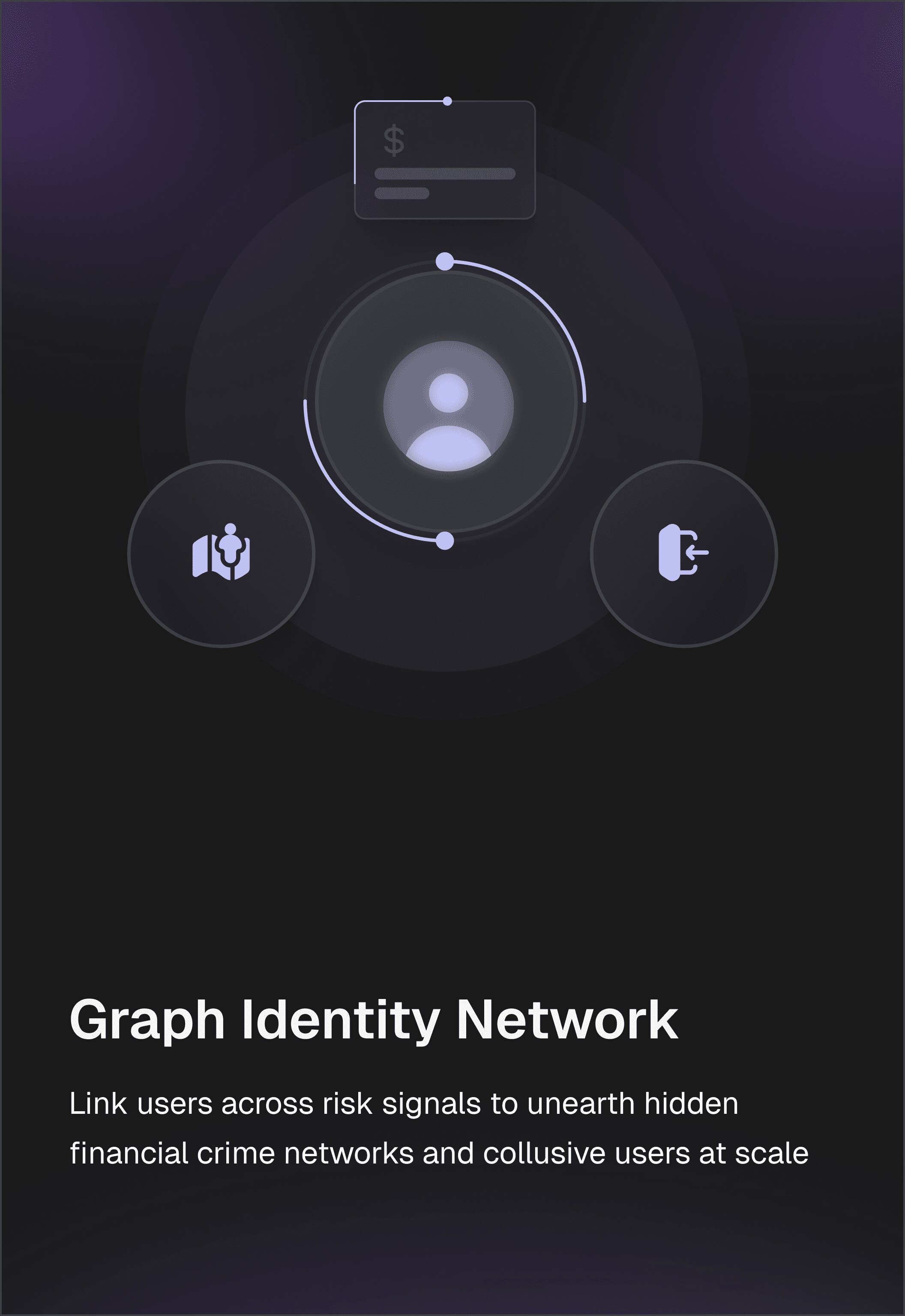
A real document can be used with bad intent. Valid credentials can be stolen. A familiar device can change hands. A person can pass KYC and become risky later. Fraudsters also coordinate, which means account-by-account review throws away the most useful clue: the relationship between accounts. Bureau's Graph Identity Network maps devices, identities, contact details, IP addresses, behavior, and transactions. Its models look for the pattern, while its no-code Workflows let risk teams decide what the pattern should trigger.
Device ID extends the same idea below the account. Bureau says it can recognize persistent device characteristics through resets, reinstalls, incognito sessions, emulators, and spoofing attempts, then combine them with app integrity, network context, and behavior. Behavioral biometrics studies how a person types, taps, points, and navigates. Identity Verification handles documents, face matching, liveness, databases, KYC, KYB, and watchlists. Alternative Data adds phone, email, and digital-footprint signals. Runtime application protection watches the software environment itself.
None of those components is unique on its own. Competitors such as Socure, Persona, Sift, Forter, Sardine, SEON, Sumsub, Alloy, Feedzai, Featurespace, and Experian cover overlapping ground. Bureau's differentiation is the integrated stack, its experience in high-growth Asian markets, the network graph, and the promise that a risk team can change workflows without waiting for engineers to hard-code every rule. It also says its privacy architecture shares decisions rather than operating as a broker of exposed consumer data, with tokenized identities behind the scenes.
What did the bet cost?
Investors have put $50.5 million into the answer. A $4.2 million seed round arrived in August 2020. Quona Capital led the $12 million Series A in December 2021, joined by Commerce Ventures, Okta Ventures, earlier funds, and strategic angels. GMO VenturePartners and GMO Payment Gateway added $4.5 million in July 2023, taking the Series A to $16.5 million. Sorenson Capital led a $30 million Series B in December 2024 with PayPal Ventures and returning investors. One media report placed the valuation near $150 million, though Bureau did not publicly confirm that number.
Capital stacked by round
What changed investors' minds from promising wedge to larger platform was traction plus a nastier threat. Bureau reported that revenue tripled before the Series B. PayPal Ventures described more than half a billion identities in the knowledge graph and named customers including Kotak Mahindra Bank, Tata Capital, Rapido, Zepto, Bajaj Finance, and IDFC First Bank. Meanwhile, synthetic identities, money mules, account takeovers, deepfakes, and real-time payment fraud made rules built for yesterday less useful.
Customers buy fewer losses and fewer annoyed customers
Fraud prevention has two invoices. The obvious one is stolen money, chargebacks, abuse, and regulatory exposure. The quieter one is false rejection: good customers abandon onboarding, transactions are declined, and investigators burn hours on harmless alerts. Bureau sells against both. Low-risk people can move through passive checks; suspicious sessions earn extra scrutiny.
Its published case studies illustrate the job, though the results are company-reported and several clients are unnamed. A property-technology platform used alternative data and custom risk models to prevent a reported $1.25 million in chargeback fraud over three months, cutting false chargeback rates from 40 percent to 8 percent. An insurer flagged more than 100 fake applications and reported 30 percent faster onboarding. A food-delivery company found a 2,700-user fraud ring. These are not laboratory comparisons, but they show what the product is purchased to change: decisions before loss, not reports after it.
The playbook worth stealing
A founder does not need half a billion identities to copy the useful parts. Bureau's operating logic can fit on one whiteboard.
Start with approve, review, challenge, or block. Work backward to the minimum evidence each outcome needs.
Link existing customer, device, behavior, and payment data before buying another isolated signal.
Measure fraud loss and good-user rejection together. A safer funnel that nobody finishes is not healthy.
Make scores explainable, route ambiguity to review, and feed confirmed outcomes back into rules and models.
The product-design lesson is equally portable: hide complexity from the legitimate user, not from the operator. Passive checks should stay passive. A risk team should see why a score changed, which relationship mattered, and what action followed. And rules need an owner. No-code does not remove governance; it makes governance urgent because more people can alter the machine.
When this approach will not work
- The business has low transaction risk and too little volume to justify enterprise orchestration.
- There are not enough lawful, consented, reliable signals to connect.
- Regional coverage is weak for the identities, documents, or regulations that matter.
- The company cannot staff investigations, tune thresholds, audit changes, or handle model drift.
- A black-box score replaces judgment instead of making judgment faster and more legible.
Where Bureau fits now
Bureau sits between identity verification, fraud detection, financial-crime compliance, and decision infrastructure. That is an attractive intersection and a crowded one. Its expansion from one mobile-number-led entry point to a modular platform is coherent: verification supplies the identity, device and behavior supply context, the graph finds relationships, and orchestration turns the mixture into policy. The acquisition of Y Combinator-backed inVOID in 2023 added verification reach; a partnership with GMO Payment Gateway supported international growth. The company operates from San Francisco with teams across India, Singapore, and Dubai.
The strategic risk is the mirror image of the strategy. A unified platform can reduce vendor sprawl, but it can also become a consequential dependency. Data coverage varies by market. Models decay as attackers adapt. Privacy rules constrain what can be collected and connected. A decision that arrives in milliseconds can still be wrong in milliseconds. Bureau's SOC 2 Type 2 and ISO/IEC 27001:2022 compliance matter here, but certifications are a floor, not a verdict.
Still, the company has chosen the right unit of analysis. Fraud is not a document problem, a device problem, or a payment problem. It is a relationship problem with a stopwatch attached. Bureau's wager is that the vendor able to see the relationship and act inside the moment earns a place deep in the customer's stack. After $50.5 million, more than 200 claimed brands, and a product that keeps widening without losing its central question, that wager is no longer merely theoretical.