The interesting thing about a venture portfolio is that it becomes a diary written in products. Forerunner's diary begins with the things people put on their faces, feet and bathroom shelves. Warby Parker made buying glasses online feel plausible. Glossier turned a beauty blog's intimacy into distribution. Dollar Shave Club made a forgettable household purchase funny enough to subscribe to. Then the entries spread outward: Chime for banking, Oura for sleep, Hims & Hers for care, Faire for independent retail. Read together, the companies record a change in the consumer's posture - less willing to accept a category as delivered, more willing to try a service designed around their own life.
That diary now has AI in nearly every margin. Forerunner's new investments include software that completes errands, infrastructure that lets agents move money, generative entertainment, automated customer service and a home-management system with a memory. It may sound like a pivot from lipstick and eyeglasses. The firm argues it is the opposite. The technology changed; the object of study did not.
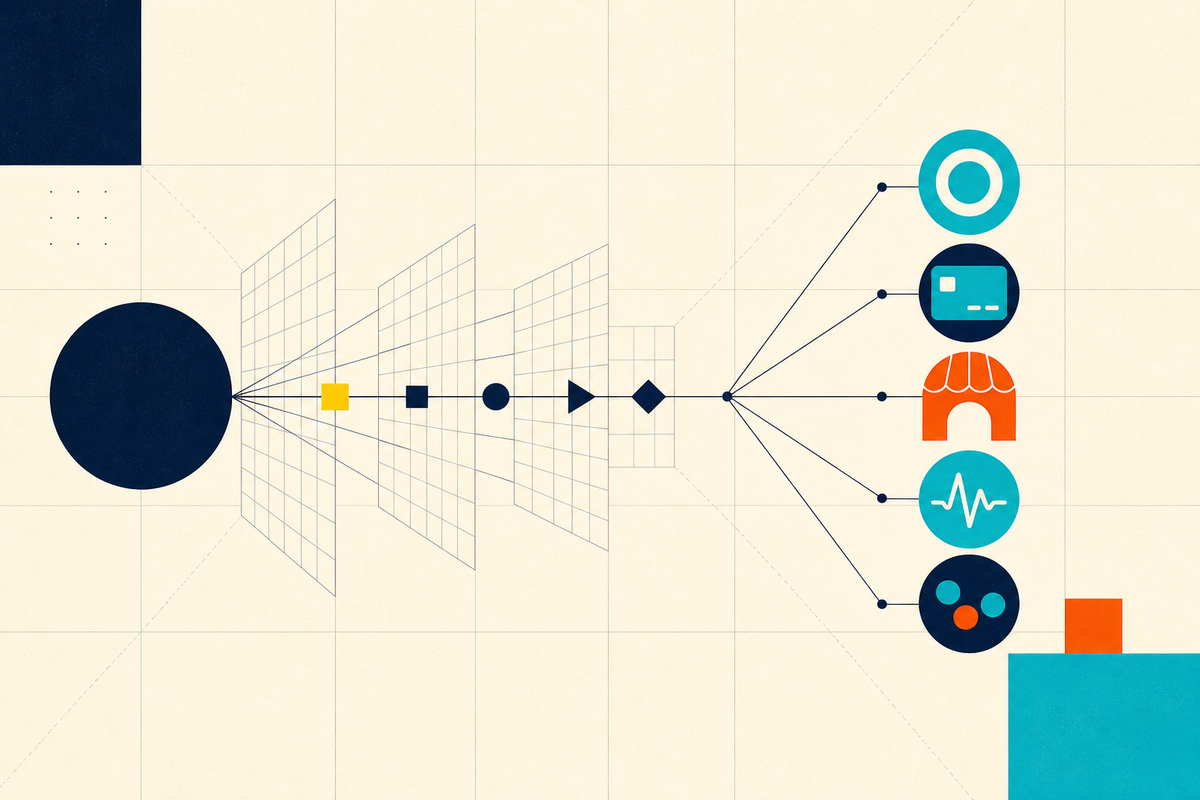
A firm that sells money, and studies desire
Forerunner is not an app and it does not sell to the shoppers who animate its thesis. Its direct customers are founders looking for capital and company-building help, and limited partners looking for venture returns. It raises funds, writes equity checks and waits for portfolio companies to produce liquidity through acquisitions, public listings or secondary sales. Fund VII, announced in November 2024, is a $500 million early-stage pool. The stated range is $1 million to $20 million from seed through Series A. In 2022, Fund VI paired another $500 million early-stage vehicle with a $500 million growth fund.
Those are the mechanics, and they resemble the mechanics at other venture firms. The differentiating claim is upstream: Forerunner treats consumer understanding as a repeatable system. Its team runs surveys, studies cultural and economic shifts, publishes market maps and turns observations into investment categories. The firm calls this perspective CQ, or consumer quotient. Its newsletter of the same name has more than 16,000 subscribers. In 2022, it worked with Bain & Company's consumer-insights group on a study of more than 4,300 American adults, asking over 100 questions and sorting the results into eight psychographic archetypes.
“The clearest view of the future comes from understanding the present deeply.”Forerunner's research principle
This is useful to founders in a practical way. A company can arrive with a product category; Forerunner wants the unmet need underneath it. That can change how the product is positioned, where it enters the market and how large the eventual business might become. A nutrition service is also an access problem. A wholesale marketplace is also a bet on the survival of Main Street. A smart ring is not merely hardware; it is a new daily relationship with health data. The firm's help spans brand, growth, hiring, strategy and network access, according to its public materials. The checks buy ownership. The pattern recognition is meant to improve the odds.
The category that refuses to stay in its box
Calling Forerunner a consumer investor is accurate but incomplete, because the firm uses a definition broad enough to annoy a tidy database. A consumer company is one where an individual pays for the product, or where revenue depends on consumer spending or engagement. By that logic, a commerce platform, a payment network and a customer-service system may all sit in the consumer economy even when their contracts are signed by businesses.
The definition explains a portfolio that moves between brands, marketplaces, financial technology, healthcare, social products, education, enterprise tools and AI infrastructure. It also gives Forerunner a rebuttal to the idea that consumer venture is simply direct-to-consumer retail with expensive advertising. In its own analysis, the firm reviewed more than 12,000 venture-backed companies and classified 7,800 of them as consumer or enterprise. Among companies that had raised a Series B, its data showed consumer businesses reaching public markets at a slightly higher rate and posting stronger combined growth and profitability at IPO.
The bars show conceptual reach across a person's day. They are an editorial diagram, not investment-performance data.
Competitors come from both sides of this elastic category. Maveron, Imaginary Ventures and VMG Partners also specialize in consumer businesses; First Round, Accel, Lightspeed and Andreessen Horowitz compete for early technical teams across sectors. Forerunner's pitch is that years spent tracing consumer adoption create an advantage at the moment when a peculiar behavior becomes a credible market. Its early records in Chime, Oura, Faire and Hims & Hers make the argument more concrete than a slogan.
When code gets cheaper, context gets dearer
Fund VII put the thesis in contemporary language. Software capabilities are becoming broadly available, Forerunner wrote, so technical prowess alone is less durable as a differentiator. The firm's wager is that products will win through trust, cultural resonance, form factor and a precise understanding of what a person is trying to accomplish. AI does not remove the consumer from the equation. It makes the cost of misunderstanding the consumer easier to see.
Recent deals illustrate three layers. On the surface are agents and experiences: Suno turns prompts into music; Town is designed as an assistant that works across a person's existing tools; Casa coordinates the tedious physical work of homeownership. Beneath them sit intelligence layers that personalize or interpret. Deeper still is infrastructure such as Natural, which Forerunner backed in a $30 million Series A to build payment rails for transactions involving AI agents. The portfolio still reaches people, but sometimes through the machinery behind the experience.
This is also where the risks live. Consumer taste is fickle. Distribution can be expensive. AI features can be copied, and infrastructure incumbents are not standing still. A generous definition of consumer creates opportunity, but it can also make a thesis difficult to falsify: almost every business eventually touches a person. Forerunner's answer is focus at the fund level - relatively concentrated portfolios, early conviction and close relationships - plus research that forces the team to state why a behavior should endure.
“Venture isn't a passive business.”Forerunner
A portfolio can mature without following the old script
The returns business has changed since Forerunner opened with two people in 2012. Dollar Shave Club and Jet.com were acquired. Warby Parker reached the market through a direct listing. Chime priced its June 2025 IPO at $27 a share, implying a valuation of about $11.6 billion. Other prominent holdings remain private. Green has spoken openly about using secondary markets as venture-backed companies take longer to go public, allowing investors and employees to find liquidity without forcing a premature exit.
Patience fits the brand, though it is not romantic. Venture funds have clocks, portfolio companies need capital, and limited partners need distributions. The firm's ability to raise seven funds and about $3 billion says investors have so far accepted its timing and method. Its compact staff - LinkedIn listed 19 employees in August 2026 - makes the scale notable. It also places pressure on judgment: a focused portfolio leaves fewer places to hide a mistake.
What founders can do with Forerunner is straightforward. They can seek an early institutional partner for a business tied to a changing human need, use the firm's consumer research to refine positioning and tap a network built across commerce, finance, health and software. What they cannot buy is certainty. The firm's most appealing idea is humbler: attention compounds. Watch closely enough, make the reasons for a decision explicit, and let each company teach you how to see the next one.
That leaves Forerunner in a distinctive place in the market. It is a consumer specialist that refuses the old consumer boundaries, an AI investor whose argument begins with psychology, and a multi-billion-dollar manager that still markets intimacy. The contradictions are productive. They allow a smart ring, a neobank, a wholesale exchange and an AI payment rail to belong to the same story. That breadth is not permission to chase everything. It is a demand to locate the human thread before a fashionable technology or familiar label gets mistaken for a thesis. The story is not that everyone needs more technology. It is that technology becomes valuable when it notices what people were already trying to do.