In February 2020, Babel Finance reported $380 million in outstanding loans. A year earlier, at the end of the first quarter, the figure had been $52 million. Flex Yang, its co-founder, was building a business around a practical inconvenience: people could own Bitcoin and still need money to pay the bills. Selling the coins solved today’s problem by surrendering tomorrow’s possible gains. Borrowing against them offered another way.
The early customers included Chinese Bitcoin miners. Their machines produced a digital asset; their expenses arrived in the ordinary world. Babel stood between the two. In a market famous for arguments about the future of money, this was a remarkably familiar opening: somebody had valuable property, somebody needed credit, and a lender proposed to connect them. The revolutionary business had an old-fashioned front door.
Yang’s career follows that doorway through several buildings. There is an accounting firm in Hong Kong, a small-business finance venture, a crypto lender, a decentralized-finance ecosystem and a synthetic-dollar project. The names change. The recurring ambition is to make financial services easier to reach. The recurring difficulty is what happens after people have entrusted their assets to the machinery.
Before the coins, the accounts
Yang studied at the City University of Hong Kong from 2007 to 2011. His degree combined accountancy and law, a pairing concerned with both the numbers and the obligations behind them. From September 2011 to May 2015, he worked at PricewaterhouseCoopers in Hong Kong as a senior associate, performing audit procedures and helping prepare reports for clients. His professional starting point was the business of checking.
He then founded Standard Financial Inclusion, seeking to extend financial services to small and micro-enterprises in China. It is an important precursor to the crypto years: access to credit was already his subject before Bitcoin became his business. His later ventures would change the assets, the distribution and the technology. The stated interest in bringing more people into financial services was present early.
By June 2020, appearing on the Bitcoin in Asia podcast, Yang was discussing a much larger ambition: building a Bitcoin counterpart to JPMorgan. Babel’s services included crypto-backed loans, deposits, financing, margin trading and derivatives. Starting with miners had supplied a specific customer and a specific need. The next step was to supply more of the financial life that developed around those holdings.
A bank-shaped ambition
Babel was founded in 2018 by Yang and Del Wang. Its early operations connected Beijing and Hong Kong, while its lending network extended overseas. In March 2020, Yang described Genesis Capital and BlockFi as major partners. He said crypto interbank lenders supplied about 70 percent of the capital used to originate Babel’s loans. Even at that stage, the business was a network of institutions lending into one another.
That detail helps explain the scale of the opportunity. A lender could expand beyond the money it raised from shareholders by borrowing from other lenders. It also explains why a customer relationship was only one part of the risk. Behind the borrower stood a chain of funding relationships. The balance sheet at the front of the shop depended on promises made elsewhere.
Credit gathers speed
In May 2021, Babel raised $40 million in a Series A round that included Sequoia Capital China and Tiger Global Management. Yang framed the new alliances around product development, compliance and service for mainstream investors. The company planned to recruit banking professionals and lawyers. Crypto’s arrival in institutional finance apparently required some of the people who already knew their way around institutional finance.
His description of the market was brisk: “The crypto market has evolved from geek-only to institutional and professional.” It captured the confidence of that period. An industry once explained through enthusiasts and unusual wallets could now speak in the familiar language of fundraising rounds and client services. Yang’s proposition was that institutions needed a financial provider built for the assets they were beginning to take seriously.
“The crypto market has evolved from geek-only to institutional and professional.”
Flex Yang, May 2021
The date that matters
Yang stepped down as Babel’s CEO in October 2021; the leadership transition was announced that December. That date matters when telling the next chapter. He was a co-founder and former chief executive when the company later froze withdrawals. A career story needs to keep the sequence straight, especially when success and responsibility are being discussed in the same breath.
In May 2022, Babel announced an $80 million Series B at a $2 billion pre-money valuation. Its reported outstanding loan balance exceeded $3 billion at the end of 2021. The company served about 500 clients. These were measures of corporate scale, and the valuation was a financing figure. Neither was a guarantee that customers could obtain their money when they wanted it.
On June 17, 2022, Babel suspended redemptions and withdrawals amid a liquidity crunch. Days later, it announced agreements with counterparties on repayment of some debts to ease short-term pressure. The distance between a funding announcement and a withdrawal freeze was roughly a month. For customers, the decisive number had become the amount they could actually withdraw.
By March 2023, Babel was seeking a moratorium in Singapore while preparing a restructuring. The company said Yang was among investors providing recapitalization funds and was expected to take a leadership position in a relaunched business. Those were plans announced during a restructuring process. His connection to Babel had therefore continued beyond his departure from the chief executive’s office.
A project called HOPE
That March also brought HOPE, Yang’s new decentralized-finance ecosystem. Its proposed stablecoin would begin with Bitcoin and Ether reserves, with a dollar-linked value as its objective. HopeSwap was planned as an entry point, using an automated market maker on Ethereum. The project sought to bring users of traditional finance into crypto through a collection of connected applications.
The name made a conspicuous promise before anyone opened the documentation. More concretely, the design moved parts of financial activity into protocols rather than leaving every step inside a single company. That changes where trust is placed. Users must still rely on the design, the implementation and the arrangements through which assets can be exchanged or redeemed. A different structure brings a different set of questions.
On October 18, 2023, HopeLend was exploited. Security analyses identified a precision-loss problem in the accounting of deposit tokens. An attacker could manipulate the relationship between a tiny holding and the collateral value assigned to it, then borrow against that distorted value. The failure sat inside the calculations that were meant to keep the lending pools in balance.
The episode acquired an especially crypto detail: another participant spotted the attack and got a copied transaction executed first. The original exploiter was outpaced. It is a striking anecdote, though the financial consequences were serious. For Yang’s broader project, the incident made the limits of a structural promise visible. Moving an operation onto a blockchain does not remove the need to get its accounting right.
The dollar, rebuilt in trades
Yang subsequently appeared publicly as founder of Stables Labs, the team behind usdx.money. In December 2024, the project announced $45 million in new financing at a $275 million valuation, with investors including NGC, BAI Capital, Generative Ventures and UOB Venture Management. Some investment took the form of warrants. Its stated plans included exchange liquidity, lending integrations and alternative payment services for underserved users.
The product, USDX, was a synthetic dollar. Its documentation described a multicoin arbitrage strategy intended to maintain an approximately dollar-neutral position through balanced trades. Staking USDX produced a separate token, sUSDX, representing a share in the staking arrangement. The financial proposition depended on trading and hedging rather than simply presenting each token as a dollar sitting in a bank account.
His public writing also returned to market mechanics. A funding-rate thesis shared on LinkedIn examined the opportunities in crypto derivatives, the enthusiasm of spring 2021 and the role of institutions such as CME. This is a useful glimpse of his public interests: the plumbing of a trade, the price of capital and the forces that make an apparent opportunity persist or disappear.
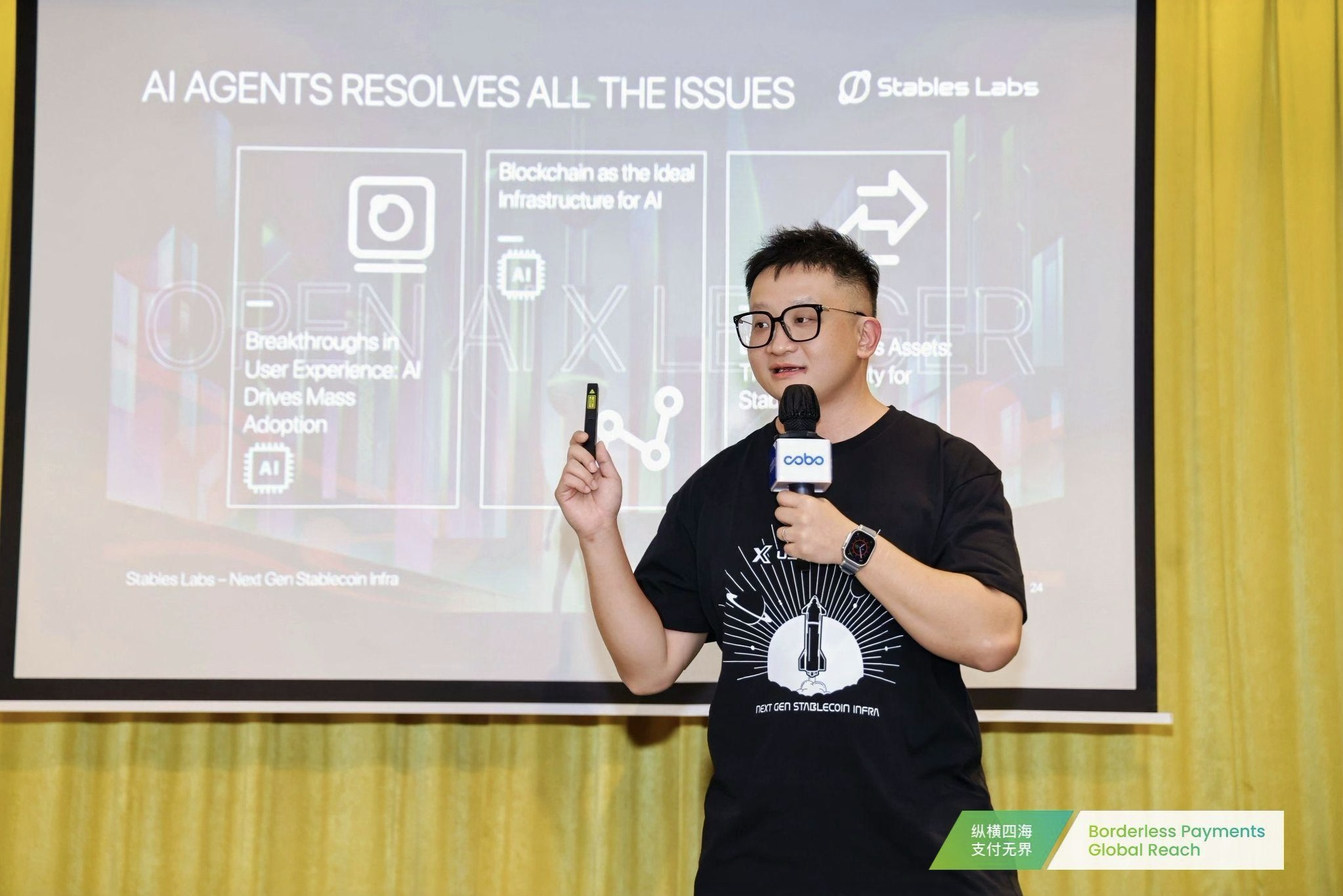
At a February 2025 payments event in Hong Kong, Yang discussed stablecoins as a bridge between established finance and decentralized applications. He also argued that artificial intelligence would change how funds were managed. “Just as the U.S. dollar once replaced gold as the global standard, stablecoins could become the next dominant financial instrument,” he said. It was an aspiration expressed onstage, with the future still in the conditional tense.
A promise meets its price
In November 2025, USDX lost its dollar peg. A later Beosin investigation described the collapse and traced transactions involving addresses it linked to Yang and Babel Finance. Its analysis alleged that associated wallets had borrowed other assets against USDX and sold tokens into available liquidity. Those wallet links and interpretations are investigative allegations; they do not by themselves establish Yang’s personal intent or a legal finding of wrongdoing.
The price failure itself supplies a harder limit to the earlier ambitions. A token intended to track a dollar had ceased to do so. The consequences reached the lending arrangements that accepted it as collateral. By the time a synthetic asset is integrated into other financial products, its reliability matters to people well beyond the audience for the original presentation.
Yang’s public career puts a persistent ambition beside an increasingly difficult record. He sought credit for small businesses, banking services for Bitcoin holders and payment infrastructure built around digital dollars. Babel’s withdrawal freeze, HopeLend’s exploit and USDX’s depeg each tested a different part of that proposition. They also give substance to the question that runs through his work: how does easier access become dependable access?
An auditor checks a set of accounts. A founder asks people to believe in a future set of accounts. Yang has occupied both positions. His story shows how much sits between them: customers, counterparties, code, collateral and the moment somebody asks for their money back. Whatever the technology, that request remains wonderfully plain English.
Follow the money, and the conversation
Projects: usdx.money · USDX documentation · Babel Finance profile