Imagine arriving at a church for the first time. The building has six doors and no obvious entrance. The website says “Join us for the Gathering,” which is perfectly clear to the people who already gather and slightly mysterious to everyone else. A bulletin contains eleven announcements, each promoted as though it were the one announcement that matters. Nobody inside the institution is being careless. They are simply fluent.
Fishhook made a company out of noticing this kind of fluency. The Indianapolis agency works almost exclusively with churches and faith-based ministries. It designs brands and websites, runs digital campaigns, coaches leaders, trains teams and maintains the machinery after launch. But the common task beneath those services is translation. What does this church believe it is saying? What does a tired parent, a skeptical neighbor or a first-time visitor actually hear?
The distinction sounds soft until it becomes operational. Fishhook's own visitor audit asks whether entrances are obvious, whether anyone says hello, whether announcements are memorable and whether the next step in a person's faith is visible. The firm looks at navigation, copy, signage, social profiles, email, staff habits and the Sunday experience as parts of one system. Most marketing agencies start with a message. Fishhook often starts with the person standing in the parking lot.
A narrow market with a complicated operating system
Evan McBroom started Fishhook in 2003 with a compact goal: help churches “improve the way they fish” by improving the way they communicate. The name nods to the biblical image of fishing for people. The tagline, “Catch More,” makes the commercial and theological metaphor do the same work.
The smarter decision was the niche. A church is not quite a business, not quite a media company and not quite a volunteer club, though on a Tuesday afternoon it may feel like all three. Its staff serves longtime members and people who have never entered the building. Its busiest campaigns are attached to sacred holidays. Its language carries emotional weight. Its communications team may be one employee, several volunteers and a pastor with strong opinions about commas.
Generalist agencies can learn that system, but Fishhook begins the meeting already knowing it. Its portfolio spans large multi-campus churches, small congregations, Lutheran schools, Baptist churches and ministries. The company says it has helped hundreds. Its advantage is accumulated context: how a first-time guest behaves, why a staff calendar becomes political, when Easter planning needs to start and why a website form may be part of pastoral care rather than mere conversion optimization.
That is also where the model has limits. A company seeking mass-market ecommerce, a self-serve logo or the cheapest possible template is buying the wrong expertise. Fishhook's deeper engagements depend on access, trust and a person inside the church who can make decisions. Its own case study with Church on the Hill credits a clear point of contact, weekly meetings, long-range planning and what it calls “a seat at the table.” Remove those conditions and an embedded partnership collapses into a queue of design requests.
The price of making the obvious obvious
Fishhook is unusually direct about portions of its price ladder. A Brand Experience Guide costs $2,500 to $5,000 and takes three to four weeks. It documents identity traits, target audiences, messaging and visual direction. A templated website runs $5,000 to $12,500 over six to ten weeks. A hybrid site, mixing a template with custom elements, is listed at $14,000 to $18,000. Fully custom brands and websites require a quote. Web support costs $130 an hour.
Bars compare upper project ranges only. Custom identities, custom websites, digital advertising and assessments are quoted individually.
The ladder reveals how Fishhook thinks. Not every church needs a bespoke digital cathedral. A small congregation may need sound bones, clear copy and training. A mid-size church may need selective custom features. A multi-campus organization moving to Rock RMS may need a system engineered around campuses, groups, events, giving and personalized content. Selling three levels protects the strategy from becoming a luxury available only to the largest customer.
The bet beneath the website
In 2016, Fishhook entered the community around Rock RMS, an open-source church management platform with a content-management layer. Vineyard Cincinnati had asked whether the agency would build a full custom site on it. Fishhook said yes before the path was smooth. An early developer later described Rock in three words: powerful, scalable and complex.
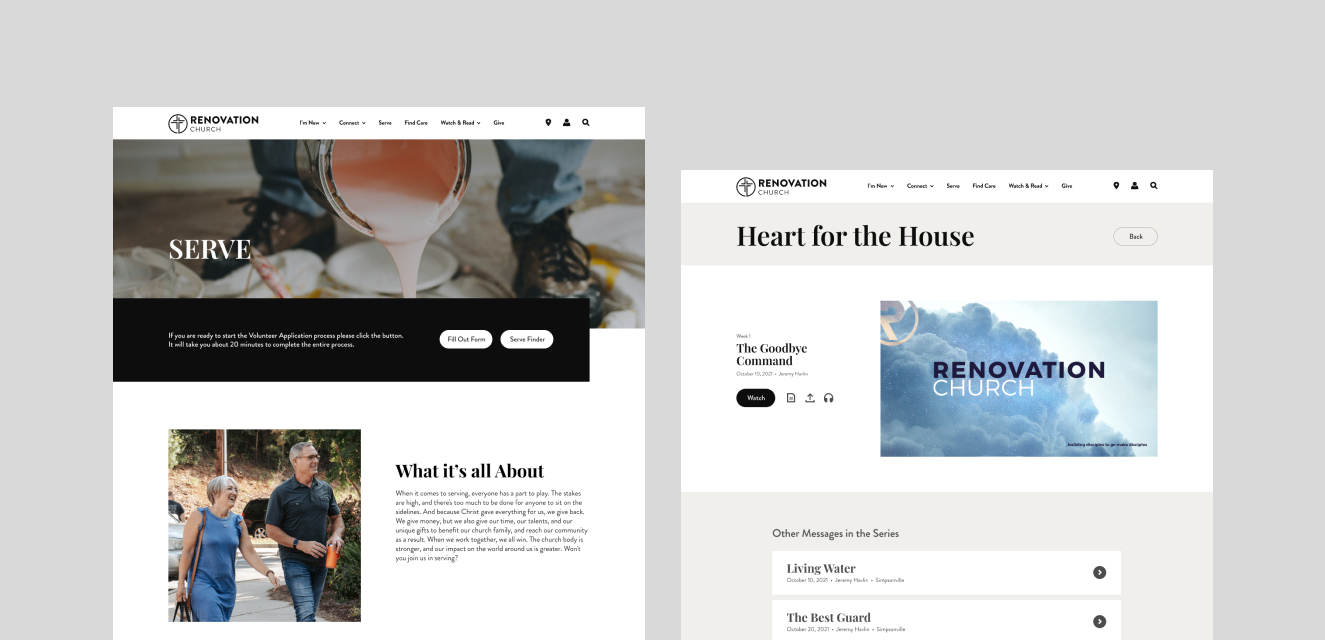
That complexity became useful. A normal website tells everyone the same thing. A Rock-connected site can use the church's underlying data and workflows to make next steps more relevant. Pages can be assembled dynamically. Multiple ministries can operate separate sites. A returning family can see something different from an anonymous visitor. The church's public front door and its internal database stop behaving like distant cousins.
By 2025, Fishhook said it had built dozens of custom Rock websites and sponsored the platform's conference for ten consecutive years. That is a genuine specialization, but not magic. Rock demands technical capacity and organizational discipline. A simple church that neither needs personalization nor has people ready to maintain a richer system may be better served by the cheaper end of Fishhook's ladder.
The cobbler's website, and other useful failures
The revealing Fishhook project is its own. In 2018, the agency admitted that its website had become a version of the cobbler's shoeless children. The redesign took nine months. At the time, Fishhook said a normal client website took ten to fifteen weeks. Expertise had not removed the familiar problems of internal work: too many opinions, borrowed time and a client who could always postpone its own deadline.
The team simplified the home page, flattened the navigation, reorganized learning material around questions rather than formats and made its portfolio more visual. The useful part is not that the site eventually launched. It is that the agency treated the delay as field research. The thing readers can copy is the reduction: fewer levels of navigation, clearer service buckets, work shown instead of merely described and content organized around the audience's problem.
Another rhythm broke during COVID. The Table, Fishhook's free gathering for often-isolated church communicators, moved briefly online and then stopped. Fishhook revived it in February 2025 after deciding the break had lasted too long. Software had kept teams connected, but it had not replaced the relief of meeting people who understood why a single Easter announcement could occupy an entire morning.
McBroom launches Fishhook around church communications.
A hard first custom build opens a durable technical specialty.
Leah Norton buys out McBroom and brings Shayla Kenworthy into the partnership.
The Table resumes, and the Rock partnership reaches a decade.
What anybody can borrow
Fishhook's most portable ideas do not require a church or an agency invoice. Start annual planning with the master calendar. Separate organization-wide priorities from messages meant for a smaller group. Make every important communication answer one question: what can I do next? Walk through the experience as someone who does not know the vocabulary. When using AI, let it structure and edit, but keep a real person's quirks in the first draft.
These are modest instructions, which is their charm. Institutions usually do not become confusing because nobody cares. They become confusing because everyone cares about a different thing, and every thing acquires its own announcement. Fishhook's business is to stand outside that enthusiasm for a moment and point toward the door.