Felix Van de Maele remembers a public contract that Collibra won against IBM. Afterwards, he heard why the young Belgian company had prevailed: its bid was €2,000 cheaper. Losing, he believed, would have brought cash problems. For a business that would later attract a multibillion-dollar valuation, survival once depended on a sum that would barely trouble a large company’s stationery budget.
The detail suits him. Van de Maele’s accounts of building Collibra make room for underpriced contracts, unfamiliar sales work and the inconvenience of having an interesting technology before anyone has agreed to buy it. There is luck in the story, and he admits it. The polished version of entrepreneurship tends to remove that sort of admission before sending the slides to investors.
His company began in 2008. Its early product helped organizations define their data. By October 2026, Collibra was buying a business that automates AI governance. Across that considerable distance, his subject has remained surprisingly consistent: how to make information understandable enough that somebody can be held responsible for what happens next.
A longer route out of Ostend
Van de Maele grew up in Ostend, on Belgium’s coast, and went to Brussels to study computer science. Four years of university did not satisfy his appetite for being a student. He wanted to go abroad. Software engineering studies took him to France for six months and Argentina for five, adding geographical variety to an already technical education.
By 2007, several plausible futures were available. He could pursue a doctorate, join a bank, become a consultant or start a business. He had been researching semantic technology at Vrije Universiteit Brussel. Reading Founders at Work, with its accounts of startup founders, made the fourth option seem worth attempting. Other people had tried it. He could at least have a go.
He added general management studies at Vlerick Business School, graduating in 2008. Alongside the coursework came a business plan. His route into entrepreneurship therefore included an unusual amount of preparation for someone who would readily admit that the founding team still had to work out which problem its technology should solve.
“We really started with technology looking for a problem to fix, which isn’t ideal.”
Felix Van de Maele
At VUB’s STARLab, his research had involved ontology-focused crawlers for the semantic web and semantic data integration. An ontology gives concepts and their relationships an explicit structure. The practical interest is understandable without a computer science degree: information travels more usefully when the sender and recipient agree on what its terms mean.
Van de Maele founded Collibra with Stijn Christiaens, Pieter De Leenheer and Damien Trog. Their company carried academic work into a setting where intellectual elegance would have to meet purchasing decisions. A buyer could admire the research and still keep the budget firmly in a drawer.
The dictionary finds its customers
The first business plan began on a single page. Van de Maele took it to his professor, then worked with the university’s technology transfer office. More versions followed. His recollection includes the familiar startup forecast of $50 million within five years, offered with a retrospective sense of the ritual involved. Ambition had arrived before commercial certainty.
The team initially looked at data integration. Its particular interest was bringing nontechnical people together to capture meaning. That was a useful distinction, because a company’s knowledge does not all reside with the employees who write its software. The person who understands a business term may have no desire to discuss the machinery underneath it.
An early product was a business glossary. It helped customers capture definitions for terms such as customer and product. These are ordinary words until two departments use them differently. Then a meeting about performance becomes a meeting about arithmetic, followed by a meeting about definitions, followed, quite possibly, by another meeting.
Conceptual illustration of the questions behind Collibra’s work.
The financial crisis gave those questions a demanding audience. Banks faced greater scrutiny and needed to explain the numbers they reported. A figure on a report had to be traceable to its origins. In Van de Maele’s telling, Collibra took roughly four years to find product-market fit. The company had started early, and the market’s education took time.
That waiting period matters. A later funding announcement compresses a business into a valuation and a paragraph about demand. The earlier experience involves deciding which prospect to call, discovering who owns a problem and making the explanation clear enough to earn another conversation. Van de Maele had entered the job from research. Selling was part of the curriculum now.
New York, because the buyers were there
The early team searched for relevant conferences and found many in the United States. They traveled, met prospects and worked the leads from Belgium. Calls and demonstrations ran into the night. At times, the founders cut their own pay. On trips between Brussels and New York, they stayed on acquaintances’ sofas. International expansion had a distinctly domestic sleeping arrangement.
Van de Maele’s explanation for choosing New York was practical: customers were there. Banks were an important market. The company followed them rather than treating Silicon Valley as the automatic destination for a technology startup. Being near buyers offered repeated opportunities to understand their problems, and fewer hours spent negotiating the Atlantic’s opinion of a convenient meeting time.
Collibra began selling remotely into America in 2012. An office in a New York WeWork followed in 2013. Van de Maele initially remained in Belgium, closely involved with engineering and product, while colleagues built the American presence. The expansion required the organization to stretch before its chief executive could make the move himself.
He relocated in 2015, following an Index-led Series B. By then he had been spending about half his time in the United States. He had also managed to hand over his product responsibilities. Crossing the ocean meant changing the job as well as the address.
Hiring brought another education. He recalled asking candidates to rate themselves out of ten: Europeans tended to offer six to eight; Americans sometimes supplied eleven or twelve. A numerical scale had acquired a cultural interpretation. For a founder building a business around shared definitions, the irony came conveniently packaged.
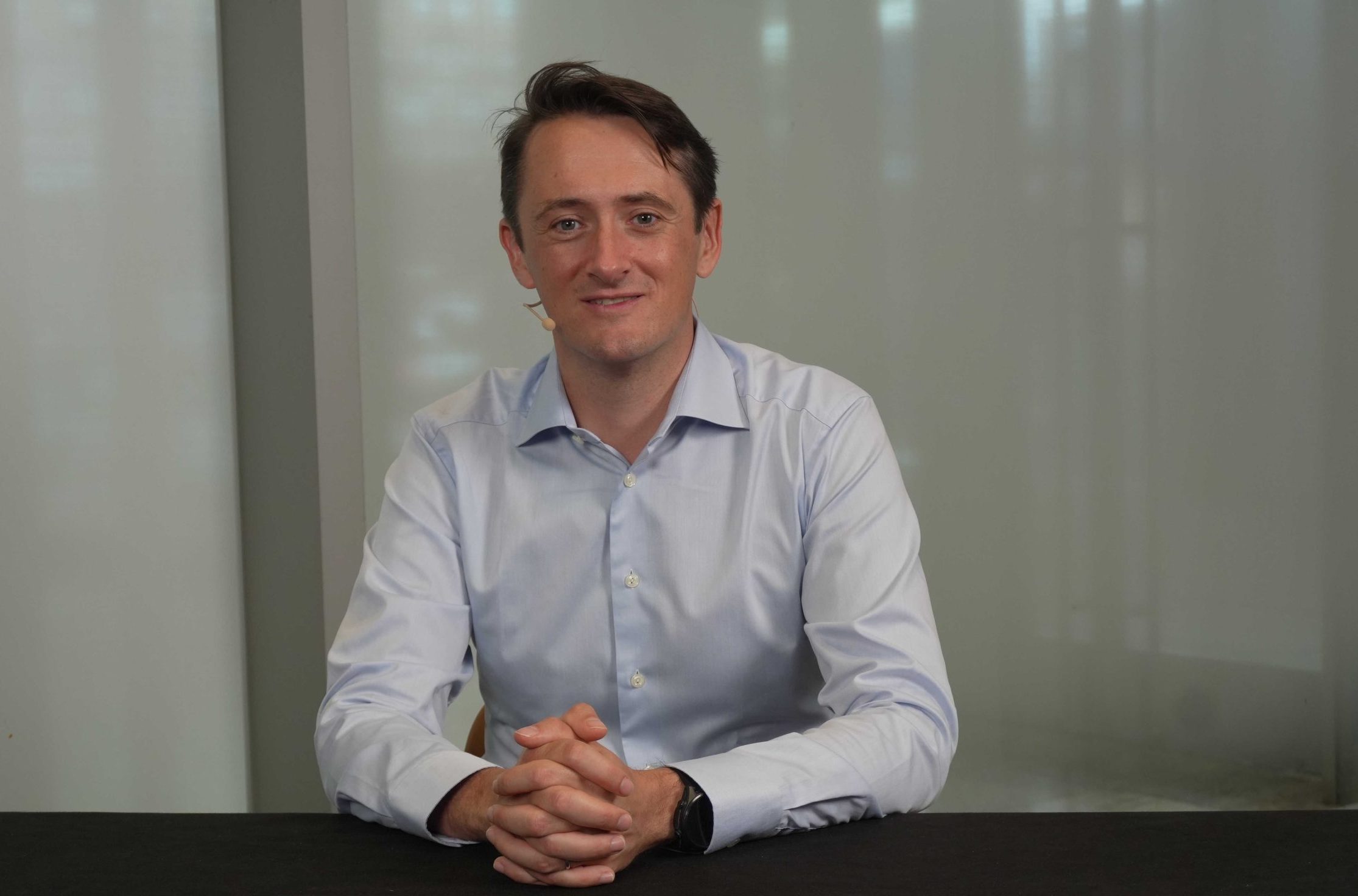
Learning to leave the product in other hands
The management work became more deliberate as Collibra grew. Van de Maele has described establishing routines, including weekly team meetings and monthly management meetings. His engineering background supplied a way to think about the company itself: observe how it operates, measure what works and make adjustments. Software was no longer the only system demanding attention.
He has also described the founding team as open-minded and having small egos. Taken as his own account of their approach, that is an appealingly useful ambition for an executive. A willingness to revise an idea is valuable when the first commercial application does not work, and equally valuable when the organization outgrows the founder’s original way of running it.
Recognition followed. In 2019 he received EY’s New York Technology Entrepreneur of the Year award. Collibra became Belgium’s first unicorn that year. In October 2021, Vlerick gave him its Enterprising Leader Award. He credited a continuing desire to learn and the growth mindset he had developed at business school.
- 2008A company emerges from VUB research.
- 2015Van de Maele moves to New York.
- 2021$250 million Series G; $5.25 billion valuation.
- 2026AI Command Center and the trail ML acquisition.
The valuation shown is the announced 2021 funding valuation.
Later in 2021, Collibra announced that $250 million Series G, led by Sequoia Capital Global Equities and Sofina. The company said it worked with more than 500 global enterprises. The financing valued it at $5.25 billion. Those figures belong to that moment in the company’s history, a considerable distance from the precarious early tender.
Money supplied room to expand the platform, partnerships and international presence. It also made a different kind of work possible for a founder who had started with university research. He now had to sustain a company whose customers expected dependable service across complicated organizations. A good concept had acquired a large number of obligations.
The machines inherit the question
AI has brought Van de Maele’s original interests into another setting. His argument now concerns systems that complete tasks and take actions, requiring business context as well as information. Definitions, ownership and permissions become part of what an agent needs to operate. An organization’s unresolved ambiguity can travel remarkably quickly when software is allowed to act on it.
In May 2026, Collibra announced AI Command Center, aimed at continuous oversight of agentic AI. Van de Maele described a “hallucination tax”: the cost of manual checking, rework and risk as companies put more agents into production. It is a pointed phrase for an unglamorous expense. Somebody still has to inspect the work when an apparently confident system gets it wrong.
His September writing drew a further distinction. Some controls, including ownership and classification, benefit from being established near the creation of data. Other decisions depend on the context in which information is used. Governing data therefore requires attention along its journey. One early check cannot settle every later question about a different use.
On October 5, Collibra announced its acquisition of Munich-based trail ML. The deal adds automation intended to assess controls, examine evidence and enforce policies as AI systems operate. The direction is clear: turn governance requirements into continuing operational work, with less dependence on repeated manual assessment.
“AI governance cannot become another manual process that slows organizations down as AI scales,” Van de Maele said. The ambition remains open to the ordinary test of enterprise software: whether it works for the people who must use it. He has spent enough years finding a market to know that a convincing explanation is the beginning of that test.
From Ostend to Brussels to New York, his career has followed a deceptively small question about meaning. The glossary has gained company. Now the machines need to understand the words, too.