Alicia Jackson thought she was heading toward fertility. She was reading about ovarian aging, where the science was moving quickly and startups were plentiful. But follow that line of inquiry long enough and you reach a curious cliff: medicine had paid remarkable attention to whether women could have children, then much less to what happened to their health in the decades after. Jackson changed course. In 2019, she and Aaron Gotwalt founded Evernow to make care for perimenopause and menopause easier to find, use, and continue.
The short version
- Evernow offers virtual visits and ongoing clinician messaging for menopause and midlife health.
- A membership costs $49 monthly, or $35 a month on an annual plan; visits and medicine can add to the bill.
- Its more interesting product is continuity: a clinician relationship that can adjust as symptoms change.
There is a quietly absurd market story here. Menopause is common, lasts longer than a single appointment, and can bring symptoms as varied as hot flashes, poor sleep, vaginal dryness, mood changes, and joint pain. Yet specialist knowledge has often been scarce. Evernow's answer was neither a bottle of supplements nor a symptom quiz with a sales button at the end. It built a way to connect patients to clinicians trained for this life stage, with plans that can change over time.
The wrong company, then the right problem
Jackson brought an unusual résumé to the subject: a PhD from MIT, work at DARPA, and experience co-founding the blood-drawing startup Drawbridge Health. In interviews, she has described learning about ovarian aging, then hearing women recount years of symptoms and contradictory advice. The discovery was commercial as well as personal. Fertility had startup attention. Menopause, a much longer chapter for many women, had much less.

The first obstacle was packaging that insight into something people would buy. Jackson has said Evernow started with zero customers and spent time figuring out how to make the offering compelling. Her eventual formulation was blunt: women wanted an experience designed around their lives, rather than a digital copy of a doctor's office. A menopause transition can last years; a ten-minute visit cannot follow it home.
“Women don’t just want a re-creation of the doctor’s office.”Alicia Jackson, 2021 interview
A clinic with a long memory
Evernow asks patients for a health profile covering symptoms and medical history. A clinician reviews it, considers treatment options, and develops a care plan. Depending on the patient, that might mean hormone therapy, a nonhormonal prescription, lifestyle guidance, or something else. When a prescription is appropriate, it can be sent to a chosen local pharmacy or filled through a delivery partner. No legitimate service can promise a prescription on demand; screening and clinician judgment are part of the product.
Share symptoms, health history, and goals through an online profile or before a video visit.
A menopause-trained clinician reviews options, including medication when medically suitable.
Members can message their provider as symptoms, questions, and treatment needs change.
The membership is for people who want ongoing care, with unlimited secure messaging and access to a care portal. A separate pay-per-visit route suits a consultation or second opinion; it includes 90 days of portal and prescription access. That split is a practical concession to how people actually seek care. Some need a continuing relationship. Others need one knowledgeable appointment and a plan.
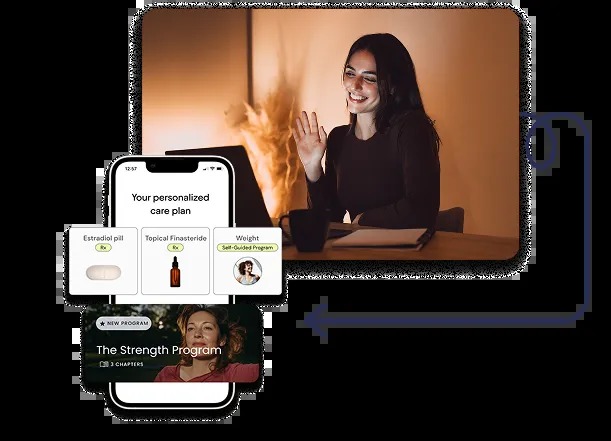
Evernow initially became known for hormone therapy, including estradiol and progesterone when clinically appropriate. Its menu now reaches vaginal health, weight management, hair loss, skin care, and mental health resources. The wider range makes sense: a patient's symptoms rarely respect a website's tidy categories. It also creates a harder test for the company. Breadth is valuable only if the care remains careful and the clinicians know when a concern belongs elsewhere.
What the bill actually says
Virtual care often looks cheap until its line items meet. Evernow's published membership prices are straightforward, but they are not a complete treatment quote. The plan pays for ongoing access and messaging. Video visits may produce a copay or deductible if insurance is used; a self-pay visit is $150. Medication is extra, with potential insurance coverage through a local pharmacy. Evernow says membership itself is not insurance covered, although HSA and FSA funds may be used.
Published membership prices
Medication is additional. A self-pay video visit is $150. Insurance eligibility depends on the service and the patient's plan.
The business began as a direct subscription. It now has more than one way into the market. In 2023, Evernow partnered with Talkspace to offer self-guided mental health resources to qualifying members and menopause materials to Talkspace clinicians. In 2025, it introduced pay-per-visit care. Clearblue test users gained a voucher for a month of Evernow care, and Oura members could share reports on sleep, cycles, and perimenopause with Evernow clinicians if they chose. Later that year, Evernow joined Progyny's national menopause and midlife care network, opening a path through workplace benefits. The commercial lesson is plain enough: even an excellent consumer health product reaches more people when employers and insurance-linked networks help them find it.
The data behind the doctor
Evernow has also gathered more than 100,000 health profiles for its menopause study. That gives the company a large view of what women report, when symptoms occur, and how experiences differ. It is a useful distinction: the figure describes profiles, not 100,000 paying patients, and a company-run observational study is not a randomized clinical trial. Still, research and care can inform each other. Better questions produce better intake; better intake can show where existing research has failed to ask the right questions.
The 2022 Series A, led by NEA with participation from 8VC, Refactor Capital, Coelius Capital, and high-profile angels including Drew Barrymore and Gwyneth Paltrow, supplied $28.5 million for expansion. The celebrity names made the announcement travel. The less photogenic work was recruiting trained clinicians, designing safe screening, keeping messages moving, and making refills predictable. Those are the details a patient notices on a Thursday afternoon when the first plan needs changing.
Can another company copy the play? The useful piece is to organize care around the length of the problem, then let people choose how much relationship they need. That works best when symptoms evolve, expert access is scarce, and follow-up matters. It is less suited to emergencies, conditions requiring a physical examination, or people whose insurance or budget cannot absorb recurring fees. Evernow does not erase the local healthcare system; its strongest case is filling a gap that system has left open.
A woman's health does not become less interesting once fertility is no longer the plot. Evernow's wager is that medicine might finally behave as if it knows that. The company sells appointments and memberships, yes. What it is really testing is whether a long neglected transition can be given the ordinary luxury of someone paying attention for more than a day.