The trunk refused to travel. It sat in a small shop in Florence, old, handsome and apparently far too delicate for an ocean crossing. Evan Walker wanted to buy it. The merchant, alert to the many imaginative ways a parcel can be broken or lost, did not want to ship it to the United States. Walker proposed tracking and protection, the sort of reassurance that came standard inside Amazon's walls. The merchant had no idea how to arrange it.
For most travellers, this would have been a charming impasse and perhaps a reason to buy something that fitted in the overhead bin. Walker was an antiques collector who had spent two decades in ecommerce. He saw the absent machinery: one willing buyer, one willing seller, and a sale stranded between them because the little shop lacked the tools of a giant marketplace.
The object was vintage. The irritation was thoroughly modern. Out of it came Route, the post-purchase company Walker co-founded with Mike Moreno and launched in January 2019. Route would track parcels, protect them and help resolve the indignities that occur after a customer has clicked “buy.” It was software for the interval when the shop has the money, the shopper does not yet have the thing, and everyone is suddenly very interested in the whereabouts of a cardboard box.
A bedroom shop before the web had manners
Walker had begun selling video games online from his bedroom in 1994, at 14. The commercial web was young enough to be awkward and old enough to take a teenager's money. Route has said that he sold the business five years later for $10 million. He enrolled in college, according to an account he later gave, but never turned up. Another business was already demanding his attention.
The details have the polished rhythm of founder folklore, but the useful part is less cinematic. Walker learned ecommerce while its customs were still being invented. He knew what it felt like to win an order and what could spoil one. Over the years he built and sold consumer brands, ran an advertising business and watched Amazon teach buyers to expect a closed loop: discovery, purchase, tracking, service and resolution under one roof.
That early start also gave him an unusually long view of online retail's changing promise. In 1994, merely finding a product on a screen felt novel. Two decades later, discovery was abundant and patience was scarce. Customers did not compare a small brand's shipping experience only with other small brands. They compared it with the smoothest transaction they had ever completed. The neighbourhood shop had acquired a global storefront, along with a global customer's expectations.
Independent merchants lived in another world. A shopper might discover a product on their site, then leave to see whether Amazon carried it. If the customer stayed and bought, the merchant still had to stitch together carriers, inbox updates, support tickets and claims. Walker's Florence encounter made this imbalance tangible. The shopkeeper did not lack taste or inventory. He lacked confidence that the transaction would survive the journey.
“A lot of people would find our product, then they'd leave our website and go to Amazon to see if that product was there.”Evan Walker on the pressure facing independent brands
The anxious little country after checkout
Route entered the least glamorous territory in retail. The post-purchase experience includes tracking pages, delivery alerts, stolen parcels, damaged goods and the dreaded support message known in the trade as WISMO: “Where is my order?” These are not naturally romantic materials. Nobody mood-boards a claims form. But they decide whether a brand feels trustworthy when the uncomplicated sale becomes complicated.
Walker framed the product around visibility and reassurance. Route's consumer app gathered orders in one place. Merchant tools added visual tracking and package protection. A lost or damaged order could move toward a refund or reorder without the shopper embarking on a small bureaucratic pilgrimage. The company's larger bet was that the moment after checkout was not administrative debris. It was part of the brand.
The distinction matters because a carrier can deliver a box while a merchant still loses the customer. An unexplained delay, a cold tracking page or a thicket of claim forms converts anticipation into suspicion. Route placed itself between those emotions and the merchant's support queue. Its product did practical work, but its commercial argument was psychological: certainty is memorable, especially when something has gone wrong.
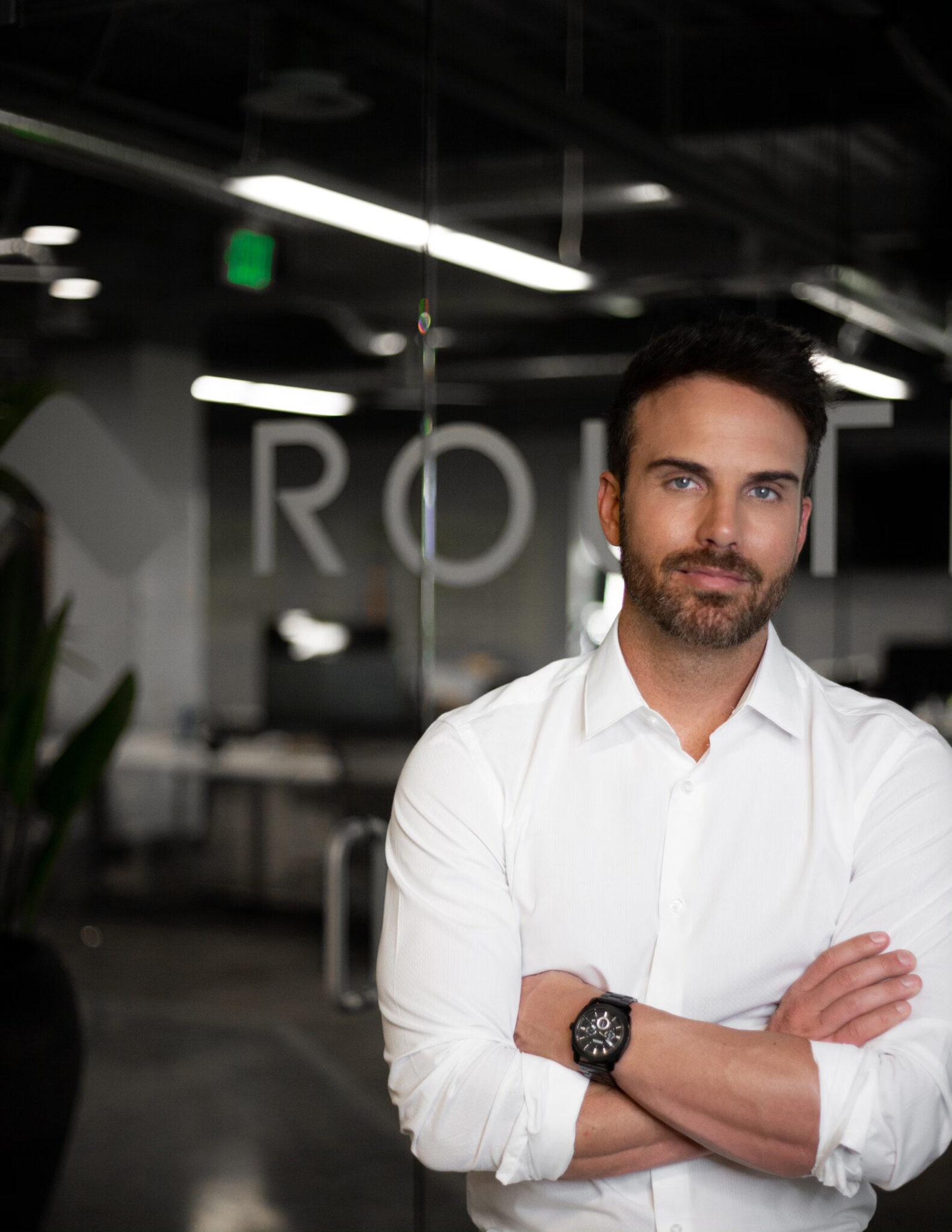
The first year supplied a startling answer. Route grew to 120 employees and more than 2,000 connected merchants. Walker said it finished the year at a $14.4 million annual run-rate. He called the expansion an explosion, which is exactly the metaphor founders use when the chart looks delightful and the calendar looks impossible.
More shops entered the route
Merchant brands reported publiclyA company grows up in public
Capital followed. A $12 million seed round was announced in 2019. Route later raised a $35 million Series A. In early 2022 came a $200 million Series B and a $1.25 billion valuation. The trunk story, once an argument for building, had become a neat way to explain a company serving tens of millions of shoppers.
Growth also complicated the simple fable. Route had to become more than the charisma and velocity of its founder. Michael Yamartino, who joined in 2020, stepped into the CEO role in 2023. Walker became executive chairman. In 2024, the company raised another $40 million at a reported $1.4 billion valuation. It said it had passed $100 million in 2023 revenue, protected more than $15 billion in merchandise and saved merchants over $100 million in refunds and reorders.
Then came another handoff. In July 2025, Eric Kobe became CEO as Yamartino moved to the board. Walker publicly welcomed Kobe's experience in scaling organizations and called the next phase one of enterprise growth. The founder who once had to persuade a Florence merchant that better infrastructure ought to exist was now helping choose the person who would operate it.
Starting Route required Walker to imagine a missing product. Maturing it required him to imagine a company whose daily operation did not depend on the founder occupying the chief executive's chair.
Founders are encouraged to tell stories of origin because beginnings make for lovely anecdotes. The later art is stranger: deciding which parts of the original vision must remain and which parts of the original authority can move. Walker did not leave Route. As executive chairman, he stayed involved in direction while professional operators took responsibility for the machinery.
The sequence also complicates the familiar mythology of the solitary founder. Moreno was there at the beginning. Yamartino helped carry Route from early acceleration into a more disciplined phase. Kobe arrived with experience across ecommerce, finance and insurance. Walker's public role became one of continuity rather than omnipresence. A company designed to connect many merchants could hardly remain a one-person performance forever.
“What gets me out of bed every morning is a passion to go create things that no one has ever experienced before.”Evan Walker, asked what he would do if he were not a CEO
The collector and the inventor
Walker's taste explains some of his method. He has described collecting artifacts from Bali, Indonesia, Egypt and elsewhere, pieces with the weathered aura of an Indiana Jones prop room. He admires Walt Disney for imagining things before they existed, then executing them in a way that felt emotional and immersive. Asked what he would do if he were not a CEO, Walker answered that he would be an inventor.
Those enthusiasms meet inside Route. Tracking and claims are logistical functions, but Walker has consistently spoken about them as experiences. He argued that commerce would blend online and offline discovery, and that brands should be presented with their stories and intentions rather than as an indiscriminate heap of products. The ambition sometimes stretched beyond the initial product, but its centre held: make the machinery of commerce feel less indifferent to the person waiting.
In January 2026, Route acquired Frate Returns, bringing exchanges and returns onto the same platform as protection and tracking. The company reported that it was serving more than 13,000 brands and had protected over $20 billion in gross merchandise value. Walker described the acquisition as a catalyst for the next stage. The stubborn trunk had acquired a return label.
There is an appealing circularity here. Walker began by moving games from his bedroom to distant buyers. He built Route after failing to move one old object from a distant shop to himself. Now, from the executive chairman's seat, he is concerned with a broader movement: customers through a system, leaders through a company, and the company beyond the personality who first drew its map.
His personal shorthand is less restrained: “Race fast cars and build big businesses.” Both pursuits reward speed. Only one of them requires knowing when to hand over the wheel. Walker's more interesting achievement may be that Route kept travelling after he did.