The machine was quick, clever and approximately as convenient as a piano. NavVis called it the M3. It scanned indoor spaces while rolling across the floor, but it could not manage stairs, ramps or slopes. An airline would not accept it as checked baggage. For a sales demonstration, it went ahead by ground freight in a shipping crate large enough to occupy the bed of a pickup truck. This was the hardware Evan McPhee was asked to introduce to America.
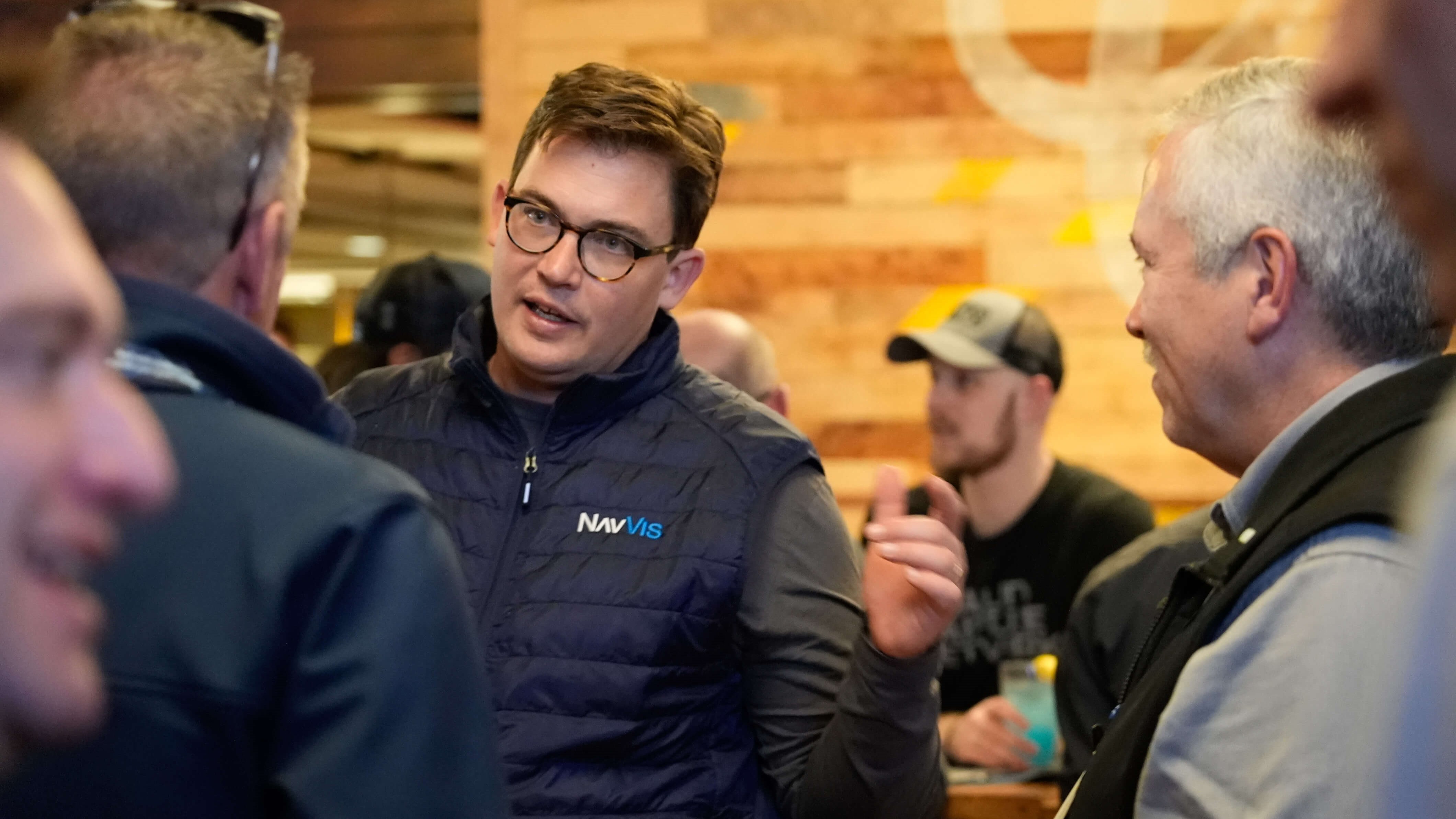
McPhee joined the Munich company in 2016 with an MBA from Harvard Business School, experience at Bain & Company and Facebook, and no deep background in reality capture. He also had no industry network waiting to receive him. His title said he ran the U.S. office. The comic detail, which he tells readily, was that he was the office's only employee.
The arrangement suited a particular sort of operator: someone willing to sell a future while wrestling with its first physical draft. The M3 could capture a building faster than older methods, yet every demo began with a minor campaign in freight management. Before McPhee could explain point clouds or indoor positioning, he had to make certain the point-cloud machine had reached the same state.
Before the crate, there was a spreadsheet
McPhee's route to NavVis was less a grand calling than a well-organised hunt. Near the end of business school, he consolidated lists of startups associated with Harvard and Stanford, added employee data and a pivot table, and published the result on Medium. He was frank about his purpose: he wanted a sales or business-development job at an interesting technology company, preferably in New York or San Francisco, and he welcomed leads.
The post is a modest but useful piece of autobiography. McPhee took an uncertain situation, made a practical tool from it, shared the tool, and stated what he needed. It is also the behaviour of a consultant who preferred a spreadsheet with imperfect rows to the romance of waiting for revelation. NavVis, founded in Munich in 2013, offered the kind of difficult proposition that such a search might uncover. It wanted to bring indoor spaces online, creating navigable digital records of buildings in the manner that street mapping had done outdoors.
The language was ambitious. The early selling was wonderfully concrete. Get the scanner to the building. Keep it on a flat surface. Show that a complicated interior could become measurable data. Find people who understood why that mattered.
“Of course, NavVis VLX 3 is way easier to sell than NavVis M3 ever was.”Evan McPhee, looking back in 2023
A market is a collection of specific favours
NavVis opened its first foreign branch in New York late in 2016. McPhee began assembling a network among surveyors, architects, engineers and operators of large facilities. An early partnership with PrecisionPoint in 2017 helped put the system in the hands of an American scanning specialist. The practical pitch concerned faster capture, browser-based building models, renovation mistakes avoided and distant teams working from the same view. “Digital twin” would become a broad and fashionable term. In the early years, the work was closer to patient translation.
One customer story explains the operating culture better than a diagram. An early client's scanning technician was unavailable and a high-priority project was at risk. NavVis had urgent work of its own. McPhee went and performed the scan himself. The client became one of the company's longest-standing customers.
The anecdote contains no ingenious pricing scheme or theatrical act of leadership. It contains a person arriving with the equipment. That is often how an unfamiliar technology wins trust. A customer must believe both the instrument and the organisation behind it will appear when the plan goes sideways.
When the person who does the scan cannot come, the person who runs the business may discover that he also does the scan.
By 2023, McPhee said the American team had grown to 30 and was recording millions of dollars in annual bookings. Its customers stretched across a country filled with factories, refineries, construction sites and buildings whose drawings had slowly parted company with reality. The business case was rarely beauty. It was the cost of sending an engineer to verify a pipe, the delay caused by designing against an old plan, or the rework produced by discovering a surprise after construction had begun.
The wearable scanner meets the immovable year
The product improved. NavVis moved from the wheeled M3 to wearable VLX systems that could travel through more complex spaces. In March 2020, the first VLX was almost ready for market. So was a global pandemic. McPhee's team had to introduce a device built for walking through buildings at precisely the moment walking through buildings with strangers became a terrible idea.
They shifted early demonstrations outdoors and into low-density locations. Demo units moved around the country instead of people gathering around them. It was an awkward launch for a more graceful machine, but the response reveals McPhee's preferred version of innovation: make a framework, then let capable people in the field solve inside it. He argues that executives do not possess all the useful ideas. Product and process improvements often arrive from teams closest to the work.
Strong convictions, loose fingers
McPhee borrows a useful phrase for risk: “strong convictions, loosely held.” The first half enables a team to move quickly and speak plainly about a product's value. The second half makes room for evidence. In reality capture, evidence has a pleasing literalness. A scan either matches the ground truth or it wanders. A workflow either saves time or merely photographs the old delay in higher resolution.
His other managerial preoccupation is the daily fire. Urgent tasks offer the immediate pleasure of resolution. Strategic work sits quietly and suffers politely. McPhee tries to resist spending each day firefighting, because a business can become remarkably efficient at handling emergencies while neglecting everything that would prevent them.
The discipline extends to measurement. Revenue matters, but he pays attention to the input metrics that predict it. The view is familiar from his career: consulting's decomposition of a problem, Facebook's enterprise scale, business school's fondness for a model, then a decade in which those abstractions met ramps, freight schedules and industrial customers.
“Innovation isn't a top-down process - executives don't have all the good ideas.”Evan McPhee on field-led invention
There is humour in McPhee's account of the old machinery and candour in his admission that he arrived without expertise. Both are management assets. People can tolerate a leader's conviction more easily when he remembers the crate. He also admits to spending more time on Twitter than is probably healthy, the sort of small confession that suggests his appetite for industry chatter did not begin with a content strategy.
When reality becomes infrastructure
NavVis has outgrown the small-company chapter McPhee entered. The company says its systems captured, processed and distributed more than one billion square metres in 2025. More than 150,000 users across engineering, maintenance and construction work with its data. In August 2026 it announced an $85 million Series D, intended to expand its spatial-data engine and accelerate an artificial-intelligence roadmap. McPhee's public reaction was brisk: NavVis had raised money; now it was time to use it to scale.
His latest product enthusiasm offers a neat bookend. The new CLX is handheld. McPhee contrasted it with the M3 he sold ten years earlier, the scanner whose shipping crate could fill a pickup bed. The distance between them is more than a reduction in dimensions. Capture has moved from an occasional specialist exercise toward something teams can do repeatedly, keeping a site's digital record closer to the site itself.
McPhee now works from Los Angeles and leads North America for a company headquartered nine time zones away. His job remains one of translation: Munich engineering into American enterprise practice, spatial data into fewer mistakes, and an impressive point cloud into an answer someone can use before boarding a plane.
The great indoors did come online, though not all at once and not by magic. It came by freight, then on shoulders, then in a hand. It arrived through partnerships, improvised demos and the occasional executive sent out to finish a scan. The future, in McPhee's telling, is seldom weightless. Someone still has to carry it through the door.