Evan Kirkham had found something people liked. That was the awkward part. Colorcast, the sports commentary app he had co-founded, had attracted more than 10,000 monthly active users. Fans could replace the television broadcast's voices with somebody else's: a friend, a former player, a comedian. For anyone who has argued with a commentator through a screen, the attraction required little explanation. The remote control had finally acquired a reply button.
By 2022, however, an audience and a business were proving to be separate accomplishments. Kirkham and his co-founders were considering fresh investment while confronting an inconvenient question: how would this thing make money? The company had momentum. It had relationships. It had people listening. Changing direction meant risking something tangible, which is considerably less comfortable than abandoning a bad idea nobody wanted.
They changed direction anyway. Colorcast became the starting point for Outlier, a sports betting research platform. Kirkham's route there ran through politics, a Dallas law firm and a very ordinary grievance about watching football. The interesting decision came after the original idea had begun to work.
A lawyer with somebody else’s problem
Kirkham grew up in Flower Mound, outside Dallas, and attended the University of Mississippi. Politics came before technology. His early work included presidential campaign fundraising, followed by work in Washington. He returned to Texas for law school at Southern Methodist University and graduated in 2017. At Carrington Coleman, he worked in securities litigation until 2020.
The dissatisfaction was about ownership. One client, a countertop installer, helped bring that into focus: the lawyer in the suit found himself wanting the business owner's position across the table. “I wanted to fight my own fights,” Kirkham recalled. It is an unusually candid reason to leave a profession built around doing the opposite.
He began posting startup ideas publicly on LinkedIn. A Thursday-night football broadcast supplied the idea for Colorcast: why couldn't a Cowboys devotee choose another Cowboys devotee to call the game? A contact responded with an invitation to lunch. An initial $10,000 investment followed. A complaint about television had acquired a budget.
“I wanted to fight my own fights.”
Evan Kirkham, on leaving litigation
Everybody gets a microphone
Colorcast launched in late 2020. Its promise was easy to grasp: turn on a game, open the app and supply your own commentary. An aspiring broadcaster did not need a studio or permission from a network. Listeners could choose the sort of company they wanted while watching. Neutrality, that sacred broadcast virtue, was entirely optional.
The company entered Sportradar's Acceleradar program in November 2020, gaining access to sports data and mentorship. That relationship matters in the story because statistics were part of the business well before Outlier became its principal product. The commentary app was already moving toward a viewing experience with more information attached.
There were recognizable names around it, too. In April 2021, rapper Vic Mensa joined as a part-owner, adviser and brand ambassador. He had used Colorcast to commentate on a Chicago Bears game and a Jake Paul fight. The company also won the 2021 SXSW one-minute pitch competition. By 2022, Kirkham was publicly celebrating a $3.5 million seed round. These were concrete reasons to keep building the original product.
The useful part was hiding in the plumbing
The eventual change grew out of work Colorcast had already done. The team had developed sportsbook relationships while exploring a feature that could connect a commentator's observation to a relevant wager. If the conversation turned to a player's performance, the app could surface a corresponding bet. The connection between talk, data and action was sitting inside the commentary business.
Kirkham and his co-founders, Peter Reggio and Luis Lafer-Sousa, began treating that connection as a product in its own right. Interviews with prospective users exposed two linked difficulties: finding useful data and understanding it once found. A spreadsheet can contain the answer and still be a fairly effective way of hiding it.
Outlier paired betting markets with contextual, visual research. Its public rebrand was announced in November 2022; the product's rollout continued into early 2023. The early ambition was deliberately accessible, aimed at novice and intermediate bettors rather than a roomful of professional traders. Education belonged beside the tools. The team had changed what it sold while staying close to the sports fan it wanted to serve.
Who pays you changes the product
For Kirkham, the business model became part of the proposition. Outlier charges subscribers for research and has operated without sportsbook affiliate revenue. That choice gives it a particular commercial relationship: the person evaluating the data is also the customer paying for the service. Renewals depend on that person continuing to find the research useful.
The point of use matters just as much. “Research needs to be at the point of sale,” Kirkham said in 2024. Outlier brings player trends, team analysis, line movement and odds comparison into the path toward a bet, with connections to partner sportsbook apps. A useful observation loses some of its usefulness if acting on it requires a scavenger hunt.
The audience has its own preferences. In a June 2026 podcast appearance, Kirkham described NBA activity as roughly 65 to 70 percent of Outlier's traffic, with player props accounting for 95 percent of usage. Those are his descriptions of the product's activity, rather than figures for the wider betting market. They give the terminal analogy a more specific setting: people examining individual performances, often in basketball, rather than simply asking which team will win. The product has to make that detailed investigation convenient enough to become a habit.
This is the practical substance behind the Bloomberg-terminal comparison associated with Outlier. The ambition is to gather information, make it legible and place it near a decision. It also explains why a former commentary app could become a research subscription without leaving sports behind. In both cases, the product sits alongside the game and changes how a fan experiences it.
- 01DiscoverFind an idea
- 02AnalyzeExamine the context
- 03ExecuteConnect to a sportsbook
The second decision about raising money
By October 2024, the conversation had shifted. Kirkham was discussing life after finding product-market fit, a lean team's development rhythm and a platform sending more than 500,000 bets a week toward sportsbook partners. That figure describes activity routed through the product, rather than subscribers or company revenue. The distinctions matter when a business has several impressive-looking counters.
He also described beginning a fundraising process that year and then abandoning it in favor of organic growth. Raising capital was becoming a choice to evaluate against the business, rather than the automatic next chapter. For a founder who had already changed products over the question of revenue, that was a consistent subject to revisit.
Fresh financing did arrive in December 2025. The announced package combined $5.7 million in equity led by Discerning Capital with $5 million dedicated to user acquisition. The plans included further product work and building engineering and customer teams in New Orleans. Capital now had specific jobs to do. The earlier concern about making the business work had become a question about how to expand it.
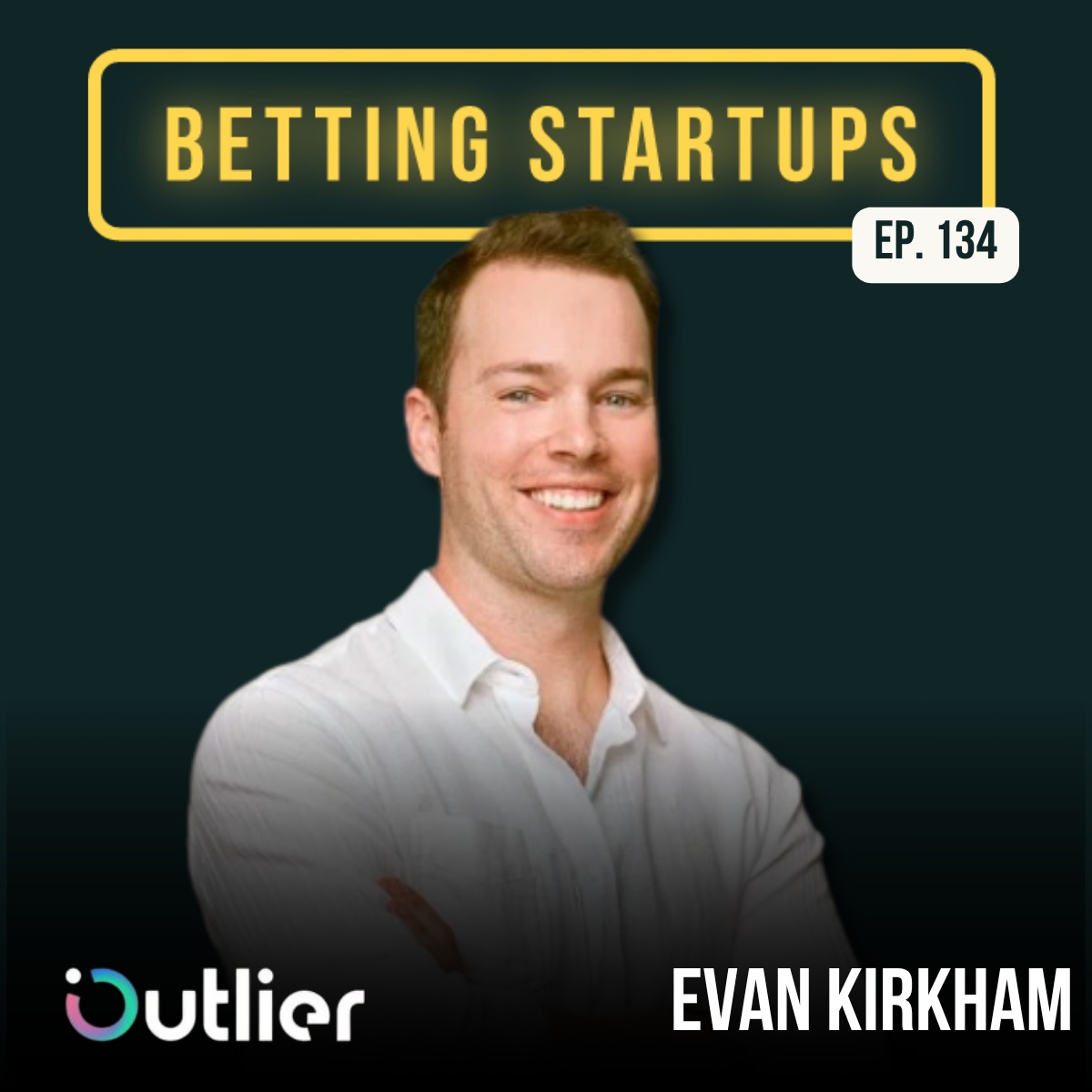
Episode artwork: Betting Startups.
A Texas founder, a New Orleans workshop
Kirkham is based in Austin. Outlier's development story also belongs to New Orleans, home to co-founder Lafer-Sousa and a product and engineering operation in the Warehouse District. During Super Bowl weekend in 2025, the company hosted technology investors and founders there. A sports business had found a fairly convenient occasion for bringing its worlds together.
By September 2026, Kirkham described an 18-person company, with five employees in New Orleans. He talked about that office as a gathering place for retreats, hackathons and trips to a Saints game. The appeal was practical as well as social: regional partners helped introduce recruits to the city and support relocations.
There is a smaller-scale version of that attention to working life in Kirkham's own habits. He has discussed auditing his calendar monthly and protecting his time. His public self-description includes backcountry adventurer and Cowboys diehard. Alongside the financing announcements, these are useful details: a founder with a schedule to inspect, a team to assemble and, apparently, no intention of giving up his football loyalties.
The game keeps moving
Outlier's next product, React Live, takes the research problem into a different clock speed. Kirkham described it as emerging from the company's annual innovation week and reaching production web and iOS apps in less than six months. Its subject is the game in progress: momentum, lineups and live performance viewed against historical baselines.
In March 2026, Outlier acquired SportsCapital's intellectual property to strengthen its data infrastructure. The wider aspiration is visible in the relationship between the products. Outlier helps with preparation before a game; React Live follows events after play begins. Kirkham has described the company as pursuing sports intelligence for a wider range of fans and uses. A single app is becoming a collection of related tools.
His reading lists offer another view of his attention. In 2025, he shared material on AI search, App Store payments, Georgia O'Keeffe and the geometry of a Möbius strip. Another edition moved from Hemingway's writing habits to championship rematches and Elvis. The list does not stay politely inside a sports technology category. Neither has his career.
The original Colorcast idea gave fans another voice in their ear. Outlier asks what information should be in front of them when they make a decision. Kirkham has repeatedly returned to that question while changing the product, the financing plan and the scale of the company around it. The Cowboys fan's complaint survived. It simply became a much more demanding business to answer.