The least informative person in a shop is, in one respect, the person who buys something. The cash register already has a story about them: a time, a basket, a total. The person who circles a display, waits, sighs and leaves is more elusive. They may have disliked the merchandise. They may have liked it perfectly well and disliked the queue. The receipt offers no testimony.
- Euclid measured visits, shopping time and repeat traffic using smartphone Wi-Fi signals.
- It moved from dedicated sensors to existing wireless networks, then offered free basic analytics.
- Privacy concerns helped end trials at Nordstrom and Philz Coffee.
- WeWork acquired it in 2019 to bring physical-space analytics into the workplace.
Euclid built a company around that missing cast. Its premise was that a physical business ought to understand the steps before a transaction as well as an online business understood the steps before a checkout. A shop window could have something resembling a click-through rate. A short visit could look like a bounce. Returning to a store could become a measurable habit.
This was useful, commercially attractive and socially awkward. A retailer saw a better way to arrange staff and displays. A shopper might see a device in their pocket quietly reporting their presence. Both were looking at the same system.
The receipt’s missing cast
Euclid belonged to the market for retail visitor analytics: software between the wireless network and the manager’s next decision. Its customers included retailers, restaurants, malls and other operators of physical locations. The company’s January 2016 announcement reported more than 500 brands in 65 countries. Those are historical company figures, not a count of businesses using Euclid today.
The early system listened for signals from Wi-Fi-enabled phones. Device identifiers were transformed, and customers received aggregated analysis. A phone did not have to join the shop’s guest network or run a retailer’s app for the passive product to detect it. That distinction explains much of Euclid’s appeal, and much of its trouble.
Compared with a simple door counter, repeat-visit and duration information supplied context. Compared with an app-based approach, passive detection avoided asking every visitor to download something. Wireless integrations also offered a route around installing another set of devices. Competitors such as RetailNext and ShopperTrak approached the wider measurement problem with their own combinations of technology; Euclid’s advantage depended on the job and the existing network.
A web analyst walks into a mall
The founders made an unusually fitting pair. Will Smith brought a family connection to shopping-center development: his grandfather had developed malls near Atlanta. Scott Crosby had co-founded Urchin, acquired by Google in 2005 and used as the foundation for Google Analytics. One background concerned where people walked. The other concerned what happened when they clicked.
Euclid was founded in 2010 and launched publicly as Euclid Elements in 2011. The name nodded to the ancient geometry text. Its ambition was rather less ancient: give the physical retailer a dashboard. The family resemblance to web analytics was explicit, but translating the idea into a shop created a different measurement problem. A browser visit leaves digital events. A human visit supplies radio signals only if a suitable device happens to be present and detectable.
“Great retail experiences don’t happen by accident.”Will Smith, co-founder and then CEO, 2013
That was Euclid’s pitch in a sentence. The practical claim underneath it was more modest and more interesting: a manager could replace some guesses with comparisons. Did a changed display attract more visitors? Did an event bring people back? Those questions could be asked repeatedly, rather than settled by whoever sounded most certain at the Monday meeting.
First, remove the box
At launch, the service cost $200 per sensor per month. The sensor fed observations to a cloud dashboard. This was recurring software revenue attached to a physical installation, and the number of sensors mattered to the bill.
Euclid Zero, introduced in early 2013, changed the installation bargain. On supported wireless systems, the retailer could use access points already in place. The software still needed compatible infrastructure; “zero” described the dedicated sensors being removed, not the disappearance of every requirement.
*On supported existing wireless infrastructure. Historical milestones, not present-day offers.
Euclid Express followed in January 2014 with free essential metrics and a paid upgrade path. Advanced capabilities included deeper comparisons, zone analysis and connections to transaction or other data. The commercial logic was legible: make the first useful report easy to obtain, then sell analysis that answered more demanding questions.
Networking partners helped distribute the idea. Cisco Meraki described an integration through its location-analytics API that could activate Euclid across existing locations. The access point was becoming both a source of observations and a sales channel. Approximately $44 million in funding, including a $20 million Series C announced in January 2016, supported the company’s expansion.
The cheap postcard wins
Euclid’s July 2013 specialty-retail announcement offered a pleasingly impolite example. An unnamed high-end denim retailer compared its expensive catalog with cheaper discount postcards. According to Euclid, the postcards coincided with better visitation and longer shopping time; the catalog did worse. The retailer dropped weak activities and expanded successful ones.
This was a company-reported pilot, not an independently audited experiment. Still, the question was excellent. Marketing’s most handsome object need not be its most effective one. Recording store visits could reveal responses that a transaction-only report missed, including people attracted by a promotion who did not immediately buy.
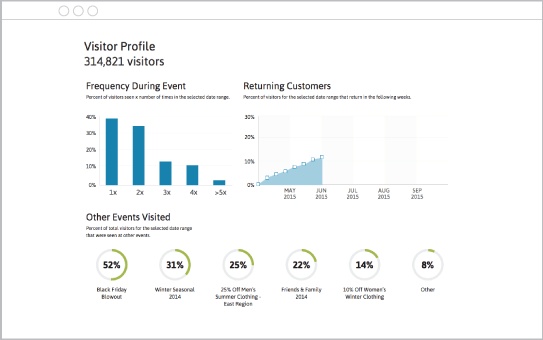
The same approach could inform restaurant staffing or comparisons between store locations. But interpretation required restraint. A long visit might signal fascination, indecision or a slow-moving line. More visits might come from an effective campaign or from circumstances unrelated to it. Analytics gave a manager something to investigate. It did not relieve the manager of investigating.
The customer noticed
One early limit was trust. Nordstrom stopped its Euclid tracking trial in 2013 after privacy concerns. Philz Coffee, an early customer, stopped in 2014 following customer complaints. These were specific losses, not proof that the entire business had failed. They did demonstrate that technical privacy protections and public acceptance were different tests.
Euclid described its passive analytics as anonymous and aggregated, and required customer notices and an opt-out. Yet someone could object to being measured even when the retailer never saw their name. Consent is a relationship with a person. An identifier transformation is an operation on data. Explaining the latter does not automatically establish the former.
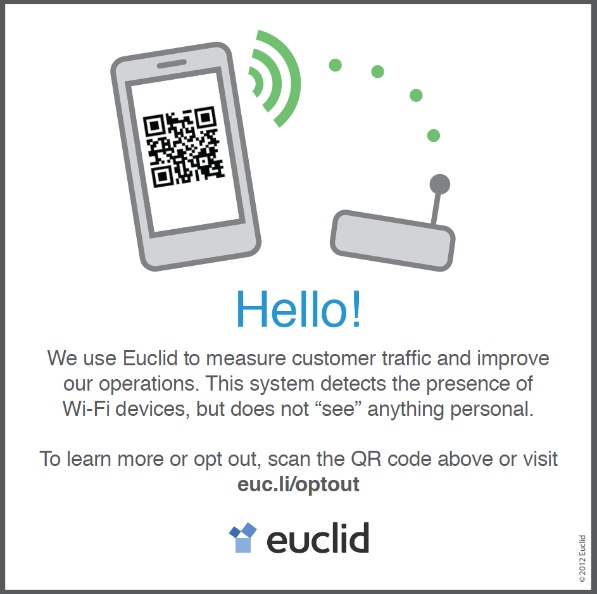
In July 2016, Euclid introduced Connect, an opt-in guest Wi-Fi platform. A login could connect a physical visit with marketing activity and support personalized engagement. This expanded the company’s job from measuring anonymous traffic to working with a participating customer. The product change is documented; treating it as a confession about the earlier model would be speculation.
A meeting moves the market
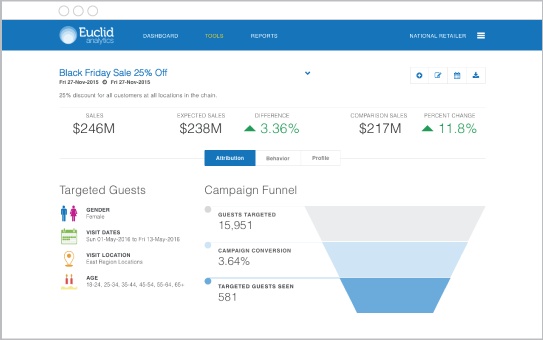
The next setting was an office. WeWork acquired Euclid in February 2019 and said its team and technology would become fully integrated, concentrating on workplace insights. The planned combination included Teem, the space-management software business WeWork had already acquired.
The distinction was straightforward: reserving a room does not tell you how it was used. Joining information about bookings with observations about space could help an enterprise assess its workplace. Euclid’s retail question - what happened here before a purchase? - became a property question: what happens here between reservations?
WeWork’s announcement described a way to improve decisions about space and engagement. Attendance data could support that effort, although presence alone would not establish productivity or satisfaction. An office full of people is a measurable fact. Whether they are doing useful work remains a more demanding inquiry.
Borrow the question
Euclid’s history offers a practical habit for anyone operating a physical business: identify the decision before collecting the metric. If you are testing a window display, visits may help. If you are testing service speed, duration needs the context of queues. If you are allocating rooms, bookings should be checked against use.
The method needs comparable periods, a reasonably representative sample and people willing to accept the measurement. It becomes weak when visitors are poorly represented by detectable devices, the network misses relevant areas, or simultaneous changes make comparisons ambiguous. Permission and clear explanations belong in the design from the beginning.
There is something attractively deflating about this legacy. The catalog may be gorgeous and ineffective. The room may be booked and empty. The shopper who bought nothing may be the person with the most to teach you. Euclid made those possibilities easier to notice. The next decision still belonged to a human.