A school gym is an unlikely place to look for the next chapter of a financier’s life. Yet there it is, at Cranbrook in Bloomfield Hills, Michigan: a building Essel W. Bailey, Jr. knew when basketball was the immediate business at hand. He and his younger brother Jim played there as students. Decades later, Essel and his wife, Menakka, committed $15 million to its restoration and permanent endowment as a performing arts center. The old gym had acquired a rather different audience.
There is a pleasing economy to that return. Bailey built a career around property, finance, and the organization of companies. Here was a property already carrying a personal history, asking for another useful life. A gym becomes a theater. A former pupil becomes a benefactor. The building keeps working, although the costumes change.
“Cranbrook made me who I am,” Bailey said. It is a short explanation for a large commitment. His connection to the school reaches back to the class of 1962, before the public companies and the California vineyard. The gift, publicly announced in April 2026, brings those later resources back to an earlier address.
The endowment is the detail to linger over. Renovation pays for an intervention; an endowment helps with the years that follow. Buildings have a habit of continuing to need attention after the ribbon is cut. For a founder whose public identity began in real estate finance, the decision to provide for upkeep has an appropriately practical ring.
Before the boardroom, a tractor
An old family photograph shows Jim and Essel as boys on a tractor. It supplies a useful corrective to the usual executive portrait: two children, an enormous wheel, and a steering arrangement that would trouble a modern driving instructor. Long before their names appeared on business ventures, the brothers belonged to a family of farmers in Michigan and Tennessee.
Their route through education included scholarships. Farming and school were both part of the family story, rather than successive worlds with a door slammed between them. Essel’s later environmental giving makes that early relationship with land especially relevant. The vineyard would eventually give the brothers another reason to return to the subject together.
Cranbrook was followed by Wesleyan University, where Bailey graduated in 1966, and the University of Michigan Law School. Michigan’s law-school alumni records place him in the class of 1969. The same year marks his admission to the Michigan bar. The sequence is straightforward: school, college, law. What came afterward was considerably less confined to a single profession.
A legal education would give him a working vocabulary for companies, ownership, and obligations. Those are useful subjects for anyone preparing to invest. They are also useful subjects for anyone preparing to give money away with instructions attached. Across Bailey’s career, the legal framework is often sitting quietly underneath the more visible transaction.

A lawyer starts signing as the founder
Bailey worked in Michigan state government and became a partner at Detroit law firm Dykema Gossett, specializing in corporate and real estate finance. His subsequent business career carried that combination into investing. Oxford Companies now lists him on its board of advisors as managing director of Alpha Capital, a private investment and advisory firm.
The founding role most closely associated with his name arrived in 1992: Omega Healthcare Investors. He became its president and chief executive at formation, adding the chairmanship in July 1995. Before Omega, he had been a managing director of Omega Capital from 1986 to 1992. The move into a public company therefore followed years spent in the investment business.
By 1999, his responsibilities also included leading Omega Worldwide, a separately listed Nasdaq company, with financial interests extending into the United Kingdom and Australia. His working map had expanded well beyond Michigan. The titles accumulated, but their common territory remained recognizable: capital, property, corporate structure, and the people responsible for making those arrangements work.
In July 2000, Omega announced that Bailey would retire from its chairmanship, presidency, chief executive role, and board when an investment by Explorer Holdings was completed. His founding tenure belongs to that period. The distinction matters in a life that continued into other businesses and advisory work: founding a company is a permanent biographical fact; running it is a job with dates.
Two brothers, another piece of land
In 2006, Bailey joined his brother Jim and their friend Tom Costin in the founding of Knights Bridge Winery in Knights Valley, Sonoma County. The location returned a business partnership to agricultural ground. The brothers had traveled a long way professionally, then found a new project that involved growing something again.
The estate began with an 83-acre parcel purchased by Jim. Its plantings included Sauvignon Blanc, Chardonnay, and Cabernet Sauvignon. The work involved examining vineyard blocks, matching plant material to soils, replanting portions of the property, and adopting sustainable management practices. Wine may arrive at dinner with an air of ease. Its preparation tends to involve rather more planning.
Essel and Menakka are co-owners. That distinction leaves room for the other people in the enterprise, including the professionals who farm the grapes and make the wine. The family connection is real, but a vineyard still requires a team. A familiar surname on the ownership list cannot prune an entire hillside.
The winery also has a small link to Menakka’s family history. Its Christobel wine is named for her mother, whose interest in education and the arts Menakka has described as a connecting force. Within this venture, agricultural work and family memory share the same label. It is an unusually portable way to keep an older generation in the conversation.
A college with room for different minds
At Wesleyan, the Baileys’ support took an academic form. In 2013, they committed nearly $3 million to endow a visiting professorship in the College of the Environment. Bailey described the attraction as “knowledge-based policy on the environment.” The wording is revealing: he was interested in how knowledge could inform decisions, and in bringing additional thinkers into the room.
A visiting appointment makes that intention concrete. It gives a college the means to invite someone with a different body of work, different questions, and different methods. A donor can support an established answer. Here the commitment also supported the arrival of new questions, an arrangement that requires some tolerance for where scholarship might lead.
In 2017, the couple added a $4 million commitment, bringing their total support for the college to $7.5 million at that point. The funding reached across a think tank, visiting scholarship, student research, internships for students with financial need, and an endowed scholarship. It addressed both the intellectual work and the cost of taking part.
Those are different obstacles. A promising topic needs time and informed attention; a student may also need the means to accept an opportunity. Funding both makes an educational idea more usable. The total matters, but so does the arrangement beneath it: several routes by which money can become an actual experience.
“Knowledge-based policy on the environment.”Essel Bailey · 2013
A toast, with the homework still attached
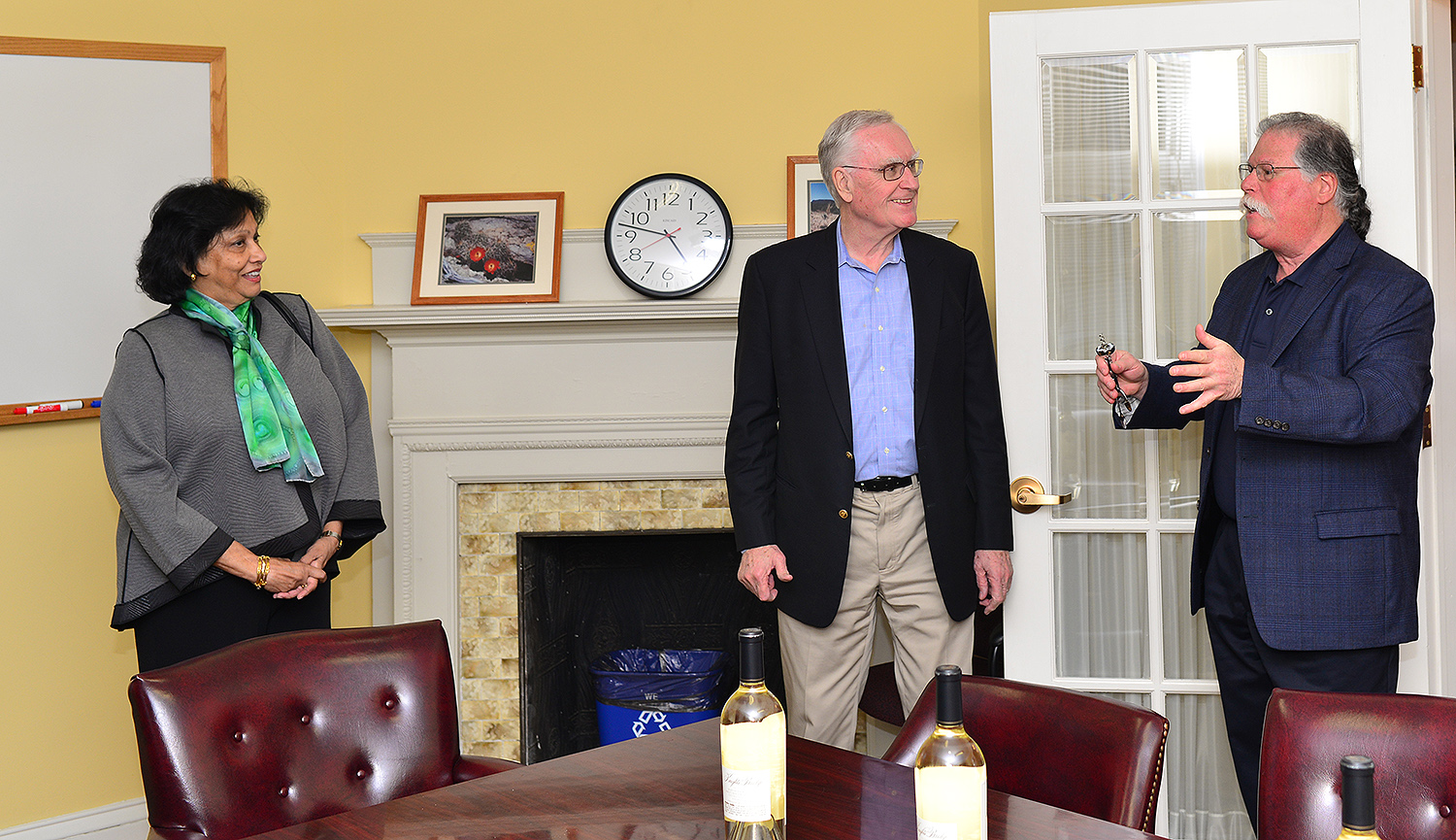
During an April 2017 campus visit, the Baileys brought wine from their California farm. Professor Barry Chernoff led a toast with faculty, staff, and students. In the photograph, Menakka stands at the left, Essel in the center, and Chernoff at the right. An academic gathering briefly shares its table with the vineyard.
It is a modest scene, and a useful one. The businesses and the philanthropy are often described in different professional languages. At this visit they occupied the same room. A bottle offered a tangible connection between the land the Baileys owned and the environmental education they supported. The conversation had refreshments.
By 2023, the college carried the couple’s names. Their support also extended to plans for updated quarters in Shanklin Hall, student funding, and faculty outreach. Menakka’s role deserves its own weight here: the educational commitments were made by a couple with a shared interest, rather than by one person with a spouse added to the photograph.
One example of the college’s reach is Mary-Jane Rubenstein’s work on space exploration and planetary habitability. Participation in its think tank helped her develop writing that became the 2022 book Astrotopia. It is a satisfyingly unexpected destination for support rooted partly in a farmer’s attachment to Earth: a discussion of what people imagine doing on other planets.
What the next students inherit
Back at Cranbrook, the building set to carry the Bailey name was designed by Eliel Saarinen in 1932. Its next phase includes improved acoustics, an orchestra pit, stage technology, and expanded gathering spaces. The preservation project therefore has to make room for contemporary use. A school cannot teach entirely inside a memory.
The planned center will accommodate classes, assemblies, lectures, and community events as well as performances. For Bailey, the return to a place associated with his own schooldays will give later pupils a setting for quite different experiences. They may remember a first performance or a difficult question from the audience where he remembers basketball.
There is no need to make the biography tidier than it is. A law practice, public companies, a vineyard, and endowed educational programs are different undertakings. Each has its own colleagues, risks, and daily work. Yet Bailey’s later commitments repeatedly bring him into contact with things that need attention over time: land, learning, buildings, and the organizations around them.
The old gym provides a good place to leave him. Somewhere in its history are two brothers playing basketball. Ahead are students who will know it by another name and use it for other purposes. Between those generations sits a gift designed to cover both change and care. The building has another turn to take.