In 2009, Eric Gundersen arrived in Kabul and found a city missing from his map. There were roads on the screen, including Jalalabad Road and the ring road. Between them, a capital had more or less disappeared. Gundersen was working with the US State Department around Afghanistan’s presidential election. Understanding what had happened required placing information somewhere. The available map offered an intersection and very little help.
It is an awkward discovery for a development consultant. Decisions still have to be made. Spreadsheets still arrive. A blank patch on a screen does not mean that nobody lives there. It means the people trying to understand the place lack a useful way to see it. Gundersen’s response eventually became Mapbox, the company he co-founded in 2010 and ran until 2021.
The distance between those two events contains a less tidy business story than the funding announcements suggest. There was consulting work, software built for immediate needs, a community mapping a world no single company owned, and a founder learning how to turn useful tools into something people would pay to keep using. The map improved. So did the business underneath it.
A town with one blinking light
Gundersen grew up in Warren, Connecticut, at the end of a dead-end road beside farmland. His father was a nuclear engineer; his mother reported for local newspapers. He remembered a town with more cows than people and a stoplight that usually blinked. His interests reached further: international history, distant places, and, later, the economics of globalization.
At American University, he studied economics and international relations before completing a master’s in international development. He subsequently worked in microfinance in Peru. The attraction was practical: how lending could function where the usual credit systems did not, and how groups could supply the social collateral that conventional banking expected in another form.
In 2004, he started a strategy business with a friend from graduate school. Development Seed became a place to build open source tools for development agencies and nonprofits. Work for clients including the World Bank and the United Nations exposed a recurring difficulty. Organizations had information. Turning it into something people could examine and act upon took another kind of work.
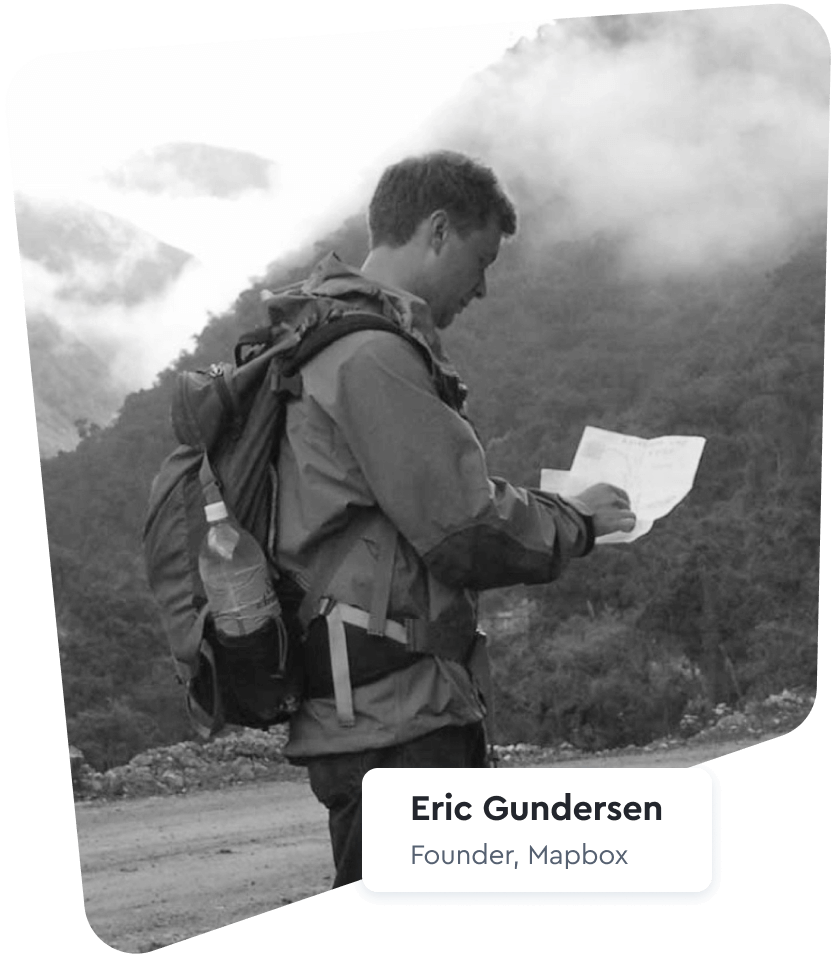
The useful thing beneath the invoice
Consulting offers an unusually direct education in what customers need. Someone brings a problem, expects an answer, and has a deadline. Repeated problems can also leave behind reusable software. A tool written for one assignment can make the next assignment easier. Eventually the accumulated tools begin to suggest a business of their own.
Mapbox grew inside that arrangement. Development Seed’s projects financed work on the mapping software. The separation between client work and product work was financially uncomfortable: both demanded attention, and only one reliably came with an invoice. Gundersen later described coming close to missing payroll. A platform might serve thousands of customers someday; employees still needed paying that week.
His early working life had supplied some less glamorous financing. While getting the business going, he worked as a bicycle messenger, then moved to bartending so that he could meet clients during the day. There is a certain efficiency to this schedule, provided one does not require many evenings off.
The software needed a commercial shape. Making a custom map was useful, but that map also needed to stay online and work when other people opened it. Hosting and services supplied a continuing reason to pay. The developer could concentrate on the application; Mapbox could handle more of the machinery beneath its map.
Somebody else’s neighborhood
A crucial part of this approach came from OpenStreetMap, the community-edited geographic database. People could contribute the details they knew: a street, a building, a connection that a distant mapmaker had missed. Mapbox built products using that shared data. The distinction mattered. A commercial company could offer design tools and services around a resource whose ownership remained outside that company.
In 2012, the Knight Foundation awarded Development Seed and Mapbox $575,000 to improve OpenStreetMap infrastructure. The work included making editing easier and improving how contributors could collaborate. Better tools could encourage more contributions; those contributions could improve the underlying map. The grant supported part of the common machinery on which the business depended.
That same year, Mapbox Streets offered a global map with street-level detail. Customization gave developers room to decide which features deserved attention. A map is full of editorial decisions, even when it looks neutral. Color, emphasis, labels, and omissions tell the person looking at it what matters.
A runner and a driver can pass through the same neighborhood while needing quite different information. The trail, the hill, and the water fountain might deserve prominence for one; road access and traffic for the other. Giving the application’s maker control over those decisions was a concrete product proposition. It also gave Gundersen a more interesting argument than simply promising another map.
“Design isn’t just about brand. Design is strategy.”
Eric Gundersen, 2014
The customer who arrived after midnight
One customer conversation began at 1:30 in the morning on a Sunday. Someone from Foursquare asked on Twitter for a connection to Mapbox. Gundersen replied. An email followed within minutes, and within five weeks Foursquare had switched over. It is a pleasantly compact sales story: a public question, an awake founder, a product ready enough to make the answer useful.
By June 2012, the relationship extended to Foursquare’s developer community. Mapbox offered developers using Foursquare’s API a special free plan, with additional storage, views, analytics, and no branding. The two services could be combined in new applications. That made the early customer relationship more than a replacement of one supplier by another. It gave builders a reason to experiment with both. A successful map inside one website could become an introduction to people working on products of their own, each with another set of uses for location data.
By October 2013, Foundry Group was leading a $10 million Series A. Its introduction to Gundersen had come through overlapping connections: Pantheon’s Zack Rosen, and work involving portfolio company Gnip and data artist Eric Fischer. Those routes supplied something a cold pitch struggles to manufacture. People the investors already trusted had seen the work.
The customer list included news organizations and software companies. For an investor interested in services developers could incorporate into their own products, the appeal was recognizable. A map could become a component, much as another service might handle payments or messages. Its provider did not need to persuade every consumer to download a new app.
That arrangement also allowed for surprises. In 2013, Gundersen talked enthusiastically about developers using Mapbox for interactive fiction and a zombie game. The platform’s reach included much stranger destinations than a directions screen. Build a flexible tool and other people will supply ideas that would look improbable in a company planning meeting.
When the map leaves the phone
In June 2015, Mapbox announced a $52.55 million Series B led by DFJ Growth. Two years later came a different order of financing: a $164 million Series C led by the SoftBank Vision Fund. Gundersen’s explanation centered on location data moving through networks of small sensors, increasingly embedded in the things around us.
The announced priorities were specific: an automotive unit, more work on augmented reality, virtual reality and gaming, and expansion in Asia and Europe. Navigation inside a car demanded a different relationship with the map from a website’s store locator. The company was moving further into systems that helped people and goods move through the physical world.
Individual announced financing rounds, not annual revenue or a complete funding history.
Growth brought obligations that an elegant demonstration could not settle. In August 2018, an antisemitic edit reached customer maps after a human override allowed quarantined data through. Gundersen accepted responsibility for Mapbox and discussed adding protections. The incident exposed the difficult middle ground between an editable world and a dependable commercial service. Someone still has to answer when a bad change gets through.

A founder takes a different seat
On February 25, 2021, Gundersen appeared before a House Judiciary subcommittee examining online gatekeepers. He described a company serving maps to 700 million monthly active users, with more than 2.6 million registered developers. These were figures from that testimony, a snapshot of the business at the end of his period as CEO.
He also argued that Google’s restrictions on combining its services with competing maps limited customers’ choices. The consultant who had needed better tools was now asking lawmakers to make room for alternative suppliers. His concern had moved from what a map could show to what a developer was permitted to combine.
Days later, Mapbox announced that Peter Sirota would become CEO. Gundersen moved to board chair and chief strategy officer. Sirota had already spent three years working across the company. After roughly a decade running Mapbox, its founding chief executive was handing daily leadership to someone who knew the organization from within.
By 2026, Gundersen’s public professional profile placed him in Switzerland, and BelTech introduced him as an investor interested in supporting founders across Central and Eastern Europe. The geography had shifted again. The questions of building teams and helping other people ship products remained close to his earlier work.
The most revealing image may still be that almost empty Kabul map. A missing city is a strong objection to the way a tool works. Gundersen spent the following years building a response that other people could use, customize, and put inside their own work. There is room on that map for election results, a delivery route, an imagined zombie, and somebody else’s next idea.