A truck can cross a state line while the information about its cargo struggles to cross an office. The shipper knows one thing. The broker knows another. The carrier has the document somebody else needs. Eric Gilmore built Turvo around the awkward space between those people, where a shipment could be moving perfectly well and its administrative life could still be in pieces.
It is a wonderfully unglamorous place to look for a software company. There are invoices, status updates and the small suspense of waiting for someone to answer an email. Gilmore’s bet was that these ordinary frictions belonged together on a shared platform. In 2014, he co-founded a business to pursue that idea. In March 2017, Turvo introduced itself publicly with a $25 million Series A.
His story has since acquired a sharp break, new collaborators and a different vocabulary. His CEO tenure ended in 2019 following an expense controversy. Turvo continued under other leaders. Gilmore is now a co-founder of Altir and has published a substantial argument about enterprise AI. Across those chapters, a question keeps returning: how much freedom does a business surrender through the systems it chooses?
The distance from Ballmer’s office to a loading dock
Gilmore’s official biography starts his entrepreneurial career at eighteen, when he founded his first technology company. He describes a Midwestern upbringing and the internet’s appeal as a route onto a global stage. For an ambitious teenager, the attraction was concrete: make something, publish it, and reach people well beyond the place where you started.
He joined Microsoft in 2003. His roles included work on the executive staff of Steve Ballmer, then the company’s CEO, and product management. A communications job close to the chief executive and a product job closer to what customers actually use offer different views of the same institution. One concerns how a company explains itself; the other concerns whether its software earns the explanation.
Before Turvo, Gilmore became vice president of retail products at Quotient Technology, formerly Coupons.com. Turvo’s launch announcement credits him with creating the Retailer iQ platform and describes his earlier work in Microsoft’s Bing search business. The route into freight ran through consumer technology and retail software, rather than through a career behind the wheel of a truck.
Turvo’s founding team supplied other experience. Jeff Dangelo brought a logistics background. Sai Rajkiran Nagboth brought technology experience, including work at Coupons.com. Gilmore was the founding CEO. Their undertaking required both an understanding of how shipments move and a willingness to question the software habits surrounding them. A familiar industry problem was being approached with tools learned elsewhere.
A shipment with too many narrators
Turvo’s proposition was easy to describe and harder to deliver: let the businesses involved in a shipment work together in real time. A shipment already connected their commercial interests. The software was supposed to connect their information, documents and conversations, too. The package would travel with something approaching a common account of its journey.
“I really want to foster a sense of collaboration between these entities.”
Eric Gilmore · 2017
The company described an environment in which participants could create orders, request updates, exchange shipping documents and assign tasks. Its pitch reached beyond one company’s internal efficiency. It concerned the handoff, the moment an otherwise competent business has to depend on another business’s information. Anyone who has chased a missing attachment will recognize the modest comedy of that ambition.
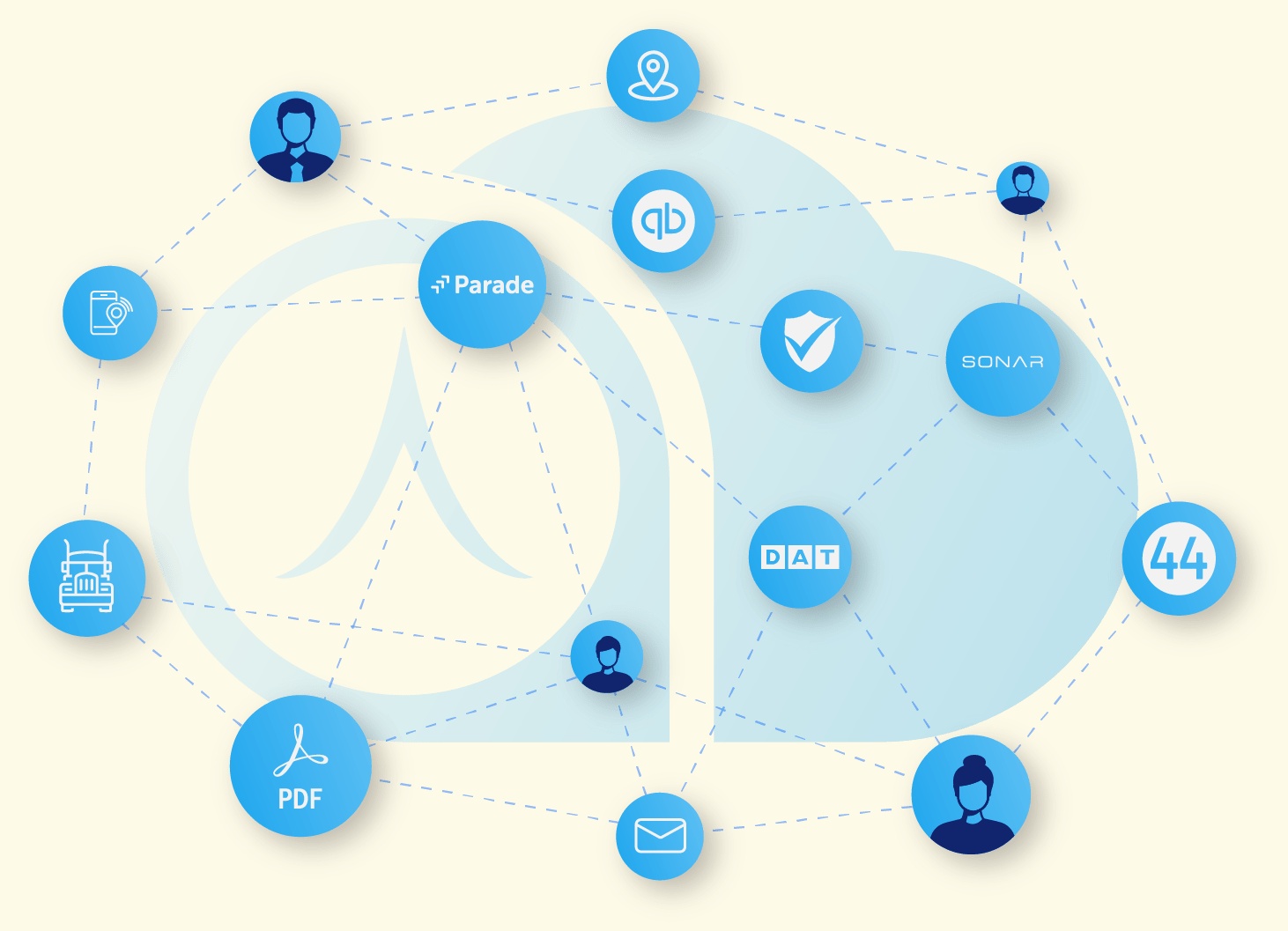
The 2018 platform description included shipment tracking, digital invoices, scheduled payments and privacy controls. Those controls mattered to the proposition. Sharing information across organizations also means deciding which information each participant should see. Collaboration requires boundaries as well as access. A shared workspace becomes much less attractive if joining it means opening every drawer in the office.
The financing gave Gilmore room to pursue that scope. Activant Capital led the 2017 Series A. In November 2018, Turvo announced a $60 million Series B led by Mubadala Ventures, with G2VP and Siemens-backed Next47 joining as investors. The two announced rounds alone amounted to $85 million. Capital was following a proposal to connect a supply chain whose participants already had plenty of software.
There was also a recruiting signal. In early 2019, Charlie Bergevin, Brian Cristol and John Stauffer moved from Uber Freight to Turvo. Their interest extended to coordination across the supply chain, beyond automating an individual brokerage function. The problem Gilmore had chosen was attracting people who had already spent time trying to improve another part of freight.
That distinction helps explain the company’s early appeal. A better tool within one business can still leave the next business waiting for an update. Turvo was addressing the relationship between them. There is less glamour in agreeing on a shipment’s status than in imagining an autonomous future. But agreement is useful when the shipment has to arrive on Tuesday.
The founder’s chair changes hands
The next turn in Gilmore’s Turvo story concerned his own conduct. In May 2019, directors removed him as CEO after a review of company-card expenses. They alleged that entertainment charges included $76,120 paid to adult entertainment venues. Gilmore challenged the procedure used to remove him. The dispute became litigation in Delaware.
An August 2019 court opinion addressed access to privileged legal communications. It expressly acknowledged that Gilmore disputed wrongdoing and did not resolve that underlying dispute. The distinction matters: an account of allegations in a procedural ruling is not a final finding that the allegations were proved. Bloomberg later reported that the parties settled in September, with terms undisclosed.
His founding CEO tenure had ended. Turvo’s subsequent progress belonged to a company under different leadership. Lineage acquired it in June 2022, extending an existing relationship; the acquisition announcement named Scott Lang as chairman and CEO. In July 2023, Billy Sarracino was appointed CEO. The business Gilmore helped create continued beyond his time running it.
The next thing he wants a company to own
Gilmore’s current work brings him back to enterprise architecture. At Altir, he is a co-founder alongside Seth Marlatt and Sai Nagboth. Both also worked on Turvo. Altir describes itself as an AI software foundry, working alongside enterprise teams to build systems that transfer to the customer. The old colleagues are addressing another version of the problem of making business systems fit together.
In July 2026, Gilmore published The Sovereign Enterprise: A Blueprint for the Cognitive Revolution. Its four parts move through enterprise ownership, intelligence, workforce and infrastructure. The project gives his present ambition a more explicit form: companies should retain control over the intelligence on which their operations increasingly depend. It is an argument about the terms of adoption, with consequences beyond choosing an AI product.
Read through the Turvo chapter, the paper has a recognizable concern with shared meaning. Its second part proposes an architecture linking business definitions, operational memory, reasoning, action and governance. An order, a customer or a shipment has to mean something consistent before software can reliably act on it. The vocabulary is technical; the coordination problem is familiar.
- 01 · EnterpriseWhat should the business own?
- 02 · IntelligenceHow does it understand its operations?
- 03 · WorkforceHow do people and agents perform work?
- 04 · InfrastructureWhat supports it, and who controls it?
The third part treats digital workers as participants in an organization’s work. In Gilmore’s proposed model, people increasingly specify, supervise, evaluate and override tasks carried out by software agents. He argues that companies should reconsider their operating structures around this possibility. These are proposals about how enterprises might organize themselves, rather than evidence that the organizational transition is complete.
The fourth part follows the dependencies down into infrastructure. Gilmore argues that reliance on cloud services can make moving data and changing providers difficult. He acknowledges the value those providers supply while making the case for preserving portability and strategic control. An attractive procurement decision can become a long relationship. The renewal conversation tends to arrive after everyone has moved in.
One useful detail in the intelligence proposal is its treatment of memory. Gilmore distinguishes the time an event happened from the time the organization learned about it. In a business where an update can arrive late or be corrected, that distinction gives the record a history. It also gives a future decision something more useful than the latest value in a field. The idea brings his argument back to the practical difficulty of coordinating work when different participants know different things at different times.
The conclusion turns that concern into a demand for deliberate choices. As companies add intelligent workflows, they also make decisions about architecture, ownership and dependence. Gilmore wants those decisions treated as matters of business strategy. His argument leaves executives with a practical test: whether the systems they adopt preserve their ability to build, adapt and govern on their own terms.
The loading dock and the AI blueprint are separated by years, a departure from leadership and a change of company. Yet both ask a business to look beyond the individual application. At Turvo, the missing connection was between the organizations moving a shipment. In his current writing, Gilmore asks companies to examine who controls the connections inside their own operations. The boxes keep changing. The trouble between them remains.