A fish can arrive at dinner with a splendid description and a surprisingly incomplete biography. There may be a species, a country, a promise about how it was caught. The people who handled it, the changes it underwent and the records connecting one stage to the next are harder to follow. Eric Enno Tamm has spent years working on that missing middle. For someone whose other career involves writing books, it is an appropriately troublesome subject. Everybody likes a good origin story. Somebody has to keep the receipts.
Tamm is the co-founder and CEO of Vancouver-based ThisFish Inc., which builds software and artificial intelligence tools for seafood businesses. His route there included work on his father’s fishing boat, journalism in Scandinavia, a biography of marine ecologist Ed Ricketts and a journey retracing a Russian imperial agent’s passage across Asia. These occupations sound awkward together on a business card. They make more sense when you consider how much of each involves following a trail.
The deckhand before the data
Born in Tofino and raised in nearby Ucluelet, British Columbia, Tamm came from a commercial fishing family with generations of experience on Canada’s Pacific coast. His first job was as a deckhand on his father’s salmon troller. The ocean was a workplace before it became a subject for his writing or the market for his company.
He has described fishing’s uncertainty as an education in prudence and perseverance. That is a useful combination for a founder: enough caution to notice trouble, enough persistence to keep working through it. His later seafood experience included harvesting, buying and processing. When he talks about information passing through the industry, he has occupied several of the places where it changes hands.
There was another early apprenticeship. At 15, he became an editorial cartoonist for his local newspaper. A cartoon requires an opinion and very little room in which to make it. His subsequent books would allow rather more space. Between the fishing deck and the newspaper page, the outlines of his working life were already present: coastal livelihoods, close observation and an interest in what the public gets to see.
He went on to earn master’s degrees in journalism at the University of Southern California and European affairs at Lund University in Sweden. He worked as Nordic contributing editor for Wallpaper*, and his journalism appeared in publications including The Globe and Mail and Canadian Geographic. Ucluelet had supplied the starting point; reporting supplied reasons to leave it.
A biographer looks behind “Doc”
His first book, Beyond the Outer Shores, appeared in 2004. Its subject was Ed Ricketts, the marine ecologist whose friendship with John Steinbeck helped place a version of him in literary history as Doc in Cannery Row. Tamm’s book examined the person and ideas behind that familiar association, including Ricketts’s connections with Steinbeck and Joseph Campbell.
It was a subject that joined literature to the Pacific coast. Ricketts’s work concerned relationships within the natural world; Tamm’s account also explored the relationships through which ideas travel between people. Readers coming for a novelist’s memorable friend encountered an ecologist with a substantial intellectual life of his own. The book was named a Kiriyama Prize Notable Book in 2005.
There is a recurring editorial choice here: look past the figure already occupying the foreground. A famous novelist can obscure a scientific collaborator. A finished seafood product can obscure a fishing community. Those are different kinds of omission, but both reward the person willing to go back and ask how the thing in front of us came to exist.
A train, a century apart
The next trail began in Sweden, when a Finnish friend told Tamm about Gustaf Mannerheim’s journey through Asia. In 1906, Mannerheim had set out from St. Petersburg on a mission to gather intelligence about China for the Russian czar. His observations offered Tamm a way to investigate change over a century without remaining in an archive.
On July 6, 2006, exactly 100 years after Mannerheim’s departure, Tamm began retracing the journey. The resulting expedition covered roughly 17,000 kilometres over nine months, crossing Central Asia and continuing through China to Beijing. His second book, The Horse That Leaps Through Clouds, brought the historical journey and his own travels into the same narrative.
The premise imposed a useful discipline. He had an earlier traveller’s record against which to set what he encountered. Modernization could be examined through places, conversations and institutions, rather than treated as an abstraction. History supplied the itinerary; the present supplied the complications. An old intelligence mission had become a rather demanding reporting assignment.
Published in Canada in 2010, the book won the 2011 Ottawa Book Award for English nonfiction. The distance is striking, but so is the method: return to the route, examine the record, notice what has changed. That method would have another application in a business where products routinely travel across borders while their documentation struggles to keep up.
Following Mannerheim’s route, one century later. Schematic, not a map.
The fish led him to a factory
In 2008, fishermen from Ucluelet approached Ecotrust Canada with a practical request: help them trace their catch and connect with consumers. They wanted buyers to know where their fish came from and hoped that knowledge would support trust and better prices. Tamm was working with the environmental nonprofit. The question came from the community where he had grown up.
An online tracing platform launched in 2010. It let a consumer use a code to discover information about a seafood product’s origin. Projects took the approach into different fisheries and countries. The apparent simplicity of entering a code depended on considerable work before the customer ever saw it.
Processing plants kept emerging as the difficult junction. Fish entered, products changed, batches moved, and essential information often remained on paper. A polished account at the end of the supply chain depended on records inside the factory. The team followed that problem upstream, toward the people weighing, recording and handling the product.
In 2015, Ecotrust Canada, Indonesian nonprofit MDPI and Wageningen University developed a prototype called Tally-O and tested it in two processing plants in Indonesia’s Maluku Islands. A beta version followed in 2017, when ThisFish launched as a social enterprise. The company won the Fish 2.0 startup competition that year and joined the Techstars Sustainability accelerator in 2018.
It is an instructive turn in Tamm’s career. The original request concerned telling a better story about seafood. The work became helping factories create the records that could support one. In a later conversation about the industry’s development, he used the phrase “digital plumbers.” It is a modest job description for technology work, and a persuasive one. Plumbing becomes interesting very quickly when it fails.
The case for asking better questions
Tamm has been explicit about his position as a founder without an engineering background. He seeks advice from staff, mentors, experts and directors, and has described changing a competition pitch substantially after listening to feedback. There is room in his account of leadership for admitting what he has yet to learn.
“People are what make tech startups successful.”
Eric Enno Tamm
His experience building the company also includes the less romantic business of funding it. In a 2023 interview, he described the difficulty of attracting investors to a specialized seafood market and the role of revenue and grants in supporting growth. A C$150,000 Aquaculture Innovation Award in 2021 helped fund TallyVision, the company’s computer vision inspection system.
The attraction is concrete: cameras can inspect fillets moving along a conveyor, counting and measuring them and identifying visible defects. Other machine learning work examines how production variables affect yield. For Tamm, the question is what a processor can actually do with the result. A prediction earns its place when it helps someone make a production decision.
His institutional commitments extend beyond the company. He chaired The Writers’ Union of Canada in 2018-2019 and appeared before Parliament during its study of remuneration for artists and creative industries. He now serves on the board of Ocean Outcomes. Authors’ livelihoods and fishing livelihoods have both claimed his attention; running a software company has not erased either interest.
Another Pacific crossing
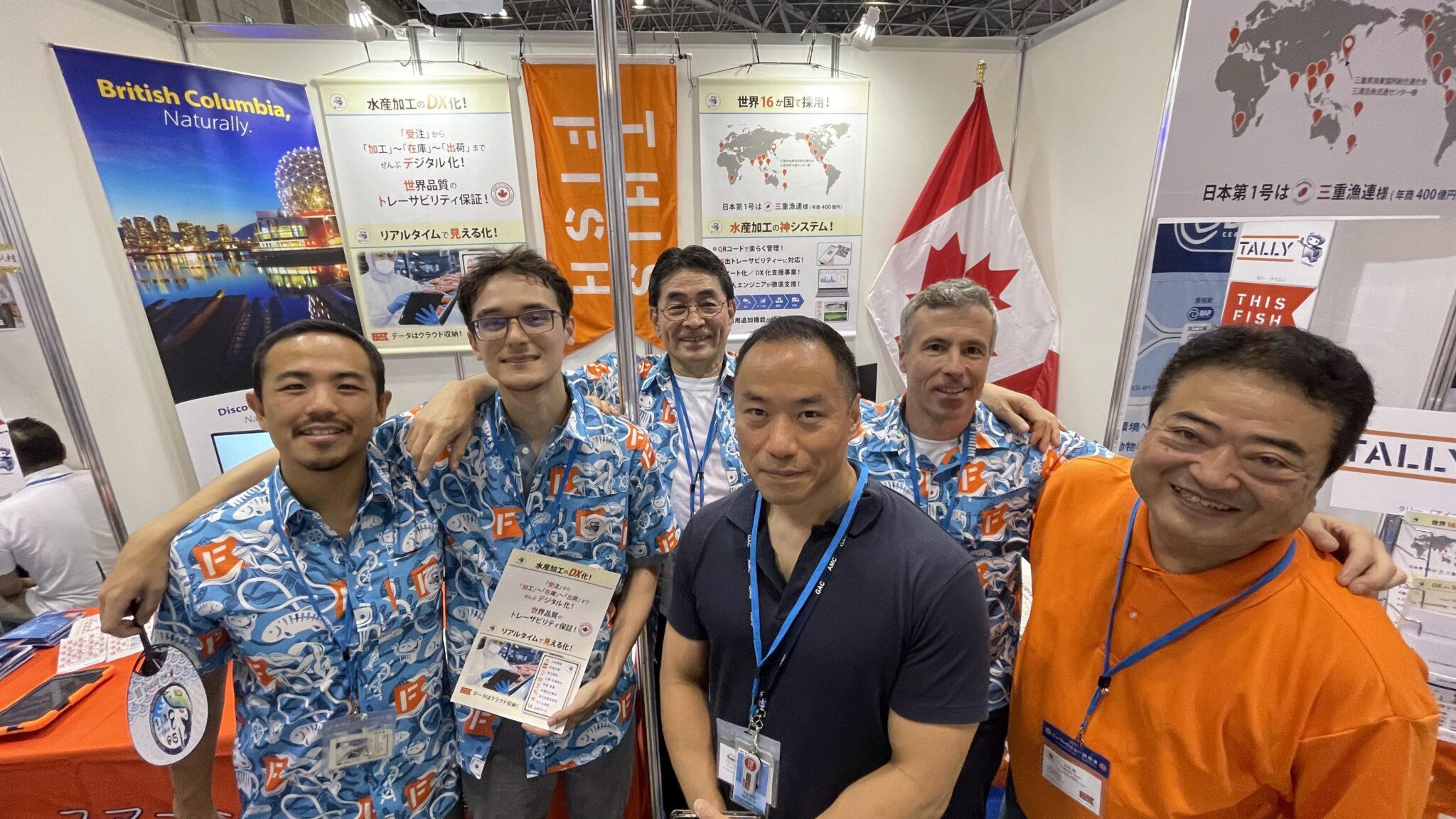
By February 2026, ThisFish was reporting customers in Japan, including Tokyo tuna wholesaler Yamayuki and the Mie Prefecture Fisheries Cooperative Federation. Local staff and partners were part of the expansion. Tamm’s work had returned to the Pacific on a different scale, linking a Vancouver company with businesses handling fish for Japanese and overseas markets.
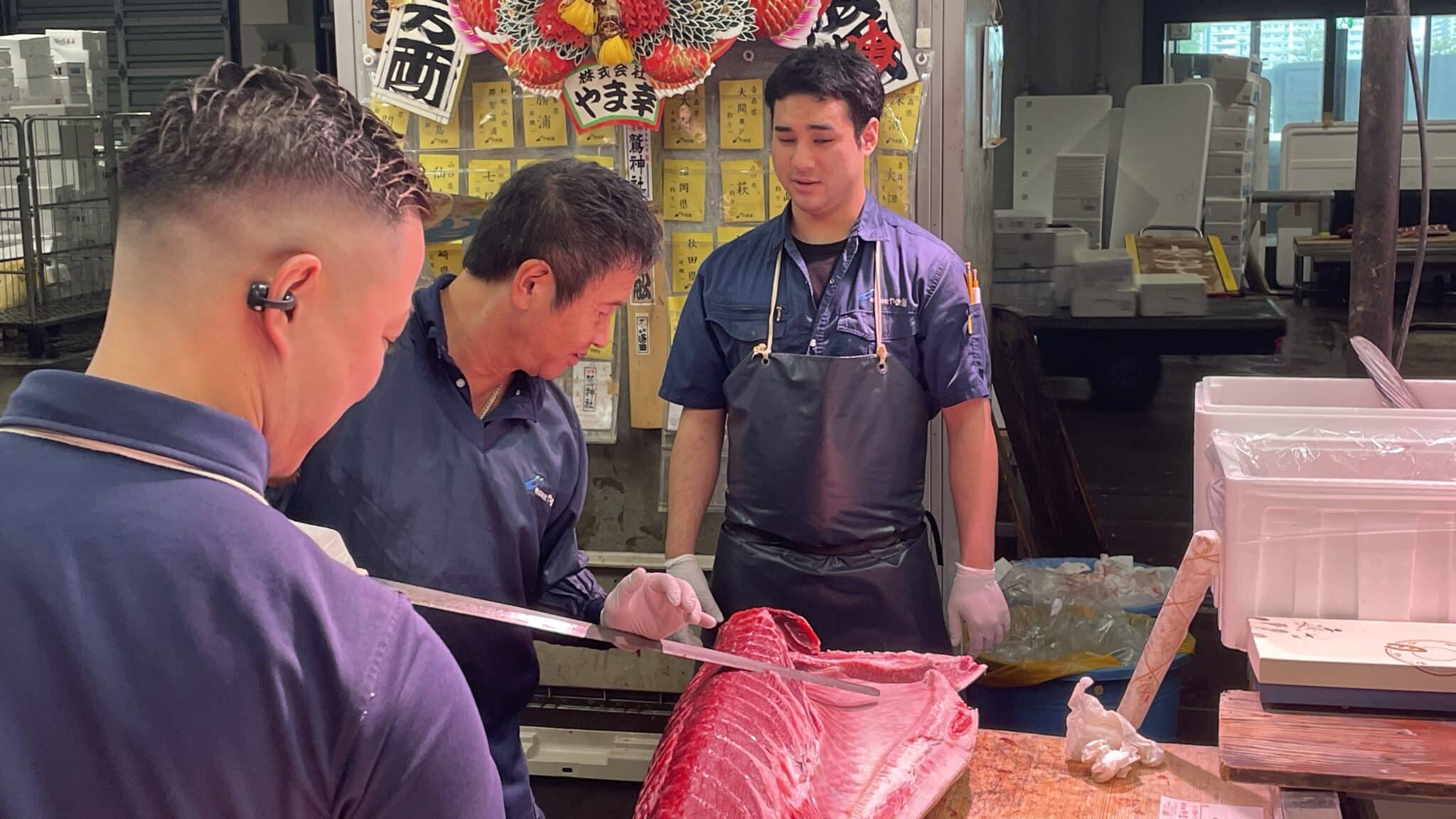
The Japanese expansion also illustrates how much of a software business happens between people. Local business development, technical support and channel partnerships accompany the product. For a founder whose early work involved connecting fishermen and consumers, those relationships remain part of getting information to travel.
His more recent writing has addressed the ownership and security of data as seafood companies adopt AI. In September 2026, he was still emphasizing the need for usable digital records before businesses can expect useful predictions. The tools have changed considerably since the early tracing project. The dependence on sound information has remained.
That continuity makes this a recognizable personal story despite the changes of profession and geography. Tamm has worked on a boat, followed a historical traveller and examined what happens to a fish inside a factory. Each offers a reason to be suspicious of an account that arrives too neatly packaged. Somewhere between the beginning and the finished version, there is work worth going back to see.