In 1999, Eric Baker wanted tickets to The Lion King. His girlfriend wanted to go; Broadway, as Broadway sometimes does, made the proposition expensive. Baker was working at Bain Capital. He could recognize a market with a generous margin when he encountered one. The question that followed was simple enough to fit on a ticket stub: why was buying somebody else’s seat still such a nuisance?
Years later, his own re-entry would cost $4.05 billion. The company doing the buying was viagogo, which he had founded. The company being bought was StubHub, which he had co-founded and then left. Most people who have an awkward departure from work can avoid the building. Baker built another business and acquired the building’s contents.
That circular journey makes a good headline. The more revealing detail is how long he stayed with the same problem. Beneath the corporate names and changes of ownership sits a familiar human predicament: somebody has a ticket they cannot use, while somebody else would very much like to be there. Getting those people together sounds easy until money, deadlines, and trust enter the room.
- Co-founds StubHubWith Jeff Fluhr at Stanford
- Leaves StubHubA co-founder disagreement
- Launches viagogoAn international marketplace
- Buys StubHub backviagogo’s $4.05bn acquisition
- NYSE debutStubHub Holdings trades as STUB
02A seat, two prices, and a gap
At Stanford, Baker tested the economics with a Lakers ticket he could not use. A broker quoted roughly $1,500 to $1,800 when Baker posed as a buyer. When he offered a ticket for sale, the offer was $1,000. The spread supplied its own business-school lesson. Finding the other side of the transaction was worth a great deal.
In 2000, Baker and fellow Stanford student Jeff Fluhr launched LiquidSeats, later renamed StubHub. Their approach brought sellers together online and put a guarantee behind the transaction. A buyer could compare options without conducting a small investigation on the pavement outside an arena.
Baker’s earlier career had followed a recognizable route through professional services: McKinsey from 1995 to 1997, then Bain Capital from 1997 to 1999. He held a Harvard bachelor’s degree and completed his Stanford MBA in 2001. Ticketing gave that financial and analytical training a particular object. Here was a market in which the merchandise had a seat number and a very unforgiving expiry date.
03The founder leaves the room
Launching an internet business in 2000 meant meeting the dot-com collapse at the door. Baker also remembers a chilly reception from the established sports business. “I was thrown out of the NFL offices,” he recalled. A marketplace could promise convenience to fans and still look unwelcome to the institutions whose tickets it traded.
The more consequential disagreement came inside StubHub. Baker and Fluhr fell out, and Baker left in 2004. In his later account, he described a governance arrangement intended to protect founders from outside investors that had failed to protect him in a dispute with his co-founder. Ownership and authority had turned out to be different things.
Fluhr belongs in this history. When the 2025 IPO filing omitted him from its founding narrative, the omission became a controversy of its own. StubHub explained that the listed entity descended from viagogo’s parent. Corporate lineage can account for a filing’s structure; it does not remove the second person from the original partnership.
04Europe was another opening
Baker launched viagogo in 2006. The opportunity was international: the ticket resale experience he had helped build in America did not have a comparable presence across the markets he wanted to reach. The new company was designed to work across borders, currencies, and languages.
This was repetition with complications. A concertgoer in Milan and a football supporter in Manchester might share the same wish to attend, but moving payments and tickets between countries added work behind the screen. Familiar demand did not make international execution automatic.
In November 2019, viagogo announced its agreement to buy StubHub from eBay. Baker’s response was unusually personal for an acquisition announcement: “It has long been my wish to unite the two companies.” The transaction joined StubHub’s North American business with viagogo’s international operation. It also returned Baker to a business whose name had continued to travel without him.
Cash acquisition price paid by viagogo for StubHub.
Completed February 13, 2020.
05The return had a balance sheet
The sale closed on February 13, 2020, for $4.05 billion in cash. That figure describes the purchase of StubHub by viagogo. It does not describe a cheque Baker personally wrote, and it does not describe his personal fortune. Those distinctions tend to disappear when a founder’s return becomes a tale of revenge.
An acquisition is also an obligation. The buyer takes responsibility for a business and the financing used to acquire it. By the time StubHub reached the public market in September 2025, Baker was explaining that reducing acquisition debt was a central reason for the offering. A sentimental reunion had become years of financial work.
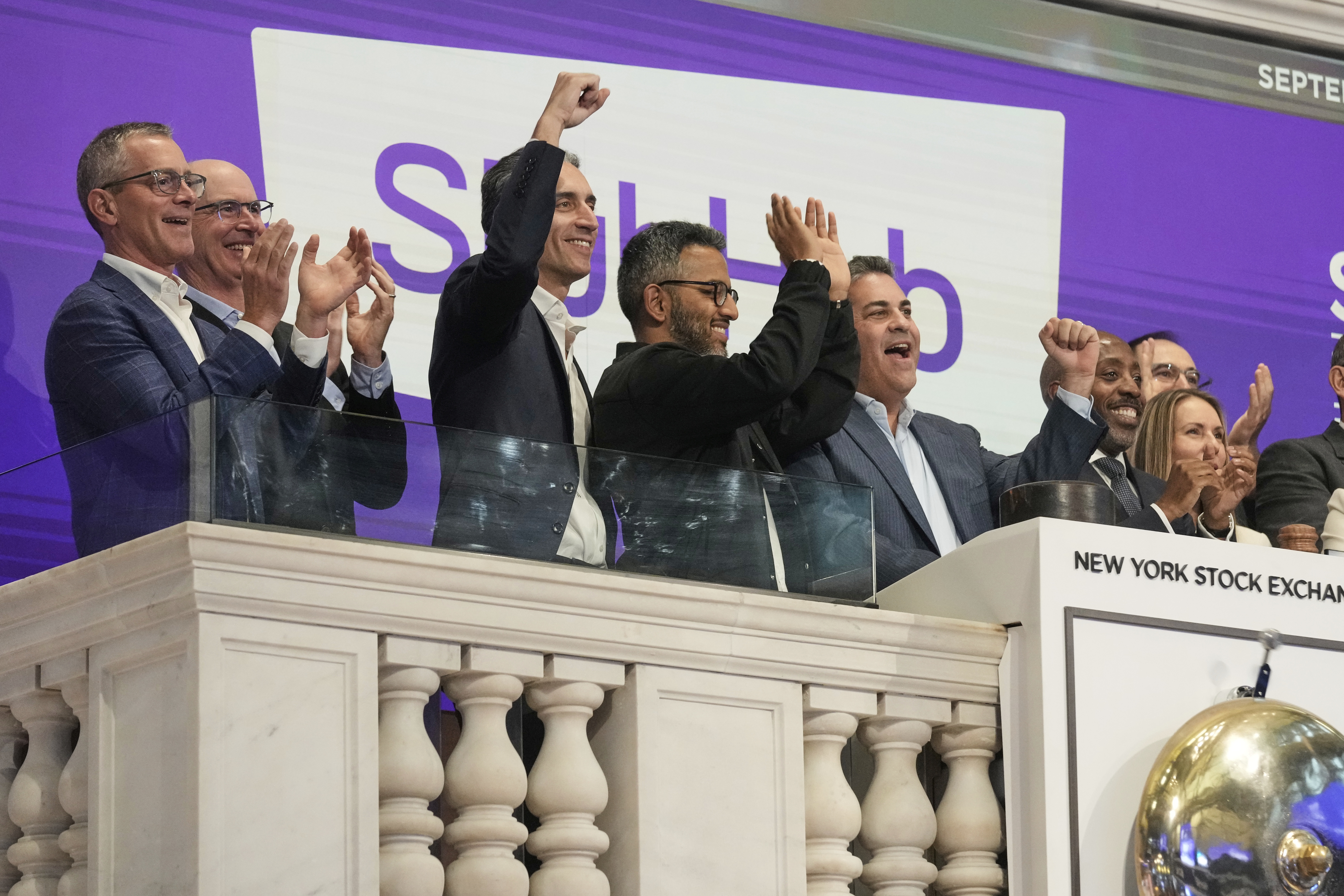
The shares began trading on the New York Stock Exchange on September 17 under STUB. The offering raised about $800 million before underwriting deductions. Shares finished their first day 6.4 percent below the $23.50 offering price. Wall Street had provided an entrance, followed promptly by an assessment. Even a long-awaited return must take a number and wait for the market’s opinion.
06Keeping his seat at the table
The IPO also formalized Baker’s grip on the company. Its prospectus projected that his Class B shares would carry approximately 87.8 percent of the voting power immediately after the offering. Each Class B share had 100 votes; each Class A share had one. Public ownership would arrive with concentrated control.
Read beside his earlier departure, that arrangement is hard to overlook. It would be too neat to assign every clause in a capital structure to a personal grievance. Still, the practical result was explicit: Baker would control the outcome of matters requiring general shareholder approval. His second act had fewer opportunities for somebody else to ask him to leave.
The same prospectus disclosed another connection: Baker was managing partner of Andro Capital, a seller on the platform. It also described a financing referral agreement with Andro affiliate Colloquy Capital. Such relationships deserve attention because the person directing a marketplace can have interests on its selling side as well. Disclosure gives investors something concrete to examine.
07Trust has to survive checkout
Baker’s original proposition depended on making an uncertain purchase feel dependable. That sets a demanding standard for the company he now leads. In April 2026, StubHub agreed to $10 million in consumer redress to settle Federal Trade Commission charges concerning ticket-price displays after the agency’s fees rule took effect in May 2025.
The allegations concerned mandatory fees missing from initial price displays during May 12 through May 14, 2025. FTC chairman Andrew Ferguson said the company fixed the issue the day after the warning letter. The settlement still required refunds and restrictions on future pricing practices. Correcting a screen does not erase what earlier customers encountered.
There is a useful distinction here between finding a ticket and understanding its cost. Baker’s marketplace can solve the first problem while remaining accountable for the second. The experience is judged at checkout and at the venue entrance, where an elegant origin story offers little assistance. For fans, trust is an amount they can see and a ticket that works.
08The next ticket may never have been resold
Baker’s ambitions now extend beyond helping tickets change hands. A September 2025 agreement with Major League Baseball set out a route for primary inventory to reach StubHub and other authorized marketplaces through the company’s direct issuance technology. The planned launch was ahead of the 2026 baseball season.
By March 2026, the company was calling this approach Open Distribution. Its vivenu partnership connected an organizer’s existing ticketing system to StubHub. Organizers could list inventory from their dashboard; a completed purchase would synchronize across sales channels. StubHub would handle payment, support, and delivery. The relationship was described as free for organizers and non-exclusive.
The underlying ambition is recognizable. Baker wants the marketplace to be a place people begin looking, whether the available seat comes from another fan, a professional seller, or the event itself. That widens the task considerably. Alongside the resale transaction sits a question about how tickets should reach an audience in the first place.
Recent results give the scale of the operation, with the usual caution that different measures count different things. In the second quarter of 2026, StubHub reported $3.1 billion in gross merchandise sales, $573.1 million in revenue, and $14.6 million in net income. Gross merchandise sales measure marketplace activity; they are not money the company gets to keep. Baker highlighted World Cup demand in discussing the quarter.
09An ordinary Sunday, with competitive interests
There are smaller scenes in Baker’s account of himself. His first paying job was as a camp counselor in Maine, managing six ten-year-olds with persuasion and pizza incentives. He has expressed regret about never trying out for the Harvard Lampoon. The unused possibility was comedy writing. Apparently even a ticket entrepreneur can leave an opening unclaimed.
He describes Sundays with football, a fantasy team, and his children. There is also a boxer dog and an interest in pickleball. These details bring the business back to its customers’ scale: a game to watch, people to watch it with, an afternoon worth protecting.
The only person I want to work for is myself.
Eric Baker · 2014
Asked why he was an entrepreneur, Baker once answered: “The only person I want to work for is myself.” It is a compact explanation for an unusually long route through the same industry. The buyback secured his return. The work that follows is less cinematic and more consequential: making the invitation, the price, and the experience agree. Somewhere, somebody still wants two seats together.
Follow the next act
- The companyStubHub ↗
- Public biographyBaker’s board profile ↗
- ListenThe Bessemer conversation ↗
- WatchBaker on Bloomberg Tech ↗
- ReadThe Stanford origin story ↗
- ReadBaker’s 2014 interview ↗
- The transactionAcquisition announcement ↗
- The transactionThe completed sale ↗
- Company recordsThe IPO prospectus ↗
- NewsThe NYSE debut ↗
- NewsThe co-founder question ↗
- InterviewBaker on the IPO ↗
- PricingThe FTC settlement ↗
- PricingThe FTC case record ↗
- PricingThe correction timeline ↗
- Next chapterThe MLB agreement ↗
- Next chapterOpen Distribution with vivenu ↗
- Latest figuresQ2 2026 results ↗
- Company socialStubHub on LinkedIn ↗
- Company socialStubHub on X ↗
- Company socialStubHub on Facebook ↗
- Photo creditRichard Drew / AP gallery ↗